Featured
Fateh Singh and the Saturday Kitchen
Fateh Singh doesn't understand why his Dadi ji spends every Saturday cooking at the Gurdwara for free. Nobody asked her. Nobody pays her. When he goes along and picks up a jug of water, he discovers what Seva really means.
Saturday Morning
The pressure cooker woke Fateh Singh.
It hissed and rattled from the kitchen downstairs — the same sound it made every Saturday, so early that the streetlights were still on. He pulled the duvet over his head, but the hissing didn't care. It pushed through the door, up the stairs, and into his pillow.
Fateh Singh opened one eye. His Lego spaceship sat on the desk, half-built. Today was supposed to be a building day. No school. No shoes. No Mrs. Okafor asking him to sit still. Just Lego and maybe toast with Nutella if Dadi ji was in a good mood.
He padded downstairs in his socks.
The kitchen was warm and smelled of onions. Dadi ji stood at the counter in her white chunni, chopping. Two enormous pots sat on the hob. A tray of spices — cardamom, cumin, turmeric in small plastic tubs — lay open on the table.
"You're up early," she said, without turning around.
"The pressure cooker woke me."
"Good. It was supposed to."
He slid into a chair. "What are you making?"
"Dal for Langar." She scraped the onions into a pan. They sizzled. "And aloo gobi. And rice. Enough for two hundred."
Two hundred. Fateh Singh tried to picture two hundred plates of food. His school had one hundred and eighty children, and the dinner ladies took all morning.
"Why do you have to cook it here?"
"I don't have to. I cook the masala base here and take it to the Gurdwara kitchen. The rest we do there." She wiped her hands on her apron. "Mum's sleeping — she was on the night shift. Dad's gone to B&Q for a tap fitting. It's just you and me."
She said it the way she said everything — calmly, as if the plan was obvious and had always been the plan.
"Come, Fateh. You can help today."
He looked at the Lego spaceship in his mind. Then at Dadi ji, tying her apron strings behind her back, already moving to the next pot.
"Can I have toast first?"
"With butter. No Nutella today."
He ate his toast at the table while Dadi ji packed the masala base into steel containers. The kitchen clock said 6:47 am. Outside, a plane rumbled overhead — low enough that the windows buzzed. Southall was under the flight path. You got used to it, the way you got used to the pressure cooker.
Fateh Singh put on his red hoodie, his trainers, and his patka. Dadi ji handed him the tray of spices. It was heavier than it looked.
"Ready?" she said.
He wasn't sure what he was supposed to be ready for.
The Walk
They turned left out of the front gate and walked down the terraced street towards The Broadway. The air was cold — March cold, the kind that pinched your ears. Two houses down, Mrs. Kapoor was sweeping her front step. She waved. Three houses after that, the tabby cat that belonged to nobody sat on a wall, watching them with flat yellow eyes.
"Dadi ji," Fateh Singh said. The tray of spices bumped against his leg with every step. "Why do you go every Saturday?"
"Because the Langar needs to be ready by eleven."
"But why does it have to be you?"
She walked a few more steps. A 207 bus grumbled past, nearly empty. "It doesn't have to be me," she said. "That's why I go."
Fateh Singh frowned. That didn't make sense. If it didn't have to be her, that was a reason not to go, not a reason to go.
"But that's —"
"Doesn't make sense?" She smiled. "I know."
They passed the sweet shop on The Broadway. It was still shuttered, but the smell of yesterday's jalebi hung in the air — warm sugar and cardamom, even through the metal shutters. Fateh Singh breathed it in.
"But why would you do something nobody asked you to do?" he said. This was his third But why? and he could feel it was the important one. The first two had bounced off the surface. This one went deeper.
Dadi ji stopped walking. She shifted the steel containers to one arm and looked at him. "Come with me today," she said, "and you can ask the parshada."
"The what?"
"Parshada. That's what we call the roti in Langar. It means a blessing from Waheguru." She adjusted her chunni. "Come. You can ask it yourself."
They turned the corner. The Gurdwara's white dome appeared above the rooftops, pale against the grey London sky. The gate was already open.
The Kitchen
The Gurdwara kitchen was nothing like the kitchen at home.
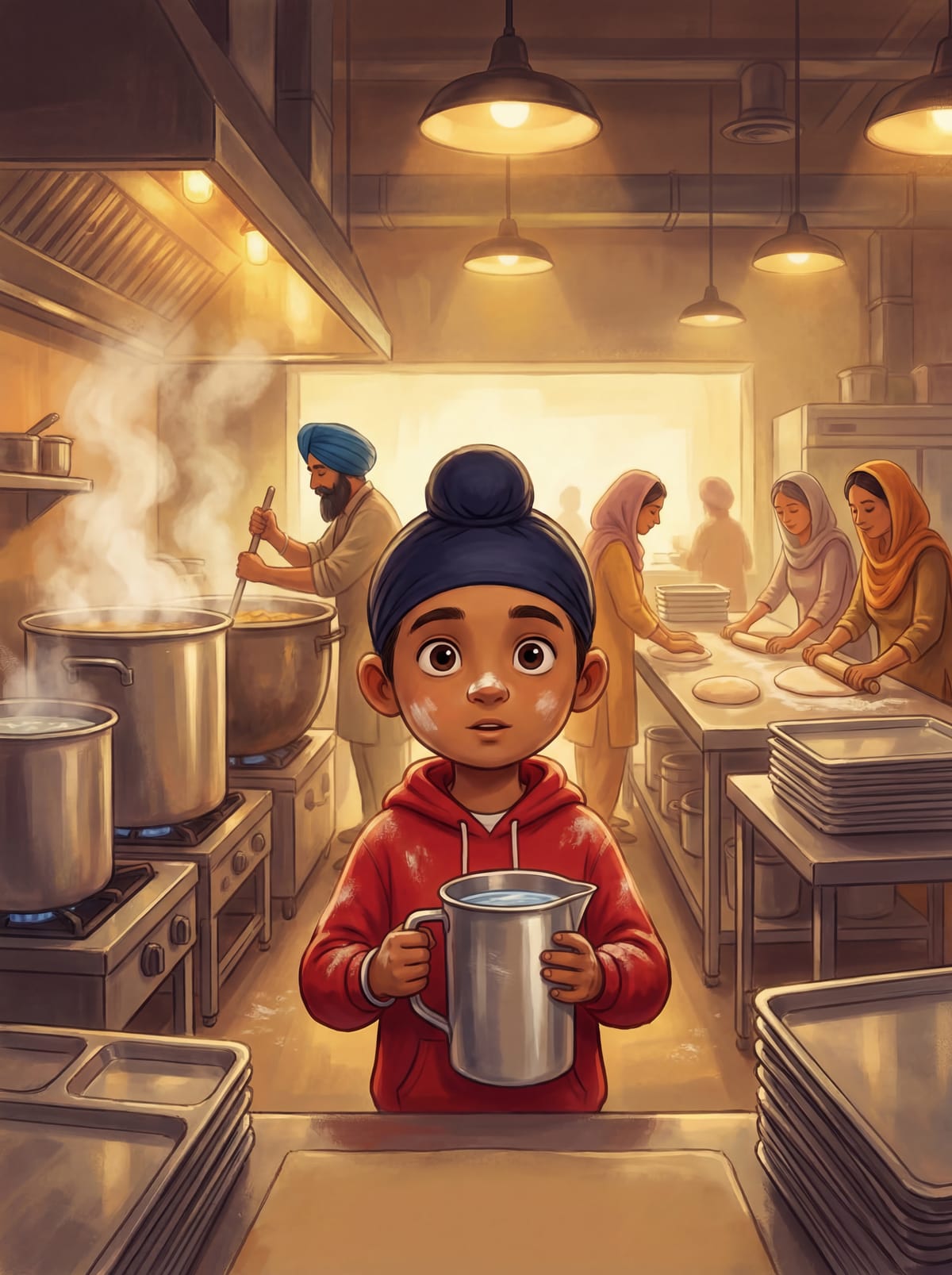
It was enormous — stainless steel counters stretching the length of the room, gas burners the size of dustbin lids, pots that came up to Fateh Singh's chest. The floor was tiled and slightly damp. Someone had left the back door open, and cold air mixed with steam.
And it was already full of people.
An uncle in a blue dastar was stirring a pot of dal with a steel spoon as long as a cricket bat. Two aunties rolled out chapatti dough at a steel table, their hands moving so fast that Fateh Singh couldn't follow the motion. A younger man — maybe a university student — was peeling potatoes into a bucket.
Nobody wore a badge. Nobody wore a uniform. Nobody seemed to be in charge.
Fateh Singh placed the tray of spices on the counter and looked around for the boss. In Mrs. Okafor's classroom, there was always a leader — someone with a clipboard, or a whistle, or at least a louder voice. Here, everyone just seemed to know what to do.
Dadi ji handed the masala base to the uncle with the dal spoon. He opened the lid and nodded. "Perfect, Bibi Ji. Same as last week."
Fateh Singh tugged on the uncle's apron. "Excuse me. Who told you to come today?"
The uncle looked down, surprised. Then he laughed — a big, round laugh that filled the kitchen. "Nobody told me, puttar. I just come."
"Every Saturday?"
"Every Saturday."
"But why?"
The uncle glanced at Dadi ji. She raised an eyebrow, as if to say: Don't look at me. He does this.
The uncle crouched down so he was level with Fateh Singh. "You know when you're really thirsty and someone gives you water?"
Fateh Singh nodded.
"They don't give you water because someone told them to. They give it because you're thirsty and they have water." He stood up and went back to stirring. "Same thing."
Fateh Singh thought about this. It made a kind of sense, but not the kind he was looking for. These people weren't here because they were told, and they weren't here because they'd get something back. So why were they here?
He decided, quietly, that they were probably just being nice. Nice people liked being thanked. That had to be it.
He was wrong, but he didn't know that yet.
The Parshada Lesson
Dadi ji stationed Fateh Singh at the parshada table.
"Parshada," she said, handing him a small ball of dough and a rolling pin.
The two aunties glanced at him and smiled. Their hands didn't stop moving. Ball of dough, press, roll, flip, roll, flip, done. Perfect circles, thin as paper, every single time. They made it look like breathing.
Fateh Singh pressed his rolling pin into the dough. It stuck. He peeled it off, dusted more flour, tried again. This time the parshada came out shaped like a cloud — a lumpy, thick, lopsided cloud.
"That's, um... creative," said one of the aunties.
He tried again. Worse. The dough tore in the middle. Flour was on his hoodie, in his hair, on the tip of his nose. Dadi ji was somewhere behind him, doing something with the rice, and he didn't want to call for help.
An elderly man sat down next to him. He was thin, with a white beard and a blue dastar, and he moved slowly, as if his knees were having a conversation with him about whether this was a good idea. He picked up a ball of dough and began to roll.
His parshada was perfect. A circle. No torn edges. No lumps. He did it without looking — his eyes were on Fateh Singh.
"First time?" the man asked.
"Yes."
"Good. Everyone's first parshada looks like a map of England." He slid the perfect circle onto the pile and picked up another ball. "What's your name?"
"Fateh Singh."
"Fateh Singh. Good name. Strong name." He rolled another circle. "What do you like at school?"
"Science. And Lego. I'm building a spaceship."
"A spaceship! What kind?"
They talked. Fateh Singh told him about the spaceship — it had a rotating radar dish and a cargo bay. The man asked questions as if a Lego spaceship was the most important thing in the world. He never talked about himself. He never said what his name was, or where he lived, or what he did during the week. He just asked, and rolled, and asked, and rolled.
After twenty minutes, Fateh Singh noticed something. "How long have you been coming here?"
"Fifteen years. Every Saturday."
"Fifteen years?"
The man smiled. "Doesn't feel like it."
"Don't you get bored?"
The man put down his rolling pin. He looked at Fateh Singh properly — not unkindly, but seriously, the way you look at someone when you're about to say something that matters.
"When your hands are busy and your mind is free," he said, "that's when you hear Waheguru."
He picked up the rolling pin and went back to work.
Fateh Singh's next parshada was still shaped like England. But he noticed that while they'd been talking, he'd stopped thinking about whether his parshadas were good enough. He'd stopped thinking about the Lego spaceship. He'd just been rolling.
The Moment
Just before twelve, the Langar was ready. The uncle with the blue dastar washed his hands and said, "Time for Ardas."
Everyone in the kitchen stopped what they were doing. Dadi ji put down her ladle. They gathered together and stood with their heads bowed and hands folded. The uncle recited the Ardas — the Sikh prayer, asking Waheguru to bless the Langar before it was served.
Fateh Singh stood too, head bowed, hands together. He didn't understand all the words, but he knew the rhythm — it rose and fell like a wave. When it ended, everyone in the kitchen said "Waheguru Ji Ka Khalsa, Waheguru Ji Ki Fateh" together. Their voices weren't many, but in the small kitchen they felt big.
Then everything moved quickly.
The sangat streamed in from the main hall. An elderly woman in a green salwar kameez, walking with a stick. A young father carrying a baby in a sling, the baby's hand gripping his collar. A man in a grey suit who looked like he'd come straight from an office somewhere. Two teenage girls in school uniforms. A man with a rucksack who looked like he hadn't slept in days. A girl about Fateh Singh's age, holding her mother's hand.
They sat cross-legged on the floor, in rows, side by side. The man in the suit next to the man with the rucksack. The elderly woman next to the teenagers. No one chose their seat — they just sat where there was space.
An uncle handed Fateh Singh a steel jug of water. It was heavy — he had to hold it with both hands.
"Pour for the sangat," the uncle said. "Half glass each. If they want more, come back."
Fateh Singh walked to the first row. He held the jug carefully and poured water into the steel glass in front of the elderly woman. She nodded without looking up. He moved to the next person. The young father. He poured. The baby stared at him with enormous brown eyes. The man in the suit. He poured. The man said "thank you" in a quiet voice.
Row after row. Glass after glass.
Somewhere around the fourth row, something happened.
He didn't notice it at first. It crept in sideways, the way sleep does when you stop trying. He stopped thinking about the Lego spaceship. He stopped counting how many glasses he'd filled. He stopped wondering whether anyone would say thank you. He stopped thinking about what he'd tell Ruby on Monday.
He just poured.
His hands held the jug. His feet moved to the next glass. The water flowed. And somewhere in the middle of it, the jug stopped feeling heavy. It was the same jug, the same water, but his arms had forgotten to complain. The faces passed — some smiled, some didn't, some were looking at the food, some were talking to the person next to them. He wasn't performing for them. He wasn't even helping them, not really — anyone could pour water. But for three minutes, or maybe five — he didn't know, because he'd stopped tracking time — Fateh Singh was not thinking about Fateh Singh.
It was the strangest feeling. Not empty. Not bored. Just... gone. As if the part of him that usually ran around asking But why? But why? But why? had sat down and closed its eyes.
The jug was empty. He stood at the end of the row and blinked. His arms ached now — the heaviness rushed back, as if it had been waiting for him to notice. The hall was loud with conversation and the clatter of steel trays. Dadi ji was three rows away, spooning dal with a ladle.
Fateh Singh looked down at the empty jug in his hands.
Something had happened, and he didn't have a word for it yet.
After the Water
They washed dishes.
Fateh Singh stood on a wooden crate so he could reach the sink. The water was warm. Steel plates came in stacks, and he scrubbed them with a sponge while Dadi ji rinsed and the uncle with the blue dastar dried and stacked. A production line. Nobody spoke much. From a speaker on the wall, kirtan drifted in from the main hall — a slow shabad that Fateh Singh didn't recognise but that filled the kitchen like warm air.
He was quiet. Dadi ji noticed.
Dadi ji always noticed when Fateh Singh was quiet, because Fateh Singh was almost never quiet. He was the boy who asked three questions before breakfast and five before bed. Silence from Fateh Singh was like snow in July — it got your attention.
"What are you thinking, Fateh?" she said, rinsing a plate.
He scrubbed a spot of dried dal. "Dadi ji, when I was pouring water... I forgot I was me."
She didn't stop rinsing. "What do you mean?"
"I mean, I was just pouring. I wasn't thinking about anything. Not the spaceship, not school, not anything. I was just... doing it." He paused. "Is that weird?"
Dadi ji put the plate on the drying rack. She dried her hands on her apron. Then she looked at him — the way the old man with the rolling pin had looked at him. Properly.
"That's Seva, Fateh."
"Seva?"
"Seva. Service. But not the kind where you help someone and then feel proud of yourself for helping. Not the kind where you do it because someone told you to, or because you want someone to say well done." She picked up another plate. "Seva is when the 'you' goes away. When you're so deep in the doing that you forget there's a you doing it."
Fateh Singh turned this over in his mind. It was like the old man's answer — when your hands are busy and your mind is free — but from a different angle.
"So when you come here every Saturday," he said slowly, "it's not because you're being nice?"
"Being nice is fine. But nice is still about you. You do something nice, and then you feel nice, and then the nice is for you." She smiled. "Seva is when you don't even notice."
He understood something then. He understood why she hadn't answered his third But why? on the walk this morning. She couldn't have explained it. She could only bring him here and let him pick up a jug.
He also understood — or began to — why the people in the kitchen didn't wear badges or have a boss. If Seva was about the 'you' going away, then a badge would bring it back. A badge would say: Look at me. I'm the one helping.
"Dadi ji?"
"Hmm?"
"Is that why you said I should ask the parshada?"
She laughed. "The parshada doesn't know who rolled it, Fateh. That's the point. It's a blessing — and a blessing doesn't belong to the person who makes it."
He went back to scrubbing. The uncle with the blue dastar hummed along. Through the kitchen window, Fateh Singh could see the Gurdwara courtyard, and beyond it, the Southall rooftops, and beyond those, a plane sliding down towards Heathrow.
He scrubbed and scrubbed, and the dishes kept coming, and he didn't think about anything at all.
Telling Ruby
On Monday, Ruby was waiting at the classroom door.
"You didn't answer my texts," she said. Her hair was in a high ponytail and she was bouncing a tennis ball against the wall, catching it one-handed. "What did you do at the weekend?"
"I went to the Gurdwara."
"You go every week. What's new about that?"
"I went to the kitchen."
Ruby caught the ball and looked at him. "The kitchen? Why?"
He told her. About Dadi ji and the 6am pressure cooker. About the kitchen with pots the size of dustbins. About the uncle who just came, and the old man who'd been rolling parshada for fifteen years. About the jug of water and the rows of people and the thing that happened when he stopped thinking about himself.
Ruby listened. She was good at listening when she was interested, and she was interested now.
"So it's like volunteering?" she said.
Fateh Singh thought about this. It was the obvious word, and it was almost right, but not quite. "Sort of. But volunteering is something you decide to do. Like, you sign up. You put your name on a list. You know you're doing it."
"And Seva isn't like that?"
"Seva is more like... when you forget you're doing it."
She looked sceptical. Ruby's sceptical face was one of Fateh Singh's favourite things — her nose scrunched and one eyebrow went up.
He tried again. "Okay. You know when you're playing football, and you pass to someone without thinking? Your foot just does it. You don't plan it. You don't think, 'I'm going to be unselfish now and pass.' You just see the other person and the ball goes."
Ruby nodded slowly. She knew that feeling. She'd scored a goal last week with a pass she couldn't explain afterwards.
"It's like that," said Fateh Singh. "But with helping. When you help someone so... naturally that you don't even notice you're the one helping."
Ruby bounced the tennis ball once, twice. "That actually makes sense."
"Really?"
"Don't sound so surprised."
The bell rang. Mrs. Okafor appeared in the doorway. Fateh Singh followed Ruby into the classroom, and as he sat down, he thought about something else. When he'd been explaining Seva to Ruby, he hadn't planned what to say. The words had just come. Like a pass he couldn't explain afterwards.
Maybe that was Seva too.
That evening, he FaceTimed Simran. She was in Toronto — it was afternoon there, and she was eating an apple on the sofa with the TV on behind her.
"I went to the Langar kitchen on Saturday," he said.
"Oh cool! I helped at our Gurdwara too, last month. With Mum."
"Did you like it?"
"Yeah. I didn't really think about it though. I just helped."
He laughed. "That's because you never ask why."
She laughed back. "That's because you ask why too much."
They talked about other things — her school, his school, a video of a dog on a skateboard — and then Mum called him for dinner and he hung up. But Simran's words stayed with him. I didn't really think about it. I just helped.
Maybe that's what Dadi ji had been doing all those Saturdays. Not thinking about it. Just helping. And maybe the reason she couldn't explain it with words was because words brought the thinking back.
Next Saturday
The pressure cooker woke Fateh Singh.
It hissed and rattled from the kitchen downstairs — the same sound, the same Saturday, the same time. But this time he didn't pull the duvet over his head.
He lay still for a moment. The streetlight outside his window was still on. A plane rumbled overhead, low and steady. The house was quiet except for the hissing.
He got up.
He put on his red hoodie, his jeans, and his patka. He brushed his teeth quickly, splashing water on the mirror the way Mum always told him not to. He went downstairs.
Dadi ji was in the kitchen, tying her chunni. The steel containers were packed. The tray of spices sat by the front door.
She looked at him. He looked at her.
He didn't say anything. He didn't need to ask why. Not today.
He picked up the tray of spices. It was heavy, but he already knew that.
They walked out together. Left at the front gate. Down the terraced street. Past Mrs. Kapoor's step — she wasn't out yet, it was too early. Past the tabby cat on the wall — it blinked at them, slow and unimpressed.
The air was cold. The sweet shop was still shuttered, but the ghost of yesterday's jalebi lingered. A 207 bus grumbled past, its windows lit orange from inside.
The Gurdwara's white dome appeared above the rooftops. The gate was already open.
Fateh Singh didn't say a word the whole way. He just walked, the tray of spices bumping against his leg, his breath making small clouds in the morning air.
Some questions, he was learning, answer themselves — not with words, but with your feet, your hands, and a jug of water.
Explore More
- How to Be a Volunteer — The Art of Selfless Service — What Seva means and how to practise it
- Simran Kaur and the Lost Sketchbook — A story about the Kara, by Fateh Singh's cousin Simran
- The Five Kakars — Articles of Sikh Faith — The five articles of Sikh identity
About This Story
This is the first story in the Fateh Singh series — five stories set in London, each woven around one of the five core values of Sikhi. In this story, Seva — selfless service — is explored through the lens of a six-year-old boy who needs to understand why before he can act. Fateh Singh is Simran Kaur's cousin. Where Simran discovers her faith by feeling, Fateh Singh discovers his by asking. Together, they represent two paths to the same place.
The word Seva means to serve or attend. In Sikhi, Seva is not charity or volunteering — it is service performed without ego, without expectation of reward, and without attachment to the outcome. Guru Nanak Dev Ji taught that Seva done in this world is the path to union with the Divine.
Gurbani Verse
ਵਿਚਿ ਦੁਨੀਆ ਸੇਵ ਕਮਾਈਐ ॥ ਤਾ ਦਰਗਹ ਬੈਸਣੁ ਪਾਈਐ ॥
In this world, perform the Lord's service — then you shall find a seat in the Court of the Lord.
Guru Nanak Dev Ji — Ang 26, Sri Guru Granth Sahib Ji
Punjabi Glossary
| Word | Meaning |
|---|---|
| Seva | Selfless service, performed without ego |
| Langar | Free community kitchen at the Gurdwara |
| Sangat | Congregation; community of Sikhs |
| Parshada | The roti served in Langar; literally "blessing from Waheguru" |
| Roti | Flatbread (also called chapatti) |
| Waheguru | God; the Wonderful Lord |
| Gurdwara | Sikh place of worship (literally, "door of the Guru") |
| Chunni | Head scarf or covering |
| Dadi ji | Paternal grandmother |
| Dal | Lentil dish |
| Patka | A head covering worn by Sikh boys |
| Dastar | Turban |
Discussion Questions
- Have you ever helped someone without being asked? How did it feel?
- Why do you think the man in the kitchen said he hears Waheguru "when his hands are busy and his mind is free"?
- What's the difference between helping someone to be nice and helping someone because you forgot about yourself?
- Where could you do Seva this week — at home, at school, or in your community?