Featured
Simran Kaur and the Picture
When a classmate asks why she never cuts her hair, Simran doesn't have an answer — until she watches her dad tie his dastar and learns that some gifts go back further than she knew.
Thirty-Two
Simran Kaur counted thirty-two steps from the front door to the school bus.
She counted them every morning — the same thirty-two, unless it had snowed and she had to take bigger steps, which sometimes made it thirty or thirty-one. Today it was thirty-two. The air was sharp and cold and her kara clinked against her lunchbox as she walked.
Today was Picture Day.
Her mum had braided her hair tighter than usual — a neat, smooth braid that started at the top and ran all the way down her back. She'd tucked a small blue clip near the top. "Hold still," her mum had said, pulling the last twist firm. "You want it nice for the photo."
Simran did want it nice. She liked Picture Day. She liked the way they called your name and you walked up and sat on the stool and the photographer said "Ready?" and the flash went off and that was it — your face, frozen for a whole year on the class wall.
Ms. Adeyemi lined them up alphabetically. Simran was near the end — Kaur came after Petrov, after Okafor, after Nguyen. She counted the kids ahead of her. Fourteen.
When it was her turn, she sat on the stool and smiled. The flash popped. Done.
At lunch, she sat with Maya and Ethan. Maya was drawing a cardinal — she'd been working on birds all week. Ethan was trading sandwich halves with a boy from the other class.
A girl named Lily sat down across from them. She was new — she'd started two weeks ago. She looked at Simran's braid, which hung over her shoulder and almost reached the table.
"Your hair is really long," Lily said.
"Thanks," said Simran.
"Do you ever cut it?"
"No."
"Why not?"
Simran opened her mouth. Then she closed it. She had never cut her hair — that was just how it was. Like counting. Like the kara on her wrist. It was just... hers.
"I just don't," she said.
Lily shrugged and went back to her sandwich. But the question stayed. It sat in Simran's chest like a seed she didn't know how to plant.
The Question
After school, Simran counted the red doors on her street (fourteen), the cracks in the pavement (she lost count at nineteen — the big maple tree still threw her off), and the fridge magnets (twelve, same as always).
She ate her roti and daal. She sat between her mum's knees while the kanga moved through her hair — smooth, steady strokes, the same as every evening. The comb was warm and familiar. Twenty-eight... twenty-nine... thirty.
"Mum?"
"Hmm?"
Simran almost asked. But the words wouldn't come out right. She didn't know how to ask a question she'd never thought of before.
"Nothing," she said.
Her mum braided her hair for the night — a loose braid, softer than the morning one — and set the kanga back on the shelf by the mirror.
Simran lay in bed and counted the streetlights from her window. Seven, same as always. But the question was still there, sitting quietly in the dark.
Why don't you ever cut it?
She didn't know the answer. And that bothered her more than the question.
Seven Wraps
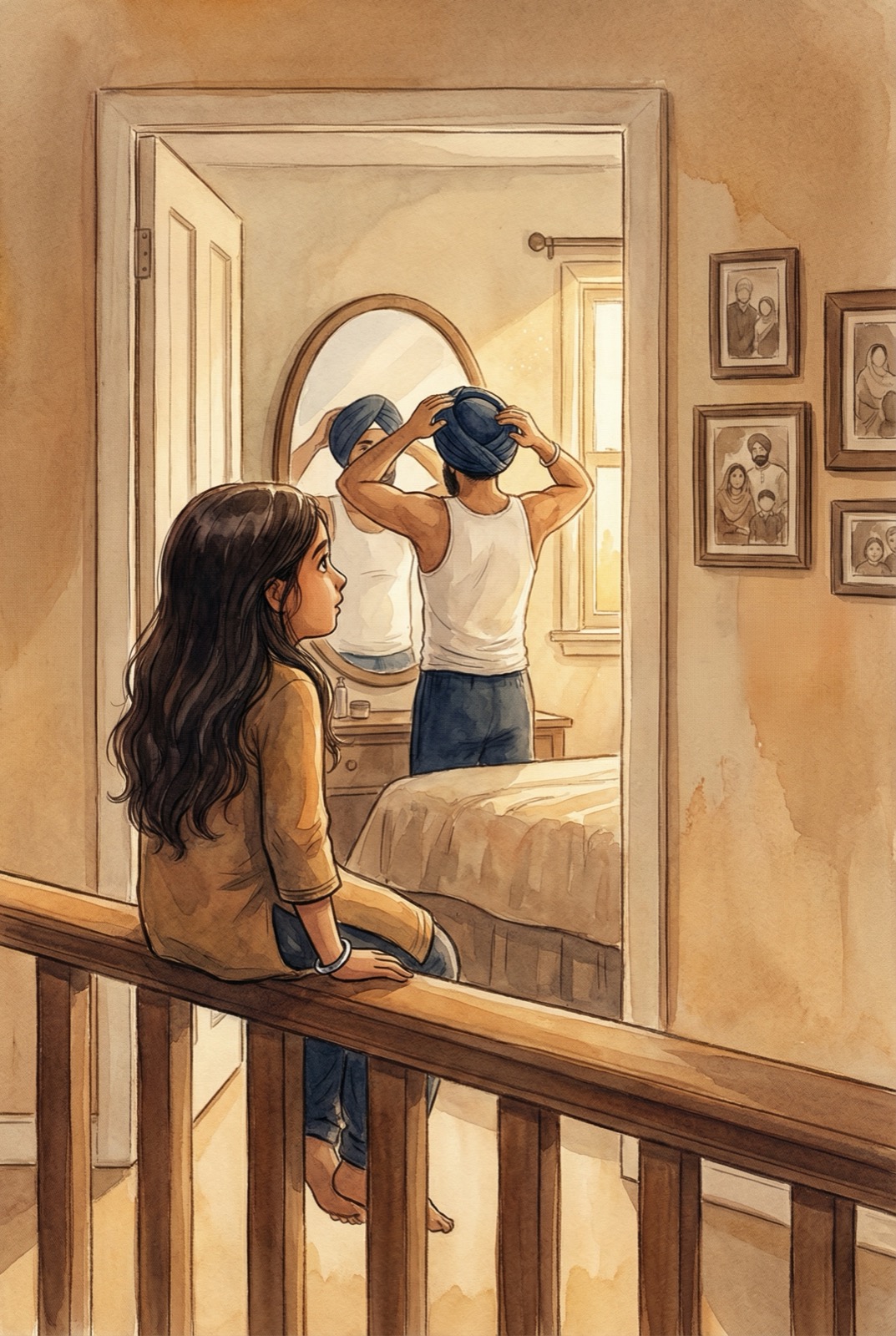
In the morning, Simran sat on the landing outside her parents' bedroom. The door was open. Her dad stood in front of the big mirror, his hair down.
She had seen this a thousand times — every morning before work, the same routine. But today she watched.
His hair was long. Longer than hers. It fell past his shoulders, dark and thick, with a few grey strands near his temples. He gathered it up, twisted it into a joora on top of his head, and reached for his dastar — the long piece of dark blue cloth that hung on the hook by the mirror.
He began to wrap. Simran counted.
One. The first wrap went around his forehead. Two. Over the top. Three. He tucked it under, pulled it smooth. Four. Five. Six. He adjusted the edge so it sat straight. Seven. The final wrap, tucked in at the side, firm and neat.
He looked at himself in the mirror and gave a small nod. Then he saw Simran sitting on the landing.
"Watching the show?" he said, smiling.
"Papa, why do we keep our hair?"
He didn't answer right away. He came and sat beside her on the landing, his dastar fresh and crisp.
"Do you know who Guru Gobind Singh Ji is?" he asked.
"The tenth Guru," said Simran. "We learned about him at the Gurdwara."
"A long time ago, Guru Gobind Singh Ji gave the Khalsa five gifts. The kara you wear." He touched the steel bracelet on her wrist. "The kanga your mum uses to comb your hair. And kesh — our hair. It was a gift, Simran. From our beloved Guru to us."
"But why hair?" she said.
Her dad thought for a moment.
"Our hair is part of how Waheguru made us," her dad said. "Every part of this body is a gift. Guru Gobind Singh Ji asked the Khalsa to keep it — to accept the way the Creator made us, and to wear that acceptance with pride. That's what kesh means. Not a rule. A gift we choose to keep."
Simran thought about that. She looked at her dad's dastar — seven wraps, dark blue, sitting perfectly on his head. She thought about all the mornings she'd seen him do this, and never once wondered why.
"Is that why you wrap it?" she asked.
"I wrap it because it's beautiful," he said. "And because my father wrapped his. And his father before him."
The Same Hair
Her dad went downstairs to make parathas. Simran stayed on the landing.
She got up and stood in front of the big mirror. Her hair was loose — she hadn't been downstairs for her mum to braid it yet. It fell past her shoulders, dark and thick. She looked at it.
Then she looked at the wall beside the mirror. Three photos hung there in a row. Her nani — hair pulled back in a joora, smiling at someone outside the frame. Her dadi — sitting in a garden, her white chunni draped over her hair, a kara on each wrist. And her dad as a little boy — maybe six, maybe seven, about her age — wearing a patka, his hair tucked underneath, grinning at the camera.
Same dark hair. All of them.
Simran touched her own hair. It was the same. The same colour, the same weight, the same way it fell. It went back — through her, through her dad, through her nani and dadi — all the way back to the people who first heard Guru Gobind Singh Ji's voice and said yes.
She didn't have all the words for it yet. But she felt it. Something warm and steady, like a thread running through the photos on the wall and into the mirror where she stood.
She went downstairs. Her mum was waiting with the kanga.
"Thirty-five... thirty-six... thirty-seven," Simran counted as the comb moved through.
Her mum braided her hair tight for school.
The Picture
At school, the class pictures were pinned on the board outside Ms. Adeyemi's room. Simran found hers — third row, near the end. There she was. Neat braid, small blue clip, her kara just visible on her wrist.
At lunch, Lily sat across from her again.
"My mum cuts my hair every six weeks," Lily said. She wasn't being mean — she was just talking. "She says it grows too fast. Does yours ever get in the way?"
"Sometimes," said Simran. "But we keep it. It was a gift — from our Guru. My dad keeps his too, under his dastar. And my nani, and my dadi. We all have the same hair."
Lily thought about that. "That's cool," she said. "Like a family thing."
"Yeah," said Simran. "Like a family thing."
Maya looked up from her sketchbook. "Can I draw your braid?" she asked. "The way it catches the light is really good."
"Okay," said Simran. She turned so Maya could see.
She sat still while Maya drew. Outside the window, she counted the pigeons on the sill. Four today — yesterday there had been three. The sun was warm and the classroom hummed and her braid hung over her shoulder, the same as it always did.
But now she knew why.
Four pigeons. Seven wraps. Twelve fridge magnets. One gift she would keep.
Discussion Questions
Let's Talk About It: Lily asks Simran why she doesn't cut her hair. Simran doesn't know the answer at first. Has anyone ever asked you a question about yourself that you didn't know how to answer?
Let's Think About It: Simran's dad says kesh is "not a rule — it's a gift we choose to keep." What's the difference between following a rule and keeping a gift?
Let's Talk About It: Simran sees old photos of her nani, dadi, and dad as a little boy. They all have the same dark hair. How does seeing those photos help her understand her own kesh?
Let's Think About It: Simran's dad says "the Creator made this body, placed life within it, and made every arrangement to care for it." What do you think that means for how we treat our bodies?
Let's Try It: Ask someone in your family about something you do together — a tradition, a practice, or something you wear. Find out where it started. You might be surprised how far back it goes.
Word Meanings
| Word | Meaning |
|---|---|
| Chunni | A light scarf or shawl worn over the head or shoulders |
| Dadi | Grandmother (on your father's side) — a term of love |
| Daal | Lentil stew — a staple of Punjabi meals |
| Dastar | A turban — a cloth wrapped around the head to cover and honour kesh |
| Joora | A topknot or bun — how long hair is gathered and held in place |
| Kanga | A small wooden comb used to care for hair — one of the five articles of Sikh identity |
| Kara | A steel bracelet worn on the wrist — one of the five articles of Sikh identity |
| Kesh | Uncut hair — one of the five articles of Sikh identity, a gift from Guru Gobind Singh Ji |
| Khalsa | The community of initiated Sikhs, founded by Guru Gobind Singh Ji in 1699 |
| Nani | Grandmother (on your mother's side) — a term of love |
| Patka | A small cloth tied over a child's hair — worn by young Sikh boys before they begin tying a full dastar |
| Puttar | Child — a term of love used by Punjabi parents |
| Roti | Flatbread — a staple of Punjabi meals |
| Waheguru | The Wonderful Creator — the Sikh name for God |
About This Story
This story is the third in the Simran Kaur series — five stories set in Toronto, each woven around one of the Five Kakars (the five articles of Sikh identity given by Guru Gobind Singh Ji to the Khalsa in 1699). In this story, Kesh — uncut hair — is not explained as a rule but shown as a gift: something that connects Simran to her family, her Guru, and the Creator who made her. Maya and Ms. Adeyemi, who appear in this story, were first introduced in Simran Kaur and the Lost Sketchbook. The evening combing routine with the kanga continues from Simran Kaur and the Knot.
Gursharn Singh is a volunteer Punjabi teacher and the founder of Maastarji.com, a English-language Sikhi resource for diaspora children and families.
Explore More
- The Five Kakars — Articles of Sikh Faith — What the Five Kakars are and why they matter
- Simran Kaur and the Knot — The second story in the Five Kakars series
- Hair Twins — A picture book celebrating Sikh identity through hair
Continue reading Simran Kaur and the Picture
You've read the first chapter. The full story — all five chapters, discussion questions, and Gurbani — is available on Amazon.
Free Coloring Sheet
A printable coloring page inspired by this story — great for after reading together.
Download PDF View all coloring sheets