The Brave 22: The Story of Bhai Tara Singh Ji Wan
A children's chapter book about the courageous Bhai Tara Singh Ji Wan, who stood up for justice with only 22 Singhs against an army of thousands.
Chapter 1: The Village of Wan
Long ago, in the land of Punjab, there was a small village called Wan.
It was a quiet place. Golden wheat fields stretched in every direction, and in the mornings, you could hear birds singing and the gentle sound of water being drawn from the well.
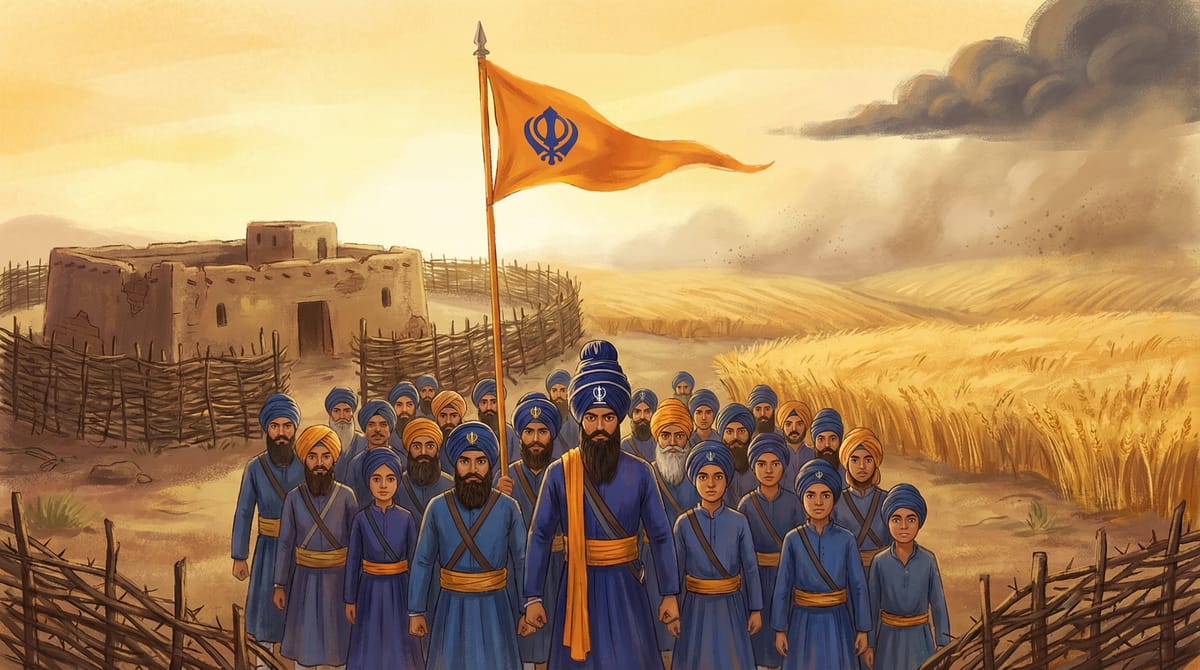
In the middle of this village stood a special home called a bunga. It was not made of marble or stone like the grand palaces of the Mughal rulers. It was simple — built from mud and brick, with thick walls of dried thorny branches stacked all around it for protection. But inside those humble walls lived one of the bravest Sikhs who ever walked the earth.
His name was Bhai Tara Singh Ji.
Bhai Tara Singh Ji was the eldest of five brothers. His father, Sardar Gurdas Singh Ji, had been a Khalsa warrior. He had received Amrit during the time of Sri Guru Gobind Singh Ji themselves, and had fought bravely alongside Bhai Mani Singh Ji and Baba Banda Singh Bahadur Ji. Courage and faith ran deep in this family, like a river that never runs dry.
When Bhai Tara Singh Ji was old enough, he too received Amrit — from the hands of the great Bhai Mani Singh Ji. From that day on, he promised to live by the teachings of the Guru. He promised to be honest. He promised to be brave. And he promised to always, always help those in need.
Bhai Tara Singh Ji wore a bright blue bana and tied a tall dhumalla on his head. He kept his weapons close, always ready, always alert. But he was not a man who went looking for trouble. He was a man who woke up every single morning before the sun — in the quiet, still hours when the stars were still shining — and sat in prayer. He would open his pothi and read Gurbani, and the sacred words of the Guru would fill his heart with peace and strength for the day ahead.
That was the kind of man Bhai Tara Singh Ji was. A saint and a soldier, just as Sri Guru Gobind Singh Ji had taught every Sikh to be.
Chapter 2: A Home for Everyone
Those were terribly difficult times for the Sikhs of Punjab.
The Mughal rulers did not like the Khalsa. After Baba Banda Singh Bahadur Ji was captured and martyred in 1716, the rulers thought they had finished the Sikhs for good. They chased Sikh families out of their homes. They burned Sikh villages. They made it a crime to even look like a Sikh.
Sikh families wandered from place to place — tired, hungry, with nowhere to go. Fathers carried their children on their backs. Mothers walked barefoot through thorny fields. Entire families slept under open skies, afraid to stop for too long in any one place.
But Bhai Tara Singh Ji always kept his door open.
"Come," he would say. "You are safe here. This is your home now."
Any Sikh who needed help could come to the bunga at Wan. Bhai Tara Singh Ji gave them food, shelter, and hope. He never asked who they were or where they came from. If you were in trouble, you were welcome. That was the rule. No one was ever turned away.
Inside the bunga, the Singhs lived together like a big family. They farmed the land side by side, ploughing the fields and planting wheat. They cooked langar — the free community kitchen — so that everyone could eat. They practised Gurbani together, reciting the sacred words of the Guru. And they trained with their weapons, practising shastar vidiya, because they knew that one day they might have to defend themselves and the people they were protecting.
Whatever food they grew, they shared. Whatever money they earned, it went to the langar. Everyone ate from the same kitchen. Everyone was equal.
At any given time, Bhai Tara Singh Ji had about fifteen to twenty Singhs living with him. Some came and went. Some stayed for years. But all of them knew this: at the bunga of Wan, a Sikh could live with dignity. A Sikh could live without fear.
Chapter 3: The Bully of Naushahra
Not far from the village of Wan, in a place called Naushahra, there lived a man named Sahib Rai.
Sahib Rai was a powerful landlord. He had money, land, and connections with the Mughal rulers. And he used all of that power to make life miserable for the Sikhs living near him.
Sahib Rai owned two fine horses — strong, beautiful animals. But instead of keeping them in his own stable, he let them roam free through the farmland. They trampled across the fields that Sikh farmers had worked on for months. They ate the crops. They destroyed the harvests. And when those crops were gone, the families who depended on them went hungry.
One day, two Sikh farmers gathered their courage and went to see Sahib Rai. They stood before him and said politely, "Please, keep your horses tied. They are destroying our crops. We have families to feed."
Sahib Rai did not listen. He did not even try to be fair. Instead, he laughed at them. He made fun of their turbans. He mocked their Sikh appearance with terrible, hurtful words. He said things so cruel that no decent person would ever repeat them.
The two farmers walked away that day. They were hurt. They were angry. But they did not lose their dignity.
When word of this reached the bunga, the Singhs were outraged. No one insults a Sikh's faith and gets away with it. Two brave Singhs — Bhai Baghel Singh Ji and Bhai Amar Singh Ji — came up with a plan. Under the cover of night, they quietly took Sahib Rai's two horses from his stable. They rode them far away to the Malwa region, where another Gursikh sold them. Every paisa of that money was brought back and given to the langar at Bhai Tara Singh Ji's bunga.
No more would those horses trample the crops of poor farmers.
When Sahib Rai discovered what had happened, he was beside himself with rage. He stormed right up to Bhai Tara Singh Ji's bunga with a group of his men. He shouted. He made threats. He demanded that the Singhs be handed over to him.
Bhai Tara Singh Ji stood before him, calm as a still lake.
"You are the one who has been troubling innocent people," he said. "You destroyed their crops. You insulted them. And now you come here making demands? This land belongs to the Khalsa. We answer only to the Guru."
Sahib Rai left that day — humiliated, embarrassed, and more angry than ever. He wanted revenge. And he knew exactly where to get it.
Chapter 4: Lies and Soldiers
Sahib Rai went straight to the local Mughal authority — a military commander named Ja'far Beg, who was the Faujdar of Patti, the nearest town.
Standing before Ja'far Beg, Sahib Rai twisted the truth. He lied.
"This Tara Singh is very dangerous," Sahib Rai said. "He is collecting his own taxes from the people. He gives shelter to criminals and thieves. If you do not stop him now, others will start to follow him. He must be punished!"
Ja'far Beg believed every word. He did not bother to check if the story was true. He did not ask the Sikh farmers what had actually happened. He simply decided: the Singhs at Wan must be taught a lesson.
That very night, Ja'far Beg sent 25 horsemen and 80 foot soldiers — 105 in all — to attack the bunga under the cover of darkness. They marched through the fields of Punjab with their swords and guns, certain that they would catch the Singhs sleeping.
But they were wrong.
The Singhs at the bunga were not ordinary people. They did not sleep until noon the way the soldiers expected. They rose before dawn, every single day. Even now, in the darkest hours of the morning, they were awake. Some were sitting in simran, remembering Vaheguru. Some were reading their Nitnem. Others were already up and about, doing seva.
Bhai Baghel Singh Ji had just finished his morning prayers and was standing outside the bunga, a short distance away, when he saw them — row upon row of soldiers, moving through the darkness toward Wan.
He had a choice to make. He could run back to the bunga and warn the others. Or he could stand right where he was and fight.
Bhai Baghel Singh Ji chose to stand.
He drew his sword, filled his lungs, and let out a mighty jaikara that echoed across the fields: "Bole So Nihal! Sat Sri Akal!"
Then he charged — one Singh, alone, into the approaching army.
The sound of his jaikara and the clash of battle woke the other Singhs. They rushed out from the bunga, weapons in hand. When the soldiers saw more Singhs pouring out, they panicked. In the darkness, confusion spread through their ranks. They broke and ran.
Ja'far Beg's army was defeated that night. Two of his own nephews fell. Many soldiers were wounded. The rest fled, stumbling through the fields to get away.
But the Singhs paid a heavy price too. Bhai Baghel Singh Ji — the brave soul who had stood alone against an army — attained shaheedi that morning. He fought to his very last breath, just as a true Khalsa warrior does.
The Singhs of Wan honoured him with deep love and deep sadness. They had won the battle, but they had lost a brother.
Chapter 5: The Storm from Lahore
The story did not end there. It was only the beginning.
Ja'far Beg, shaking with humiliation, rode straight to Lahore and threw himself before the Governor of Punjab — the powerful and feared Zakariya Khan.
Zakariya Khan was a sworn enemy of the Sikhs. He and his father before him had spent years trying to destroy the Khalsa. He had already executed Baba Banda Singh Bahadur Ji and hundreds of Sikh prisoners. He believed he had crushed the Sikhs for good.
And now? Now he was hearing that a small band of Singhs in a tiny village had defeated his soldiers?
Zakariya Khan was furious.
"I thought we had finished these Singhs!" he shouted in his court. "The more I kill, the more they grow!"
A court advisor spoke up. "You do not understand their power," he said carefully. "Every drop of a Singh's blood that falls upon the ground causes countless more Singhs to rise."
But Zakariya Khan did not care for explanations. He wanted the Singhs of Wan gone.
He called upon his trusted commander, Momin Khan, and gave him the largest force he could assemble: two thousand and two hundred horsemen, five massive war elephants, forty camel-mounted guns, and four heavy cannons on wheels.
All of that — two thousand soldiers, elephants, and cannons — to fight the Singhs of one small village.
If you ever needed proof of how much the rulers feared the Khalsa, this was it.
Chapter 6: Twenty-Two
When word reached Wan that the Governor's army was on its way, many well-meaning Sikhs came to Bhai Tara Singh Ji. They begged him to leave.
"You have already won once," they said. "There is no shame in going underground. Hide in the forests. Live to fight another day. Why die here for no reason?"
Bhai Tara Singh Ji listened patiently. Then he did what he always did when he needed guidance. He reached into his kamarkasa — the cloth sash tied around his waist — and took out his Das Granthi pothi. He said Ardaas, asking Guru Sahib for direction. Then he opened the pothi and took a Hukamnama.
The Guru's words were clear. There was no running from what was meant to be. This was the path.
Bhai Tara Singh Ji looked up at the Singhs gathered around him. His eyes were calm. His voice was steady.
"Those who wish to stay with me and attain shaheedi, stay. Those who have families depending on them, you may go. There is no shame in it. Go in peace."
Some of the younger Singhs left that day to be with their families. But the rest — the ones who stayed — came forward, one by one, and stood beside Bhai Tara Singh Ji.
Twenty-two Singhs in all.
They were farmers who had tilled the earth with their hands. They were warriors who had trained with the sword. Some were young — barely more than boys. Others were older men with grey in their beards. But every single one of them had made the same promise, and not one of them was going to break it.
Bhai Tara Singh Ji also sent word to his closest companions — Singhs from nearby villages who had once shared Amrit with him, who had eaten from the same bowl, who had long ago made a promise to one another: "When the time comes, we stand together."
One by one, they came.
The Singhs fortified the bunga. They stacked the walls of thorny branches higher. They raised the Nishan Sahib — the saffron flag of the Khalsa — so it flew high above the village. And they sounded the Nagara, the great war drum.
The beating of the Nagara was an act of defiance. In those days, only the Mughal rulers were allowed to beat the war drum. Anyone else who dared to do so was declaring sovereignty — declaring that they bowed to no earthly king.
The 22 Singhs of Wan were declaring exactly that. They bowed only to Vaheguru. They followed only the Guru.
Chapter 7: The Night and the Dawn
The army of Momin Khan arrived at Wan as the sun began to set. It was a terrifying sight. Horsemen stretched across the fields in every direction. Elephants lumbered forward, their armour glinting. Cannons were wheeled into position. Campfires lit up the land like a second sky.
Two thousand two hundred soldiers. Five elephants. Forty guns. Four cannons.
And before them: twenty-two Singhs, a wall of thorns, and a flag.
As night fell, the battle began.
The Singhs fought from behind their walls. They knew the land — every ditch, every field, every tree. In the darkness, the great army stumbled and struggled. They could not see clearly. They did not know the terrain. And every time a group of soldiers tried to push forward, the Singhs held them back.
Through the long, dark night, the 22 Singhs of Wan did not budge.
Hours passed. The stars wheeled slowly overhead. The sounds of battle rose and fell. And still, the small band of Khalsa warriors held their ground against the might of Lahore.
Then the sky began to lighten. Dawn was coming.
With daylight, the army could finally see how few Singhs were actually inside the bunga. The commanders ordered their soldiers to fire from a distance. Cannons boomed. Gunfire crackled across the fields.
One by one, the brave Singhs began to fall.
When only a handful remained, Bhai Tara Singh Ji made his decision. He would not hide behind walls any longer. He opened the gates of the bunga.
The remaining Singhs stepped out together into the morning light. They stood side by side, raised their swords, and let out the jaikara one final time:
"Bole So Nihal! Sat Sri Akal!"
Then they charged.
They fought with everything they had. Every last ounce of strength, every beat of their hearts, they gave to that final charge. Bhai Tara Singh Ji himself was said to have fought with such ferocity that the soldiers around him fell back in astonishment.
That morning, all twenty-two Singhs attained shaheedi in the fields of Wan. Not one of them surrendered. Not one of them asked for mercy. Not one of them broke their promise to the Guru.
Chapter 8: The Flame That Never Went Out
The army of Lahore won the battle that day. But they did not win what mattered.
Because the story of what happened at Wan — the story of twenty-two Singhs who stood against two thousand — spread across all of Punjab like a flame caught by the wind.
In villages and forests, in camps and hilltops where the Khalsa had regrouped after years of relentless warfare, Sikhs heard what Bhai Tara Singh Ji and his companions had done. And something stirred inside them.
If twenty-two could stand against thousands, they thought, then imagine what we can do together.
The sacrifice of the Brave 22 galvanised the Khalsa Panth. After years of fighting in small bands — scattered across Punjab, recovering and regrouping — Sikhs began to come together in larger numbers. They formed new jathas. They stood up for their rights. They refused to be crushed.
The fire that Bhai Tara Singh Ji had lit at Wan could not be put out — not by armies, not by cannons, not by all the power of the Mughal Empire.
Today, a beautiful Gurdwara Sahib stands in the village of Wan, in the Amritsar district of Punjab, right where Bhai Tara Singh Ji's bunga once was. The Nishan Sahib still flies there, just as it did on that day so long ago.
And whenever we hear this story — whenever we remember those twenty-two Singhs standing together in the morning light — we are reminded of what Sikhi truly means.
It means standing up for what is right, even when the whole world stands against you.
It means helping those who have no one else to turn to.
It means trusting the Guru's Hukam with all your heart.
And it means that even a small group of people, when they stand together with love and courage and faith, can shake the entire world.
A Note for Parents and Educators
Historical Context
Bhai Tara Singh Ji Wan was born around 1687 CE in the village of Wan (also known as Dall-Wan), in present-day Tarn Taran district, Punjab. He was the eldest of five sons of Sardar Gurdas Singh Ji, who had received Amrit during the time of Sri Guru Gobind Singh Ji and fought alongside Bhai Mani Singh Ji and Baba Banda Singh Bahadur Ji.
Bhai Tara Singh Ji received Amrit from Bhai Mani Singh Ji and became known as a devout Sikh and skilled warrior. During the period of intense persecution following the execution of Baba Banda Singh Bahadur Ji in 1716, Bhai Tara Singh Ji's bunga at Wan became a refuge for displaced Sikhs.
The conflict with Sahib Rai of Naushahra Pannuari, a government informer, led to two engagements at Wan. In the first, a contingent of 105 soldiers sent by Ja'far Beg (the Faujdar of Patti) was routed, though the Singhs lost the brave Bhai Baghel Singh Ji. In retaliation, Zakariya Khan, the Governor of Lahore, sent a massive force of 2,200 horsemen, 5 elephants, 40 camel-mounted guns, and 4 cannons under Momin Khan.
Bhai Tara Singh Ji, with only 22 Singhs, held off this army through the night. All 22 attained shaheedi the following day on 24 December 1732 CE. Their sacrifice is considered one of the most significant acts of Sikh resistance after Baba Banda Singh Bahadur Ji's time, reinvigorating the Khalsa Panth and inspiring future generations.
Primary sources: The Sikh Encyclopedia; Ratan Singh Bhangu, Prachin Panth Prakash.
Key Sikh Values in This Story
- Seva (Selfless Service): Bhai Tara Singh Ji opened his home to anyone in need, sharing all that he had.
- Nimrata and Courage: He never sought conflict, but never ran from injustice either.
- Chardi Kala (Eternal Optimism): Even facing overwhelming odds, the Singhs maintained their spirits and faith in Vaheguru.
- Sangat (Community): The Singhs lived, worked, prayed, and stood together as one family.
- Trust in Guru Sahib: Bhai Tara Singh Ji turned to Gurbani for guidance at the most critical moment, placing his full trust in the Guru's Hukam.
Discussion Questions
- Why did Bhai Tara Singh Ji help the Sikh families who had nowhere to go? How can we do seva in our own lives?
- What happened when the two farmers tried to talk to Sahib Rai politely? Was Sahib Rai being fair?
- Bhai Tara Singh Ji asked Guru Sahib for guidance by doing Ardaas and taking a Hukamnama. How do we ask Guru Sahib for help in our lives today?
- Why do you think the 22 Singhs chose to stay even though the army was so much bigger?
- What does this story teach us about standing up for what is right, even when it feels hard or scary?
- Bhai Tara Singh Ji said his land belonged to the Khalsa and he answered only to the Guru. What did he mean by that?
- The story says the sacrifice of the Brave 22 "woke up" the Khalsa Panth. How can one act of bravery inspire others?
Glossary
- Amrit: The sacred initiation ceremony of the Khalsa, established by Sri Guru Gobind Singh Ji.
- Ardaas: The Sikh collective prayer — offered standing, remembering Sikh Gurus, martyrs, seeking guidance, and asking for the well-being of all.
- Bana: The distinctive dress of a Khalsa Sikh, often blue or bright yellow.
- Bunga: A fortified dwelling or rest house, often attached to or near a Gurdwara Sahib.
- Das Granthi: A compilation of selected Gurbani compositions, often carried as a small pothi.
- Dhumalla: A tall, round turban style traditionally worn by Nihang Singhs and Khalsa warriors.
- Faujdar: A Mughal military commander or district officer.
- Gurbani: The sacred writings contained in Sri Guru Granth Sahib Ji.
- Gurdwara Sahib: The Sikh place of worship where Sri Guru Granth Sahib Ji is parkash (installed).
- Hukam: The divine will or command of Vaheguru, accepted with faith by Sikhs.
- Hukamnama: A hymn from Sri Guru Granth Sahib Ji taken as the Guru's command or guidance.
- Jaikara: The Sikh shout of victory: "Bole So Nihal! Sat Sri Akal!" (Whoever speaks shall be blessed! True is the Timeless One!)
- Jatha: A group or band of Sikhs organized for a common purpose.
- Kamarkasa: A cloth sash tied around the waist, used to carry weapons and items like a pothi.
- Khalsa: The community of initiated Sikhs, established by Sri Guru Gobind Singh Ji in 1699 CE.
- Langar: The community kitchen where free meals are served to all, regardless of background.
- Nagara: A large kettledrum — a symbol of Khalsa sovereignty.
- Nishan Sahib: The Sikh flag, usually navy blue or bright yellow, that marks the presence of the Khalsa.
- Nitnem: The daily prayers recited by Sikhs, typically in the early morning hours.
- Pothi: A small prayer book or volume of Gurbani.
- Seva: Selfless service performed without any expectation of reward.
- Shaheedi: Martyrdom — giving one's life for faith and principles.
- Shastar Vidiya: The Sikh martial art — the science of weapons.
- Simran: Meditative remembrance of Vaheguru's name.
- Vaheguru: The Sikh name for God — the Wonderful Lord.