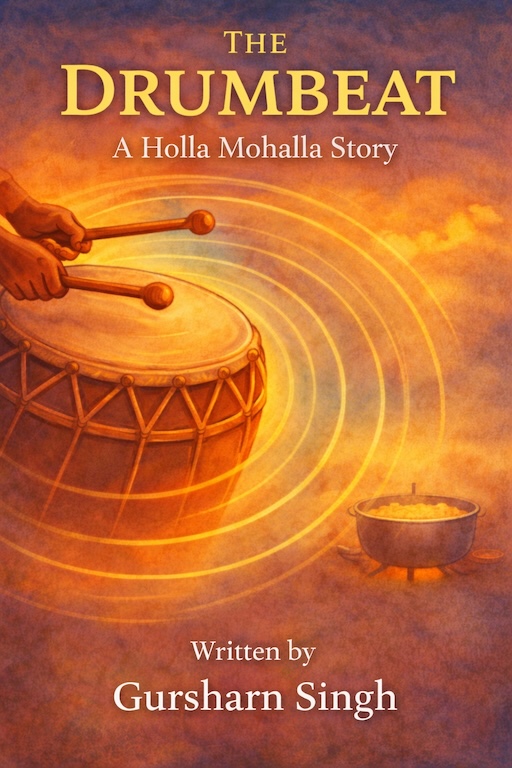
The Drumbeat: A Holla Mohalla Story
Available on Amazon
Bring this inspiring story into your home. Every copy sold helps us create more resources for Sikh children.
A diaspora girl visits Anandpur Sahib for her first Holla Mohalla — and discovers that the thundering war drums she fears are really the heartbeat of the Khalsa.
Are We There Yet?
Anand pressed her forehead against the car window and watched the world go by. Flat green fields stretched out in every direction. Sugarcane stood tall and straight along the road. A truck painted in a hundred colours rumbled past, honking its horn.
They had been driving for a long time. Anand's parents were in the front. And beside her, in the back seat, sat Naniji — her grandmother — with her white chunni draped neatly over her head and a ladoo wrapped in a cloth on her lap. Naniji always carried snacks.
"How much longer?" Anand asked. She had already asked this three times.
"Not long now," said Naniji. She said this every time.
They were in Punjab, visiting family. But today they were not going to anyone's house. Today they were going to Anandpur Sahib for something called Holla Mohalla.
Naniji had been talking about it the entire trip. "You will see warriors on horses," she said. "You will hear drums that shake the ground. You will eat langar made in pots as big as bathtubs."
Anand wasn't sure about any of that. She liked her gurdwara back home. It was quiet. She knew where everything was. This sounded loud and crowded and far away.
"Wait until you hear the drums," Naniji said softly, looking out the window with a little smile. "You will never forget them."
Anand looked back out at the fields. She wasn't so sure about that either.
Louder Than Anything
She heard Anandpur Sahib before she saw it.
A deep, booming sound rolled through the air like distant thunder. It came and went. Then it came again, louder this time. Anand sat up straight.
"What is that?"
"The nagaras," said Naniji. Her eyes were bright. "The war drums."
When they got out of the car, the sound hit her like a wall. BOOM. BOOM. BOOM. The drums were enormous — wider than Anand's arms could stretch — and two men were striking them with thick wooden sticks. Each hit shook the air. Anand felt it in her chest, in her teeth, in the soles of her feet.
She grabbed Naniji's hand.
The crowd was everywhere. Thousands and thousands of people, more than she had ever seen in one place. Flags in blue and yellow waved above their heads. The smell of frying pakoras and sweet jalebi drifted from stalls along the road. Dust rose from the ground and hung in the warm air like gold.
Anand squeezed Naniji's hand tighter. It was louder than the airport. Louder than a thunderstorm. Louder than anything.
"I want to go back to the car," she whispered.
Naniji squeezed her hand back. She bent down and said, very gently: "Listen, Anand. Really listen. That is the heartbeat of the Khalsa. It has been beating for over three hundred years."
Anand listened. The drums boomed on. But she was not convinced.
The Warriors in Blue
Naniji led her through the crowd, holding her hand firmly. People made way for the old woman and the small girl.
And then Anand saw them.
They came riding through the crowd on tall horses — men in deep blue robes with turbans so high they looked like towers. Steel rings called chakrams glinted around their turbans, catching the sunlight. They carried long spears and curved swords in their belts. Their beards were long, their backs were straight, and their horses stamped and snorted as they walked.
Nihang Singhs. Anand had seen pictures in books at the gurdwara. But pictures were nothing like this.
One rider came close — so close that Anand could see the silver stitching on his blue robes, and the muscles in his horse's neck. The horse was taller than her father. She stepped back behind Naniji.
But then she noticed something. The rider was smiling. Not a fierce smile. A calm, happy smile. He sat on his horse like he belonged to the sky.
"Are they soldiers?" Anand asked.
Naniji watched them pass with shining eyes. "They are Sikhs," she said simply. "When I was your age, I thought they were giants."
Anand watched the blue riders move through the crowd. The nagaras boomed behind them. The flags rippled above. For a moment, she forgot to be scared. She just watched.
The Girl With the Sword
The crowd gathered around a wide, open space in the dust. Naniji found a spot where Anand could see. "Watch," she said. "This is Gatka."
Two young men stepped into the circle. They each held a wooden staff. They bowed to each other. Then, without warning, they began.
The staffs cracked together so fast that Anand flinched. The men spun, ducked, leaped. Their feet kicked up dust. Anand peeked from behind Naniji's arm.
More fighters came. Some used real swords. Some used shields. They moved like dancers, fast and smooth, their weapons singing through the air. The nagaras kept time like a heartbeat.
Then something stopped Anand cold.
A girl walked into the circle. She looked maybe nine or ten — not much older than Anand. She wore a blue chola and an orange dumalla tied neatly on her head. In her hands she held a curved sword.
The girl raised the sword. The crowd went quiet. Then she began to move — spinning the blade in wide, bright circles. Her feet barely touched the ground. Her dumalla stayed perfectly in place. She was fast. She was precise. And she was smiling.
Someone let out a great roaring jaikara: "Bole So Nihal! Sat Sri Akal!"
Anand's mouth hung open. She wasn't behind Naniji anymore. She was standing right at the edge of the circle, watching.
"Naniji," she said quietly. "She's not much bigger than me."
Naniji put her hand on Anand's shoulder. "No," she said. "She is not."
The drums boomed again. This time, Anand didn't cover her ears.
The Biggest Kitchen
"Are you hungry?" Naniji asked.
They walked to where the langar was being served. Anand helped at langar at her gurdwara back home sometimes — she would stack cups or carry napkins. But this was something else entirely.
Enormous pots — as tall as Anand herself — bubbled with daal. Steam rose in white clouds that smelled of cumin and ginger. Men and women stood in long rows making rotis, slapping the dough from hand to hand, then tossing them onto hot griddles where they puffed up like little balloons. Phulp. Phulp. Phulp.
Thousands of people sat in long, straight rows on the ground — this was the pangat. Rich and poor, young and old, everyone together, eating the same food from the same steel plates.
Naniji spoke to one of the sevadaars — the volunteers — and soon Anand had a job. She was given a steel jug of water and a stack of small cups. Her job was to walk along the pangat and pour water for anyone who needed it.
The jug was heavy. The sun was hot. But Anand walked carefully down the rows, pouring water into each cup that was held out to her. An old man with a long white beard smiled at her and said, "Waheguru ji ka Khalsa, Waheguru ji ki Fateh." She didn't understand every word, but she knew it was kind. She filled his cup to the top.
"This is seva," Naniji said, watching from nearby. "It is the same everywhere — here or home. When you serve others, Waheguru smiles."
Anand's arms were tired. But something warm had settled inside her chest, and it wasn't just the sun. She poured another cup.
The Drumbeat
The Nagar Kirtan started in the morning.
The Panj Pyare — the Five Beloved Ones — walked at the front, dressed in blue and saffron, leading the way. Sri Guru Granth Sahib Ji was seated in a beautiful palki — a golden palanquin decorated with flowers. Behind them came the Nihang Singhs on horseback, and behind them, thousands and thousands of people.
Kirtan filled the air — devotional singing so beautiful that people along the road stopped and stood still. Voices and harmoniums and tabla blended together and rose above the crowd like a river.
And the nagaras played.
BOOM. BOOM. BOOM.
The same drums that had frightened her that morning. The same deep, thundering sound that had made her want to run back to the car.
But Anand did not run. She did not cover her ears. She did not hide behind Naniji.
She stood at the edge of the road and watched the Nagar Kirtan pass. She saw the golden palki gleaming in the light of the sun. She saw the Panj Pyare walking with steady, quiet strength. She saw a Nihang Singh lift his spear to the sky, and the crowd around her answered with a jaikara that rose like a wave.
And Anand felt the drumbeat. Not just in her chest this time. Somewhere deeper. Like it had always been there, waiting for her to hear it.
Naniji looked down at her. Anand was still holding her hand, but not from fear. She held it the way you hold someone's hand when you are happy and you want them to know.
On the long drive back that night, Anand fell asleep in the back seat with her head on Naniji's lap. The fields were dark outside the window. The car hummed along the road.
Naniji stroked her hair and whispered: "Did you like the drums?"
Anand, half asleep, smiled.
"They're inside me now, Naniji."
Discussion Questions
Let's Talk About It: Anand was nervous about Holla Mohalla at first. Have you ever been nervous about something new that turned out to be wonderful?
Let's Think About It: Naniji said the nagara is "the heartbeat of the Khalsa." What do you think she meant by that?
Let's Talk About It: When Anand saw the girl doing Gatka, something changed inside her. Why do you think that moment was so important?
Let's Try It: Anand did seva by pouring water at the langar. What is a kind of seva you can do at your gurdwara or in your community?
Let's Think About It: At the end of the story, Anand says the drums are "inside me now." What do you think she means?
Let's Talk About It: Naniji says "Seva is the same everywhere — here or home." Do you agree? Why?
Word Meanings
| Word | Meaning |
|---|---|
| Chakram | A steel ring worn on the turban by Nihang Singhs |
| Chola | A long robe or tunic, often worn in blue by Sikh warriors |
| Daal | A thick lentil dish, commonly served in langar |
| Dumalla | A style of turban, often round and tied in the warrior tradition |
| Gatka | The traditional Sikh martial art, performed with swords, staffs, and shields |
| Gurdwara | A Sikh place of worship — "the door to the Guru" |
| Holla Mohalla | An annual Sikh festival of martial spirit, established by Guru Gobind Singh Ji in 1701 at Anandpur Sahib |
| Jaikara | A victory cry — "Bole So Nihal! Sat Sri Akal!" |
| Khalsa | The community of initiated Sikhs, established by Guru Gobind Singh Ji in 1699 |
| Kirtan | Devotional singing of hymns from Sri Guru Granth Sahib Ji |
| Langar | A free community kitchen at the Gurdwara where everyone eats together |
| Nagara | A large war drum, beaten during Sikh processions and festivals |
| Naniji | Grandmother (maternal) — a term of love and respect |
| Nihang Singh | A member of the Sikh warrior order, known for their blue robes, towering turbans, and traditional weapons |
| Palki | A decorated palanquin in which Sri Guru Granth Sahib Ji is seated during processions |
| Pangat | Sitting together in rows to eat langar — everyone equal |
| Panj Pyare | The Five Beloved Ones — the first five Sikhs who offered their lives at the founding of the Khalsa |
| Roti | Flatbread, a staple food made fresh in langar |
| Seva | Selfless service — helping others without wanting anything in return |
| Sevadaar | A volunteer who does seva |
| Waheguru | The Wonderful Creator — God |
About This Story
Holla Mohalla was established by Guru Gobind Singh Ji in 1701 at Anandpur Sahib, Punjab. He created it as a gathering where the Khalsa could practise martial skills, perform kirtan, recite poetry, and share langar together. It falls the day after Holi and has been celebrated every year for over three hundred years. Today, hundreds of thousands of people visit Anandpur Sahib for Holla Mohalla, and Sikh communities around the world mark the occasion with Gatka demonstrations, Nagar Kirtans, and special langars.
This story is a gentle introduction to the festival for young readers. It is not a detailed historical account, but an invitation to experience the sights, sounds, and spirit of Holla Mohalla through the eyes of a child.
Gursharn Singh is a volunteer Punjabi teacher and the founder of Maastarji.com, a English-language Sikhi resource for diaspora children and families.
Available on Amazon
Bring this inspiring story into your home. Every copy sold helps us create more resources for Sikh children.