Featured
The Story of Jaito Da Morcha
The incredible true story of how thousands of Sikhs stood up peacefully for their right to worship at Gurdwara Gangsar Jaito — and won.
A King Who Would Not Bow
In 1912, Maharaja Ripudman Singh ascended the throne of Nabha, a small Sikh kingdom in Punjab. He was twenty-eight years old, and he was not like other rulers.
Maharaja Ripudman Singh came from the lineage of Bhai Phul, who had been blessed by Sri Guru Har Rai Sahib Ji. The royal family had received Amrit from Sri Guru Gobind Singh Ji's own hands. That Sikh spirit ran deep in Maharaja Ripudman Singh's blood.
Even before becoming king, he had spoken boldly in the British Governor General's Council. He fought for the Anand Marriage Act so that Sikh marriages would be recognised by law. He challenged why all the top government positions went to British officers instead of the people of this land. He opposed laws that took away people's right to gather freely.
The British Government did not like a king who thought for himself.
After the martyrdom at Nankana Sahib in 1921, Nabha was the only Sikh state that joined the entire Panth in honouring the shaheeds. Nabha was also the only state where a Kirpan-wearing Singh in a black dastar could walk freely without being stopped and questioned.
This was too much for the British. They wanted Maharaja Ripudman Singh gone. Through political pressure, betrayal by his own ministers, and outright trickery, the British forced the Maharaja off his throne in 1923. He was expelled from his own capital, his own palace, treated — in his own words — "like a rebel and a prisoner." A British administrator named Johnston was placed in charge of Nabha.
The Sikhs watched all of this with heavy hearts.
The Akhand Path Is Broken
On August 25, 1923, the Sangat at Gurdwara Gangsar in Jaito began holding gatherings and performing Akhand Path of Sri Guru Granth Sahib Ji — the continuous, unbroken reading of the sacred scripture from beginning to end. They sought Waheguru's guidance and expressed their love for the Maharaja who had stood by the Panth.
The British administration warned them to stop. The Sikhs continued.
Then, on September 14, 1923, while the Sangat sat inside Gurdwara Gangsar listening to the Akhand Path, a squad of armed soldiers marched in. They seized the Singh who was seated at the Tabia, reading from Sri Guru Granth Sahib Ji. They grabbed him by the arm and dragged him away. Every listener, every sevadaar, was arrested. The Akhand Path was forcefully interrupted.
For Sikhs, the interruption of Akhand Path was unbearable. The news spread across Punjab like wildfire. What had begun as a political matter — the removal of a king — had now become a matter of religious freedom.
Did Sikhs have the freedom to gather and worship in their own Gurdwara?
The Shiromani Gurdwara Parbandhak Committee resolved to restart the interrupted Akhand Path and complete 101 continuous Akhand Paths at Gurdwara Gangsar — without accepting any conditions from the government.
Twenty-Five at a Time
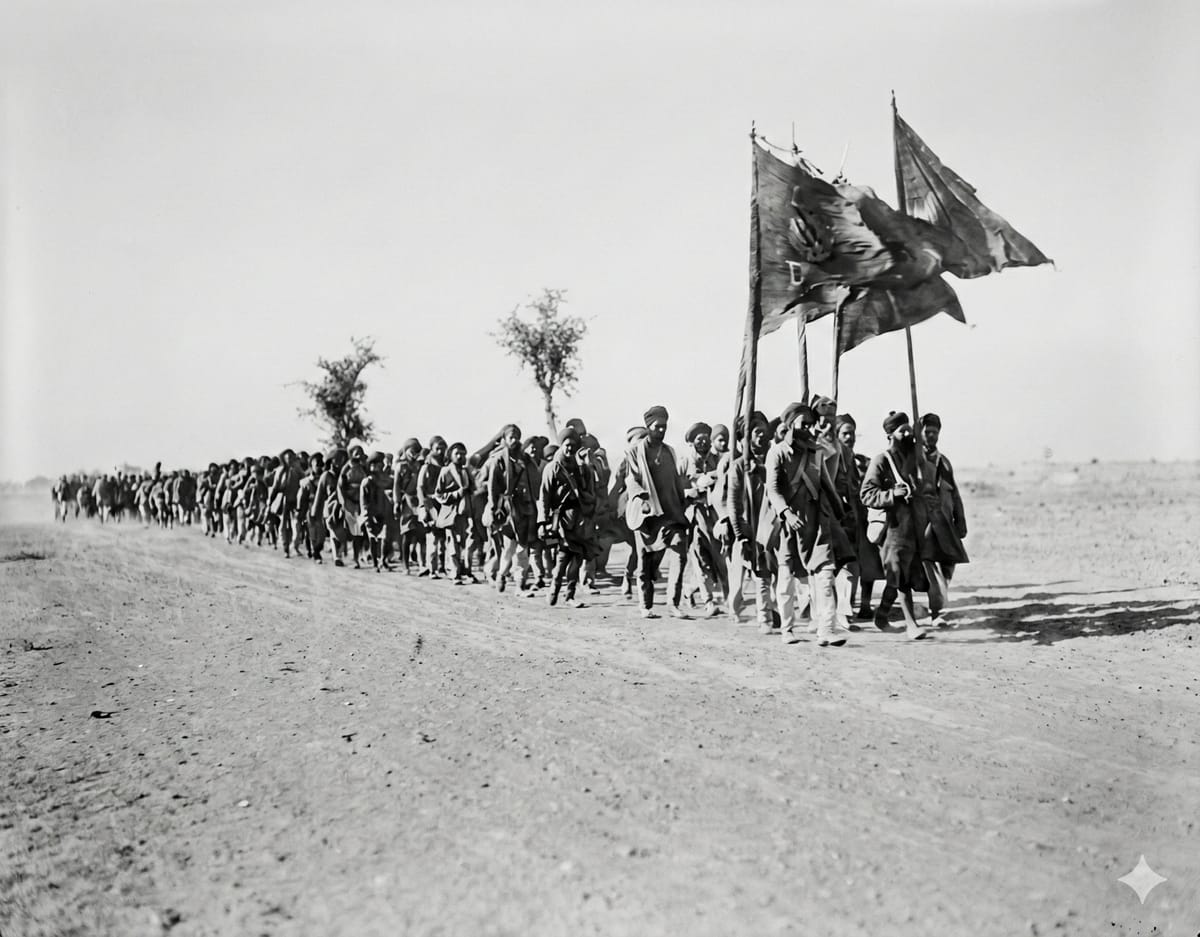
Starting September 15, 1923, a Jatha of twenty-five Sikhs departed on foot from Sri Akal Takht Sahib in Amritsar every single day. Before leaving, each Jatha stood before the Takht, performed Ardaas, and took a solemn vow: they would remain non-violent in thought, word, and deed. They would not resist. Whatever hardships came, they would endure them with humility.
Every day, the Jatha walked the long road to Jaito. Every day, they were arrested before they could enter the Gurdwara. They were locked in open enclosures, often kept hungry for two days. Some were beaten. Then they were loaded onto trains, taken three hundred miles away, and dropped without money or food in the middle of nowhere.
They walked all the way back to Amritsar and signed up to go again.
During these early weeks, Pandit Jawaharlal Nehru, along with Mr. K. Santhanam and Principal Gidwani, travelled to Jaito to see the situation for themselves. All three were arrested and put in handcuffs. The news of Nehru's arrest turned the eyes of all India toward the Jaito struggle.
On October 13, 1923, the British declared both the SGPC and the Akali Dal illegal. Over 110 Panthic leaders — including the President and Vice-President of the SGPC, the Jathedar of Sri Akal Takht Sahib, Master Tara Singh, Professor Sahib Singh, and dozens of others — were arrested and charged with conspiracy against the Crown.
The government believed the movement would collapse without its leaders.
It did not. The daily Jathas of twenty-five continued, without pause.
The First Shahidi Jatha
By early 1924, the Panth decided that twenty-five at a time was not enough. A Shahidi Jatha — a Band of Martyrs — of five hundred would march to Gurdwara Gangsar and restart the Akhand Path.
On February 9, 1924 — the day of Basant Panchmi — five hundred Sikhs departed from Sri Akal Takht Sahib on foot. They were ordinary Sikhs from all walks of life. Before leaving, the Jathedar of Sri Akal Takht Sahib commanded them to remain non-violent in thought, word, and deed.
For twelve days, the Jatha walked through the villages of Punjab. At every stop, thousands gathered. The Sangat served them with great love. Inside the states of Nabha, Patiala, and Faridkot, the government tried to stop villagers from welcoming the Jatha. In the village of Phul, all gates were locked and guards posted. People climbed over walls to bring them tea and water.
On the morning of February 21, 1924, the Jatha marched from the village of Bargari toward Jaito. Thousands followed — men, women, children. At the front of the Jatha, five Singhs carried Nishan Sahibs. In the centre was the palki of Sri Guru Granth Sahib Ji. The Jatha moved in rows of four.
Near Gurdwara Gangsar, machine guns were mounted on the fort. The army and police stood with rifles aimed. Administrator Johnston himself was present. When the Jatha was 150 yards from Gurdwara Tibbi Sahib, a European officer stepped forward and warned them: move ahead and you will be fired upon.
The Jatha did not stop.
On Johnston's signal, firing began from three sides. After a short pause, a second volley came. Bullets rained for five minutes. The Jatha walked forward with peace, courage, and a steady heart. Those who fell to bullets were left where they lay if they could not be carried. But the Jatha did not stop. Bibi Balbir Kaur, a mother was hit by bullets but she kept walking. A bullet hit the baby in her arms and killed him. She put the dead baby down and kept walking. She continued to walk until her last breath. The palki of Sri Guru Granth Sahib Ji was protected from the firing at all costs.
By the time the firing stopped, the entire Sangat had reached Tibbi Sahib. About one hundred Sikhs had been martyred. Three hundred were wounded. Many wounded died in the hours that followed because the army would not allow anyone to give them water or care.
The World Responds
The news of the massacre spread across India and around the world. A correspondent from the New York Times had walked with the Jatha and witnessed the firing firsthand.
Mohandas K. Gandhi expressed deep sorrow. Maulana Shaukat Ali, President of the National Congress and Khilafat Committee, sent telegrams of sympathy. Hindu and Muslim leaders held massive gatherings in Calcutta and Madras, passing resolutions that declared: "The success of the Sikhs is the success of non-violent Satyagraha. The entire country should help the Sikhs in this war."
Pandit Jawaharlal Nehru said: "It is the first time in history that so many men have been killed or wounded while remaining non-violent without taking revenge."
Did the Sikhs stop after this terrible day? Not for a moment.
Mohandas K. Gandhi sent a telegram urging the SGPC not to send a second Jatha. But there was a difference in thinking between Gandhi's and the Khalsa's. Gandhi saw the sacrifice as wasteful, but the Khalsa did not consider a life given on the Guru's path to be wasted. In their hearts, if this body could be sacrificed for the Guru's cause, what could be a greater joy?
On February 28, 1924, the second Shahidi Jatha of five hundred departed from Amritsar. Before they left, mothers, sisters, and wives garlanded their sons, brothers, and husbands. One mother, whose eldest son had been martyred in the first Jatha, garlanded her second son and said: "I will be very fortunate if my second son is also sacrificed for the Guru."
More Jathas followed. A third. A fourth. A fifth. Sikhs came from Bengal, walking through Patna, Benaras, Allahabad, and Delhi. A Jatha of eleven Sikhs sailed from Canada. Another came from Hong Kong. Another from Shanghai. In every city they passed through, Hindus, Muslims, and Sikhs welcomed and served them.
Sixteen Shahidi Jathas of five hundred marched to Jaito between February 1924 and April 1925.
The Bhujangis
Among the sixth Jatha were twenty-two boys between the ages of twelve and sixteen — Bhujangis, young warriors of the Khalsa.
When the Jatha was arrested at Jaito on June 19, the boys were separated from the adults and taken to a place in Nabha called the Kar Khas. They were made to stand on burning sand in scorching heat for an hour. No water. No food for the entire journey and arrival. When bread finally came, it was served with dal that was more than a third pebbles.
Each day, soldiers took the boys out four at a time. They beat them badly, lifted them up and slammed them to the ground, demanding their home addresses and their fathers' names — so their families could be punished.
Not a single boy gave his address.
This continued for seven days. Seven days of beatings, hunger, and thirst. After a week, the boys were thrown onto a train and dropped at a distant station. People from a local Gurdwara bandaged them, fed them, and sent them to Amritsar. When the boys could walk again, they asked to be sent back to Jaito.
They were sent by train. When the police were busy arresting the eighth Shahidi Jatha, these boys rushed toward Gurdwara Gangsar from the station side, calling out Jaikaras. A police squad caught them and locked them in a train carriage. When the train slowed at Kotkapura station, the boys forced the doors open, jumped out, and hid in the jungle at night. In the morning, they walked to the Gurdwara on foot. They were arrested again and taken back to the Kar Khas.
Three times these boys were captured. Three times they returned. Each time, the treatment grew more severe. Their only words: "We will go to the Gurdwara and perform the Akhand Path."
Victory
The struggle continued for one year and ten months. Thousands of Sikhs were imprisoned. Many were martyred. Some were disabled for life. Properties were seized. Families were expelled from their states. In the jails, Akali prisoners were tortured — forced to grind eighteen seers of wheat daily, beaten with belt buckles, hung from ceilings by their hair, kept standing through winter nights without adequate clothing. Some died of pneumonia and cold. Some died of thirst in the heat.
But the Jathas never stopped coming.
Finally, on July 21, 1925, the British Government lifted all restrictions. The army was removed from Gurdwara Gangsar. A special Jatha of 101 Sikhs, which had departed from Sri Akal Takht Sahib, reached Jaito and began the first Akhand Path.
In the place where the British would not allow even one Akhand Path, the Khalsa completed 101 — exactly as they had resolved before Sri Akal Takht Sahib nearly two years earlier.
When people asked how such a small community could force the mighty British Empire to bow, two voices from that time give the answer:
C.F. Andrews said: "I consider their religion to be the basis of this. Every man among them had the conviction that he was surrendering himself to Waheguru."
Sarojini Naidu said: "The secret of the Akalis' success lies in organization and unity."
Did You Know? The Jaito Da Morcha was part of the larger Gurdwara Reform Movement, in which Sikhs worked to bring their Gurdwaras under Panthic management instead of corrupt mahants or British interference. The SGPC, which manages Sikh Gurdwaras to this day, was forged in the fires of these struggles
Discussion Questions
- The Sikhs at Jaito chose to remain non-violent even when they were fired upon. What does this tell us about their belief and discipline?
- The Bhujangis were as young as twelve. They were beaten, starved, and sent away — yet they came back three times. What do you think gave them that strength?
- Sikhs from all across the world — including Canada, Hong Kong, and Shanghai — came to participate in the Morcha. Hindus and Muslims walked with them and served them. Why do you think this cause mattered to Sikhs?
Word Meanings
| Word | Meaning |
|---|---|
| Akhand Path | A continuous reading of Sri Guru Granth Sahib Ji from beginning to end |
| Amrit | The nectar of initiation into the Khalsa |
| Ardaas | A prayer — a humble request before Waheguru |
| Bhujangis | Young warriors; here, the brave boys who marched to Jaito |
| Dastar | A Sikh turban |
| Gurdwara | A Sikh place of worship |
| Jatha | An organised group marching together for a cause |
| Jaikaras | Sikh slogans of victory |
| Kar Khas | A special enclosure in Nabha where prisoners were held and tortured |
| Khalsa | The community of initiated Sikhs, founded by Sri Guru Gobind Singh Ji in 1699 |
| Kirpan | One of the five articles of Sikh identity — a small ceremonial sword representing dignity and responsibility |
| Morcha | A struggle or agitation for a cause |
| Nishan Sahib | The Sikh flag, flown at every Gurdwara |
| Palki | The decorated seat or palanquin where Sri Guru Granth Sahib Ji is placed |
| Panth | The worldwide Sikh community |
| Sangat | The gathered congregation |
| Seva | Selfless service |
| Sevadaar | A person performing selfless service |
| Shaheed / Shaheeds | A martyr / martyrs — those who gave their lives for truth and justice |
| Shahidi Jatha | A "Band of Martyrs" — a group prepared to sacrifice their lives |
| SGPC | Shiromani Gurdwara Parbandhak Committee — the elected body that manages Sikh Gurdwaras |
| Sri Akal Takht Sahib | The highest seat of Sikh temporal authority, in Amritsar |
| Sri Guru Granth Sahib Ji | The eternal Guru of the Sikhs — the sacred scripture |
| Waheguru | The Wonderful Creator — God |
About This Story
This story is based on the Jaito Da Morcha (1923–1925), one of the most significant episodes of the Gurdwara Reform Movement. The primary source material is Morcha Gangsar Jaito by Sikh Missionary College Ludhiana and The Struggle for Freedom of Religious Worship at Jaito, published by the Sikh Itihas Research Board of the SGPC, first printed in 1924.
Explore More
- Sikh Heritage Month Resource Hub — A digital toolkit for educators exploring Sikh history
- Why Sikhi Matters More Than Ever — A guide for parents on teaching Sikh values
- The Light of Truth: The Life of Guru Nanak Dev Ji — The story of the founder of Sikhi