Sikh Trailblazers — Inspiring Sikh Canadians Who Made History
A guide for kids and families highlighting notable Sikh Canadians and their contributions — from the first Sikh settler in 1897 to leaders shaping Canada today.
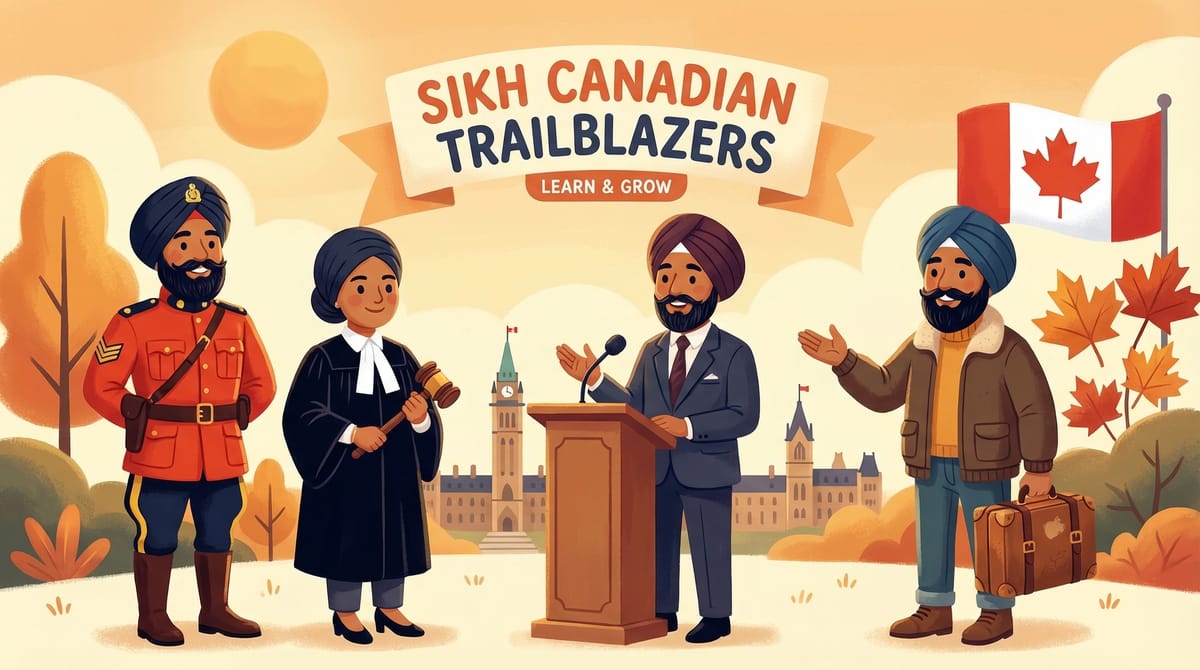
Every April, Canada celebrates Sikh Heritage Month — a time to recognise the contributions Sikh Canadians have made to this country for well over a century. From the very first Sikh settler who arrived in 1897 to leaders serving in Parliament, on the bench, and in uniform today, the story of Sikhs in Canada is one of courage, perseverance, and Seva (selfless service).
This guide highlights nine Sikh Canadians who broke barriers and made history. For each, you will find who they are, what they achieved, why it matters, and a question to explore together as a family.
Kesur Singh — The First Sikh Settler (1897)
Who he was: Kesur Singh was a Risaldar Major in the British Indian Army — a high-ranking cavalry officer.
What he achieved: In May 1897, Kesur Singh sailed from Hong Kong to Vancouver aboard the Empress of India. He was part of a group of Sikh cavalry officers travelling to London for Queen Victoria's Diamond Jubilee — a journey that highlights the early military connection between Sikhs and the British Crown, and the global service that brought Sikhs to distant shores long before formal immigration began. Kesur Singh is credited as the first Sikh to set foot in Canada. His arrival opened a door. Within a few years, Sikh immigrants began arriving in British Columbia in larger numbers, working in lumber mills, mines, and on the Canadian Pacific Railway. By the early 1900s, 95% of all South Asian immigration to Canada was Sikh.
Why it matters: Every community has a beginning. Kesur Singh's arrival in 1897 marks the start of a Sikh presence in Canada that is now over 125 years old. In 1997, the centenary of his visit was celebrated across the country.
Family discussion: One person's journey can change the path for thousands who come after. Can you think of a time when you did something first — and it helped someone else feel brave enough to follow?
Buckam Singh — A Soldier in Flanders Fields (1915)
Who he was: Buckam Singh was born in 1893 in Mahilpur, Punjab. He arrived in British Columbia at age 14, seeking opportunity.
What he achieved: In 1915, at age 22, Buckam Singh enlisted with the 59th Battalion of the Canadian Expeditionary Force, becoming one of roughly nine Sikh Canadians who served in the First World War. He fought in Flanders with the 20th Canadian Infantry Battalion, was wounded twice in battle, and is said to have been treated by Dr. John McCrae — the physician who wrote the poem In Flanders Fields. For his service, Buckam Singh was awarded the Victory Medal and the British War Medal. He contracted tuberculosis while recovering in England and died in a Kitchener, Ontario, hospital in August 1919.
Why it matters: For decades, Buckam Singh's story was forgotten. His grave in Kitchener is now the only known WWI Sikh Canadian soldier's military grave in Canada. His community rediscovered his story and now commemorates him with an annual Remembrance Day service. His sacrifice reminds us that Sikh Canadians have served this country from its earliest conflicts.
Family discussion: Buckam Singh's story was lost for many years before it was found again. Why do you think it is important to remember people who served, even if their stories are not well known?
Baltej Singh Dhillon — The First Turbaned RCMP Officer (1990)
Who he was: Baltej Singh Dhillon was born in 1966 in Malaysia and immigrated to Canada with his family in 1983.
What he achieved: In 1990, the Canadian government changed its policy to allow Sikh officers to wear turbans while serving in the Royal Canadian Mounted Police. Dhillon became the first RCMP officer to serve wearing a turban and keeping his beard when he joined in 1991. The decision was fiercely debated — over 150,000 people signed petitions opposing the change. For seven years, Dhillon was the only turbaned Mountie in the country. He served a full career with the RCMP and was appointed to the Canadian Senate in 2025.
Why it matters: Dhillon's case established that being Canadian and being Sikh are not in conflict. The Dastar (turban) is not merely cultural clothing — it is an obligatory article of faith for many Sikhs, representing equality, royalty, and a commitment to being recognizable in a crowd to help anyone in need. A Dastar belongs on the head of a Mountie just as much as a Stetson. His perseverance in the face of national opposition changed the RCMP — and Canada — permanently.
Family discussion: Baltej Singh Dhillon faced opposition from people who thought the turban did not belong in the RCMP. How would you feel if someone told you that part of your identity did not belong?
Harjit Sajjan — Canada's First Sikh Minister of Defence (2015)
Who he was: Harjit Singh Sajjan was born in 1970 in Bombeli, Punjab, India. His family immigrated to British Columbia when he was five years old.
What he achieved: Before entering politics, Sajjan served as a detective with the Vancouver Police Department and as a lieutenant-colonel in the Canadian Army. He was deployed to Bosnia-Herzegovina and served three tours in Kandahar, Afghanistan, where he was described as "the best single Canadian intelligence asset in theatre." He was awarded the Meritorious Service Medal in 2013. In 2015, he became Canada's first Sikh Minister of National Defence. He also invented and patented a gas mask that worked with a beard — a practical solution born from his commitment to both his Sikh identity and his military service.
Why it matters: Sajjan's career shows that identity and duty are not in competition. He served Canada at the highest levels of both the military and government without compromising who he was.
Family discussion: Harjit Sajjan found a creative solution when his turban and beard did not fit standard military equipment. When have you had to find a creative way to solve a problem?
Jagmeet Singh — First Non-White Federal Party Leader (2017)
Who he was: Jagmeet Singh was born and raised in Canada to Punjabi Sikh parents.
What he achieved: On October 1, 2017, Jagmeet Singh won the leadership of the New Democratic Party on the first ballot — becoming the first person from a visible minority group to lead a major federal political party in Canada. He previously served as a Member of Provincial Parliament in Ontario, where he introduced the bill that led to Ontario proclaiming April as Sikh Heritage Month in 2013. As federal NDP leader, he played a key role in Canadian politics for nearly eight years.
Why it matters: Leading a national political party is a position of enormous visibility. Singh's leadership normalised the image of a turbaned Sikh at the centre of Canadian political life. His earlier work on Sikh Heritage Month gave the entire community an annual platform for recognition.
Family discussion: Jagmeet Singh helped create Sikh Heritage Month when he was a provincial politician. If you could create a special month or day to celebrate something important to you, what would it be — and why?
Justice Palbinder Kaur Shergill — First Turbaned Sikh Judge in Canada (2017)
Who she is: Justice Palbinder Kaur Shergill is a lawyer and human rights advocate based in Surrey, British Columbia.
What she achieved: On June 23, 2017, Shergill was appointed to the Supreme Court of British Columbia in New Westminster — becoming the first turbaned Sikh to serve as a judge anywhere in Canada. Before her appointment, she ran her own law firm handling personal injury, civil litigation, and constitutional law. She was named Queen's Counsel in 2012 for exceptional contributions to the legal profession. As General Legal Counsel for the World Sikh Organization of Canada, she represented the WSO in landmark Supreme Court of Canada cases, including Multani v. Commission scolaire Marguerite-Bourgeoys (2006) — a case that upheld the right of Sikh students to wear Kirpans (articles of faith representing a commitment to justice and protection of the weak) in Canadian schools. This landmark decision shaped religious freedom laws for all Canadians.
Why it matters: Justice Shergill's appointment matters on two levels. She broke a barrier for Sikh representation in Canada's judiciary. And her earlier legal work directly shaped the rights and religious accommodations that Sikh Canadians rely on today.
Family discussion: Justice Shergill fought for the right of Sikh students to wear Kirpans in school. Why is it important to have people in the justice system who understand different communities and their traditions?
Navdeep Bains — Canada's Youngest Liberal MP (2004)
Who he is: Navdeep Singh Bains is a Canadian politician and member of the Liberal Party.
What he achieved: In 2004, at the age of 26, Bains was elected as the youngest Liberal Member of Parliament in Canada. He later served as Minister of Innovation, Science and Industry from 2015 to 2021, overseeing economic development, research policy, and the creation of Canada's Digital Charter in 2019. He was awarded the FCPA designation by CPA Ontario in 2016 for outstanding community leadership.
Why it matters: Bains entered Parliament at an age when many people are just starting their careers. His work on innovation and technology policy shaped how Canada approaches the digital economy. He demonstrated that young Sikh Canadians belong not just in politics, but in portfolios that shape the country's future.
Family discussion: Navdeep Bains became an MP at age 26. What is something you would like to achieve while you are still young — and what steps could you take to get there?
Ruby Sahota — Representing Brampton in Parliament (2015)
Who she is: Ruby Sahota is a Canadian politician and former criminal lawyer, born and raised in Toronto.
What she achieved: Sahota was elected as the Member of Parliament for Brampton North in 2015, bringing her legal background to the House of Commons. She has served her community in Parliament, representing one of the most diverse ridings in Canada.
Why it matters: Brampton is home to one of the largest Sikh communities outside of Punjab. Having representation in Parliament from someone who understands and comes from that community ensures that the voices of Sikh Canadians are heard where national decisions are made.
Family discussion: Ruby Sahota represents a riding with a large Sikh community. Why is it important for communities to see people who look like them in positions of leadership?
Bardish Chagger — First Woman to Lead the House of Commons (2016)
Who she is: Bardish Chagger's parents immigrated to Waterloo, Ontario, from Punjab, India, in the 1970s. Her family is Sikh.
What she achieved: Chagger was elected to Parliament in 2015. She was appointed Minister of Small Business and Tourism — becoming the first Sikh woman to serve in the Canadian federal Cabinet. In August 2016, she became the Leader of the Government in the House of Commons, making her the first woman ever to hold that position in Canadian parliamentary history. She later served as Minister of Diversity and Inclusion and Youth.
Why it matters: Chagger broke two barriers at once — as a Sikh and as a woman. Her career shows that the ceiling is not as low as it once was, and that representation matters on multiple fronts.
Family discussion: Bardish Chagger was the first woman to lead the House of Commons. Can you think of other "firsts" — in your school, your community, or the world — that helped open doors for others?
What Connects These Trailblazers
These nine Sikh Canadians come from different generations, different provinces, and different fields — the military, law, politics, and public service. What they share are values rooted in Sikhi:
- Courage — Every person on this list faced opposition, prejudice, or enormous personal risk. They moved forward anyway.
- Seva (selfless service) — From Buckam Singh's sacrifice in Flanders to Harjit Sajjan's deployments in Afghanistan, service to others runs through each story.
- Perseverance — Baltej Singh Dhillon waited seven years as the only turbaned Mountie. Buckam Singh's story was lost for decades before his community reclaimed it. These are people — and communities — that did not quit.
- Sarbatt da Bhalla (the well-being of all) — A central prayer in the Sikh Ardas, this principle runs through every story here. Each trailblazer worked not only for their own community but for a more just and inclusive Canada for everyone.
Sikh Heritage Month is a chance to celebrate these contributions — and to make sure the next generation knows the names of the people who walked this path first.
Key Dates
| Year | Event |
|---|---|
| 1897 | Kesur Singh arrives in Vancouver — the first recorded Sikh settler in Canada |
| 1915 | Buckam Singh enlists in the Canadian Expeditionary Force |
| 2004 | Navdeep Bains elected as the youngest Liberal MP at age 26 |
| 2013 | Ontario proclaims April as Sikh Heritage Month (through Jagmeet Singh's bill) |
| 2015 | Harjit Sajjan appointed Canada's first Sikh Minister of National Defence |
| 2015 | Bardish Chagger becomes the first Sikh woman in federal Cabinet |
| 2016 | Bardish Chagger becomes the first woman to serve as Leader of the House of Commons |
| 2017 | Jagmeet Singh becomes the first non-white leader of a major federal party |
| 2017 | Justice Palbinder Kaur Shergill appointed to the BC Supreme Court |
| 2019 | April proclaimed Sikh Heritage Month across Canada |
| 2025 | Baltej Singh Dhillon appointed to the Canadian Senate |
Sources
- Sikhism in Canada — Wikipedia
- Canadian Sikh Heritage — Sikh Figures
- Baltej Dhillon Case — The Canadian Encyclopedia
- Harjit Sajjan — The Canadian Encyclopedia
- Jagmeet Singh — The Canadian Encyclopedia
- Palbinder Kaur Shergill — The Canadian Encyclopedia
- Buckam Singh and Sikh Canadians in the First World War — The Canadian Encyclopedia
- Sikh Heritage Month — Wikipedia
- Bardish Chagger — Wikipedia
- Navdeep Bains — Wikipedia