How to Celebrate Sikh Heritage Month in Your Classroom
A practical, week-by-week guide for K-8 educators to bring Sikh Heritage Month into the classroom with activities, discussion prompts, and curated resources.
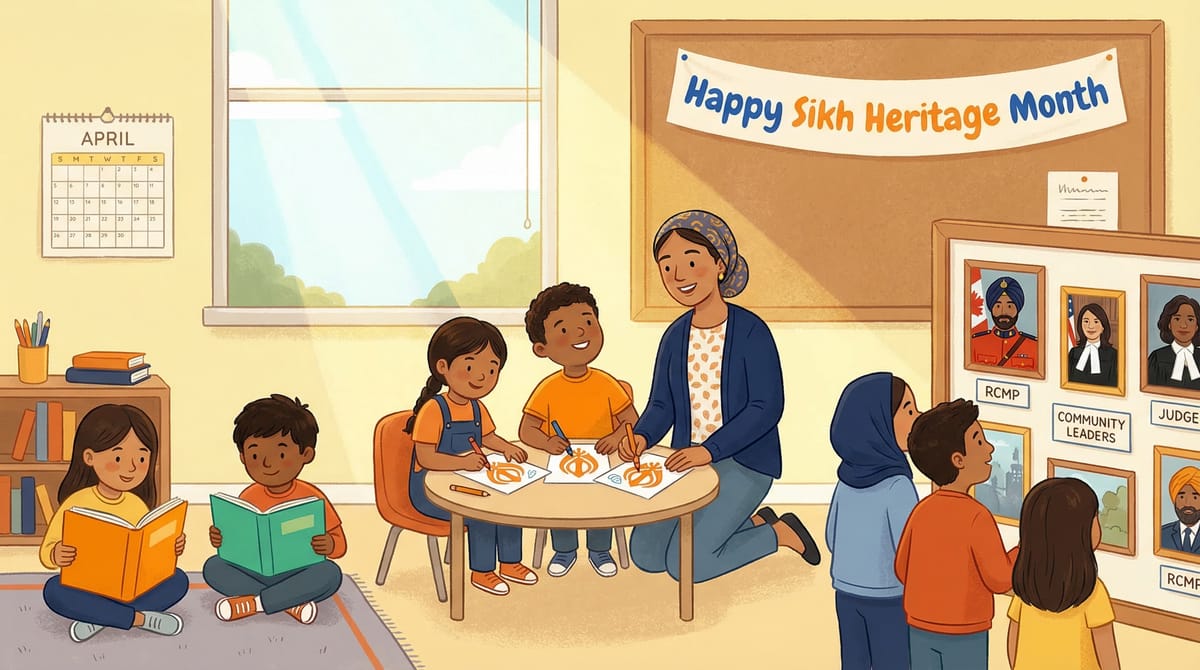
Every April, Canada recognizes Sikh Heritage Month — a time to explore the history, culture, and contributions of Sikh Canadians. For educators, it is an opportunity to bring meaningful, curriculum-connected learning into the classroom. This guide provides a practical, week-by-week plan for K-8 teachers who want to go beyond a single bulletin board and create an engaging month of discovery.
Why Sikh Heritage Month Matters in Schools
Sikh Heritage Month was officially established by the Canadian Parliament in 2019 through the Sikh Heritage Month Act. April was chosen to coincide with Vaisakhi (usually April 13 or 14), an ancient harvest festival that Guru Gobind Singh Ji transformed in 1699 into the birthday of the Khalsa — the community of initiated Sikhs — giving it a new spiritual meaning of sovereignty and equality.
For many students, this will be their first introduction to Sikhi. For Sikh students, it is a chance to see their heritage reflected in the school day. Either way, the goal is the same: build understanding through engagement, not just exposure.
Before You Begin: Quick Foundations
A few key concepts will anchor your students' learning throughout the month:
- Ik Onkar — One Creator. The foundational belief in Sikhi is that there is one creative force connecting all people.
- Seva (selfless service) — Serving others without expecting anything in return.
- Langar (community kitchen) — A practice where everyone sits together and eats together, regardless of background. It is one of the most visible expressions of Sikh values.
- The Five Kakaars (5 Ks) — Five articles of identity worn by initiated Sikhs: Kesh (uncut hair), Kangha (wooden comb), Kara (steel bracelet), Kachera (cotton undergarment), and Kirpan (an article of faith representing a commitment to justice, protection of the weak, and the struggle against oppression).
These concepts will come up repeatedly across activities, so introducing them early gives students a shared vocabulary.
Week-by-Week Activity Plan
Week 1: Who Are the Sikhs? (Introduction and Context)
Focus: Build foundational knowledge about Sikhi and the Sikh community in Canada.
Activities:
- K-3: Read aloud a picture book about Sikh identity or the Gurdwara (Sikh place of worship). Follow up with a drawing activity where students illustrate one thing they learned.
- Grades 4-8: Explore the three pillars of Sikhi — Naam Japna (remembering the Divine), Kirat Karo (earning an honest living), and Vand Chhakna (sharing the fruits of one's honest labor with those in need). Have students create a short presentation or poster connecting one pillar to their own life. For a deeper discussion, introduce the concept of Miri-Piri — the Sikh principle that spiritual devotion (Bhakti) and standing up for justice (Shakti) go hand-in-hand. This helps students understand why Sikhs are sometimes called "Saint-Soldiers" — meditation and action are not opposites, but two sides of the same commitment.
Discussion prompt: "What does it mean to serve your community without expecting anything in return? Can you think of a time someone did that for you?"
Maastarji resource: Start with the Sikh Heritage Month Resource Hub for background posters and visual references.
Week 2: Symbols, Identity, and the Five Kakaars
Focus: Understand Sikh identity through the Five Kakaars and the significance of the turban.
Activities:
- K-3: Read selections from the Five Kakars book series by Simran Kaur, available on Maastarji. Each book introduces one of the five articles of Sikh identity through illustration and storytelling. Pair the reading with the Sikh Heritage Month coloring pages — students can color while discussing what each Kakaar represents.
- Grades 4-8: Research project — each student or group is assigned one of the Five Kakaars. They research its meaning, history, and significance, then present to the class. Encourage students to think about what objects or symbols represent their identity. Pay special attention to the Dastar (turban) — it is not a hat or cultural clothing, but a Crown of Equality. Historically, only kings and rulers wore turbans. The Sikh Gurus gave the turban to everyone to signal that every human being has innate royalty and dignity. This is a powerful message about identity, anti-bullying, and self-worth that resonates with students of all backgrounds.
Discussion prompt: "Why do people wear things that show who they are or what they believe in? What does your appearance say about what matters to you?"
Week 3: Sikh Contributions to Canada
Focus: Explore the history and contributions of Sikh Canadians.
Activities:
- K-3: Timeline activity — use simple illustrated cards showing key moments in Sikh Canadian history (arrival in B.C. in the early 1900s, the Komagata Maru, Sikh Heritage Month becoming law in 2019). Students arrange them in order and discuss one event as a class.
- Grades 4-8: Research notable Sikh Canadians across fields — politics, military service, business, arts, sports, and community leadership. Create a classroom "Wall of Contributions" display. This connects well to Social Studies curriculum expectations around Canadian identity and multiculturalism.
Discussion prompt: "What does it mean to contribute to your country? How do communities that have faced discrimination still find ways to give back?"
Maastarji resource: The Sikh Heritage Month Resource Hub includes historical posters and visual timelines.
Week 4: Celebrate and Reflect
Focus: Bring everything together with interactive activities and reflection.
Activities:
- K-3: Coloring and creative day — use the Sikh Heritage Month coloring pages as a calming, reflective activity. Students can write or dictate one sentence about what they learned this month on the back of their coloring page. Display them in the hallway.
- Grades 4-8: Take the Sikh Heritage Month Quiz as a class activity — project it on the board and work through it together, or have students complete it individually on devices. It is a low-pressure way to review what they have learned. Follow up with a written reflection: "What surprised you most about what you learned this month?"
- All grades — Classroom Seva Project: Put Vand Chhakna into action with a collective Seva project. Ideas include a food drive for a local food bank, a card-making session for residents at a nearby long-term care home, or assembling care packages for a community shelter. Moving from learning about Seva to living it allows students of all backgrounds to experience the Sikh value of selfless service first-hand.
Discussion prompt: "How does learning about another community help us understand our own?"
Curriculum Connections
These activities are designed to connect with Canadian provincial curriculum expectations. Here are some common touchpoints:
| Subject | Connection |
|---|---|
| Social Studies | Canadian identity, multiculturalism, community contributions, rights and responsibilities |
| Language Arts | Read alouds, creative writing, research presentations, discussion circles |
| Visual Arts | Coloring pages, poster design, symbol exploration |
| Health / Character Ed | Empathy, identity, community service, respect for diversity |
| History | Immigration history, the Komagata Maru, Canadian legislation (Sikh Heritage Month Act) |
Book Recommendations
These books work well for classroom read alouds and independent reading:
- The Five Kakars series by Simran Kaur (available on Maastarji) — a beautifully illustrated series introducing each article of Sikh identity. Ideal for K-4.
- P Is for Punjab by Deepa Kaur Sahota — an alphabet book exploring Punjabi culture.
- The Sikh Gurus: Illustrated Biographies — age-appropriate introductions to the ten Sikh Gurus for older readers.
- A Lion's Mane by Navjot Kaur — a story about a Sikh boy and his hair, great for conversations about identity and belonging.
When selecting books, look for titles written by Sikh authors that present Sikhi on its own terms rather than through a comparative religion lens.
Tips for Educators
- Use Punjabi terms. Introduce words like Seva, Langar, and Gurdwara — students enjoy learning vocabulary from other languages, and it shows respect for the community.
- Invite a guest speaker. If your school has Sikh families, ask if a parent or community member would be willing to speak to the class. A personal connection is more powerful than any worksheet.
- Avoid the single-day approach. A full month of activities, even brief ones, builds genuine understanding. A single "Sikh Heritage Day" risks reducing a rich tradition to a checkbox.
- Let Sikh students lead — but do not put them on the spot. Some may want to share; others may not. Never single out a student as the classroom representative of their community.
- Connect to universal themes. Equality, service, honest work, and standing up for what is right are values every student can relate to, regardless of background.
Resources at a Glance
| Resource | Best For | Link |
|---|---|---|
| Sikh Heritage Month Resource Hub | Background reading, posters, visual resources | Visit |
| Sikh Heritage Month Quiz | Week 4 class review activity | Take the Quiz |
| Sikh Heritage Month Coloring Pages | K-4 creative activities | Download |
| The Five Kakars Book Series | K-4 read alouds on Sikh identity | Explore |