Sikh Heritage Month Resource Hub
A Digital Toolkit for Educators and Students to Explore, Preserve, and Share Sikh History.

Welcome to our community resource page dedicated to celebrating Sikh Heritage Month in Canada. This page was created as a central digital library to collect, preserve, and share educational posters and visual resources for students and educators across Canada.
Our goal is to provide high school students with ready-to-use materials that raise awareness about the rich history, vibrant culture, and enduring contributions of the Sikh community to the Canadian fabric. By making these resources accessible, we hope to foster an environment of inclusion, curiosity, and mutual respect within our schools.
Core Values: The Three Pillars of Sikhism
To understand the Sikh way of life, one must look at the three foundational pillars established by Guru Nanak Dev Ji, the founder of Sikhism. These principles are not just religious guidelines but are practical ethics that encourage a balanced, selfless, and purposeful life. In a high school setting, these values resonate deeply with the themes of mental well-being, social justice, and community service.
1. Naam Japna (Meditation & Remembrance)

This pillar emphasizes the importance of staying connected to the Divine (Waheguru) through constant remembrance and meditation. In a busy world, it teaches students the value of mindfulness, inner peace, and maintaining a moral compass.
2. Kirat Karni (Honest Living)

This principle encourages earning one’s livelihood through honest, hard work and physical or mental effort. It promotes integrity, personal responsibility, and the dignity of labor, rejecting exploitation or dishonesty in any form.
3. Vand Chako (Sharing with Others)

The third pillar is the spirit of selfless giving. It mandates sharing one’s honest earnings, time, and resources with those in need. This is most visibly seen in the practice of Langar (free community kitchen) and Seva (selfless service), teaching us that we are all part of one human family.
Threads of Heritage: From Struggle to Celebration
To understand the Sikh experience today, we must look at the milestones that shaped Sikh community’s identity and presence in Canada. This section explores the deep spiritual roots of Vaisakhi, the vibrant public expression of Nagar Kirtans, and the solemn history of the Komagata Maru, all of which culminate in our annual celebration of Sikh Heritage Month. Together, these topics tell a story of resilience, faith, and an unwavering commitment to the values of justice and equality.
Sikh Heritage Month

Celebrated every April, Sikh Heritage Month recognizes the long-standing contributions of Sikh Canadians to the country’s social, economic, and cultural fabric. It is a dedicated time to promote intercultural dialogue and celebrate shared values of equality, social justice, and religious tolerance.
Vaisakhi

Vaisakhi commemorates the 1699 formation of the Khalsa Panth by the tenth Guru, Guru Gobind Singh Ji. This historic event, known as the Amrit Sanchar, saw the initiation of the Panj Pyare (Five Beloved Ones) and established a distinct Sikh identity centered on devotion and the fight for equality.
Looking for family activities? Visit our Vaisakhi Celebration Hub for a quiz, coloring pages, book recommendations, and a comprehensive family guide to Vaisakhi and the birth of the Khalsa.
Nagar Kirtan: A Procession of Unity
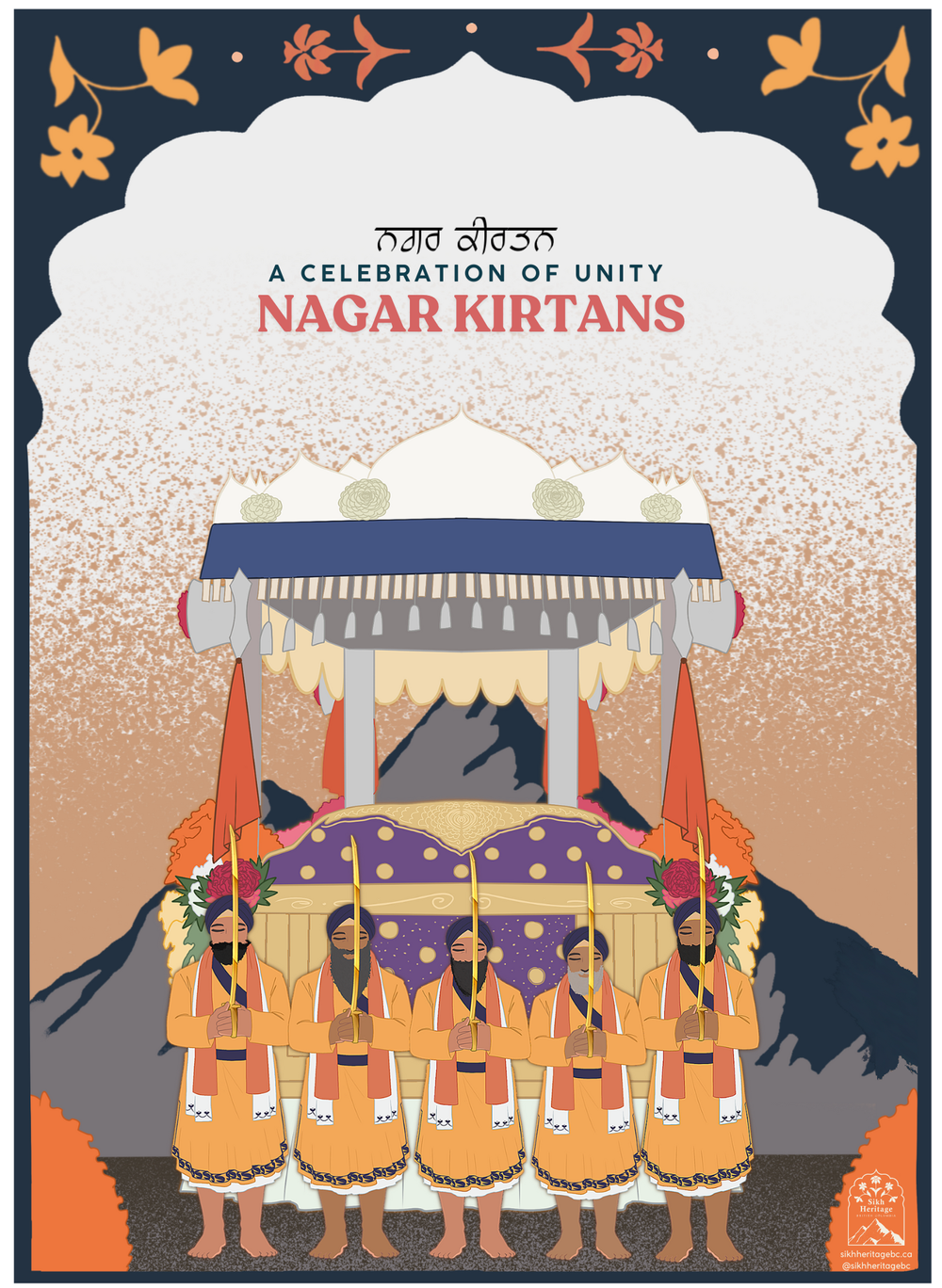
Nagar Kirtan is a vibrant community procession that brings the message of the Guru into the streets. Led by the Panj Pyare (Five Beloved Ones) and the Guru Granth Sahib Ji, the event features devotional singing, martial arts demonstrations (Gatka), and the distribution of free food (Langar) to all, regardless of background. It serves as a powerful public expression of Sikh values, promoting equality, humility, and community service.
The Komagata Maru Incident (1914)

In 1914, the steamship Komagata Maru arrived in Vancouver with 376 passengers, mostly Sikhs and Punjabi, who were denied entry due to racist “continuous journey” laws. After a two-month standoff in the harbor, the ship was forced back to India, where many passengers faced tragic deaths or imprisonment. Today, this event serves as a powerful symbol of the early Sikh struggle for justice and civil rights in Canada.
Resilience and Radiance: Celebrating Sikh Trailblazers
The history of the Sikh diaspora is defined by individuals who have harmonized their faith with a relentless drive to serve and innovate. This section spotlights iconic personalities—from pioneering doctors and social justice activists to world-class athletes and artists—who have broken barriers while upholding the core values of Seva (selfless service) and Chardi Kala (eternal optimism). Their stories serve as a powerful reminder for students that heritage is not just about the past, but a foundation for making a profound global impact today.
Dr. Sarjit Siddoo: A Legacy of Medicine and Seva

Dr. Sarjit Siddoo was a trailblazer who became one of the first South Asian women to graduate from a Canadian medical school in 1950. Her journey is a powerful example of how academic ambition can be used to uplift humanity and bridge cultures.
Risaldar Major Kesur Singh: Canada’s First Sikh Settler

Risaldar Major Kesur Singh is recognized as the first Sikh to settle in Canada, arriving in Vancouver in 1897 as a decorated officer in the British Indian Army. His historic journey paved the way for the vibrant Sikh community that has shaped the Canadian landscape for over 125 years.
Bibi Harnam Kaur: A Pioneer of Family Reunification

Bibi Harnam Kaur was one of the first Sikh women to settle in Canada, arriving in 1912 after a courageous legal battle against discriminatory “continuous journey” immigration laws. By refusing to be turned away, she set a historic precedent that challenged the separation of families and paved the way for South Asian women and children to join their loved ones in Canada. Her legacy is a testament to the strength and resilience of the women who helped transform the Sikh diaspora into a permanent and flourishing community.
Senator Baltej Singh Dhillon: A Legacy of Inclusion

Baltej Singh Dhillon broke significant barriers as the first RCMP officer to wear a turban, winning a historic legal battle for religious freedom in 1991. After a distinguished 30-year career in law enforcement, he was appointed to the Senate of Canada, exemplifying a life dedicated to justice and public service.
Justice Palbinder Kaur Shergill: A Landmark for Canadian Justice

Justice Palbinder Kaur Shergill made history in 2017 as the first turbaned Sikh to be appointed to a superior court in Canada. Before her appointment to the Supreme Court of British Columbia, she was a prominent human rights lawyer who spent decades advocating for constitutional rights and religious freedoms. Her career serves as a powerful inspiration for students, proving that commitment to justice and heritage can reach the highest levels of the legal system.
Conclusion: A Living Legacy
The stories and resources gathered here are more than just a chronicle of the past; they are the blueprints for a future built on courage, service, and integrity. From the legal battles of the early pioneers to the modern-day achievements of trailblazers in medicine and law, the Sikh experience in Canada is a testament to the power of staying true to one’s roots while branches grow to reach new heights.
As you explore these materials during Sikh Heritage Month, we hope you feel empowered to carry forward the values of Seva and Chardi Kala in your own communities. Your heritage is a living legacy—how will you choose to write its next chapter?
Ontario Curriculum Connections
The resources in this hub align with the following Ontario secondary school courses. Educators can use these materials to meet specific curriculum expectations:
Civics and Citizenship (CHV2O)
- The “Three Pillars of Sikhi” connect to discussions of civic responsibility, community participation, and ethical citizenship
- Senator Baltej Singh Dhillon’s story illustrates the relationship between individual rights and the Canadian Charter of Rights and Freedoms
- The Komagata Maru incident supports analysis of how Canadian laws and policies have evolved over time
Canadian History Since World War I (CHC2D)
- The Komagata Maru provides a case study of early 20th-century immigration policy and systemic discrimination
- Bibi Harnam Kaur and Kesur Singh contextualize the South Asian Canadian experience alongside other immigrant communities
- Baltej Singh Dhillon’s 1991 legal victory fits within broader discussions of multiculturalism policy
World Religions and Belief Traditions (HRT3M/HRF3O)
- The Three Pillars offer an introduction to Sikh theology and ethical practice
- Vaisakhi and the formation of the Khalsa illustrate the development of religious identity and community
- Nagar Kirtan demonstrates the relationship between ritual practice and public expression of faith
Challenge and Change in Society (HSB4U)
- Justice Palbinder Kaur Shergill and Dr. Sarjit Siddoo support discussions of systemic barriers and institutional change
- The hub as a whole can prompt analysis of how communities preserve and transmit cultural heritage
Equity and Social Justice (HSE4M)
- The Komagata Maru and continuous journey legislation illustrate historical mechanisms of exclusion
- The trailblazer profiles support examination of intersectionality — how gender, race, and religion interact in shaping individual experiences
- The Three Pillars framework (particularly Vand Chako) connects to contemporary discussions of mutual aid and solidarity
How to Use This Hub: From Classroom to Community
These resources are designed to be more than just digital images—they are tools for advocacy and education. Here is how you can use them during Sikh Heritage Month and throughout the school year:
For Students: Become a Storyteller
- Present Your History: Use the biographies of trailblazers like Dr. Sarjit Siddoo or Bibi Harnam Kaur for your next Social Studies or Social Justice presentation.
- The “One-Minute” Share: Choose one “Pillar of Sikhism” or one historical event and share a 60-second summary during your school’s morning announcements.
- Visual Advocacy: Download the posters and ask your teachers if you can feature them on the “Sikh Heritage Month” bulletin board in your hallway.
For Educators: Create an Inclusive Space
- Primary Source Analysis: Use the Komagata Maru section to lead a classroom discussion on how immigration policies have evolved in Canada over the last century.
- Ethical Discussions: Use the “Three Pillars” as a framework for discussing modern civic engagement, mental health (Naam Japna), and social responsibility (Vand Chakna).
- The Power of Representation: Displaying Justice Palbinder Kaur Shergill or Senator Baltej Singh Dhillon in your classroom sends a powerful message to students of all backgrounds that they belong at the highest levels of leadership.
For Everyone: Spark a Conversation
- Share Digitally: Post a link to this hub on your social media or school Discord. Use the hashtag #SikhHeritageMonth to join the national conversation.
- Reflect & Write: Pick one trailblazer and write a short reflection on how their struggle or success makes your life in Canada different today.
Resource Credits
The educational posters featured throughout this hub were created by the Sikh Heritage BC Society and are used with appreciation. Their full poster collection, along with additional resources, is available at sikhheritagebc.ca/shbc-posters.
Related Resources
- The Story of Jaito Da Morcha — A children's book about the Sikh struggle for religious freedom at Jaito
- Learn Punjabi for Kids — Resources for learning the Punjabi language and Gurmukhi script
- Interactive Gurmukhi Games — Fun games to help students learn Gurmukhi letters
Share this guide
Join the Discussion
Have thoughts or questions about this guide? Share your feedback or discuss with others on X.
Discuss on X