Your Family's First Nagar Kirtan: What to Expect
A warm, practical guide for families attending a Nagar Kirtan for the first time — what it is, what happens during the procession, and how to prepare.
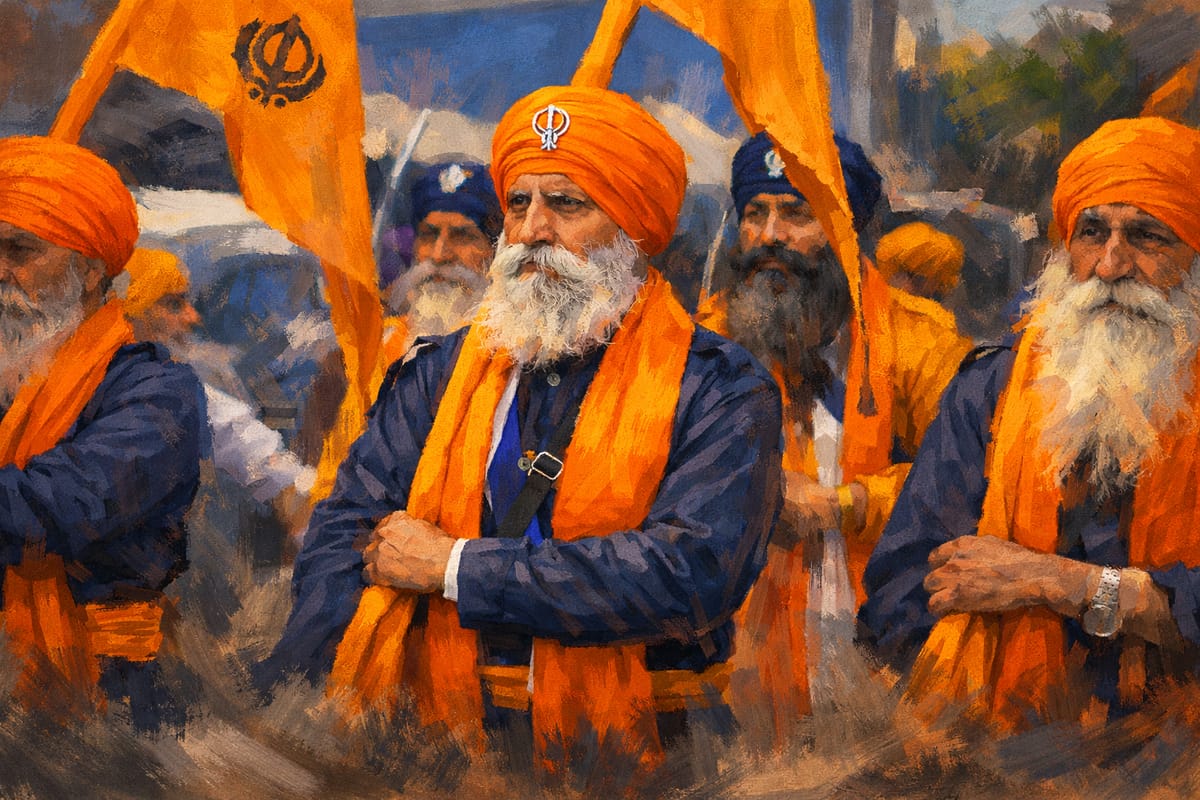
The short answer: A Nagar Kirtan is a Sikh procession through the streets of a town or city, centred on Sri Guru Granth Sahib Ji being carried on a beautifully decorated float. It is led by the Panj Pyare (the Five Beloved Ones) and filled with Shabads (sacred hymns), Gatka (martial arts) demonstrations, and Langar (community kitchen) Seva along the route. Everyone is welcome, regardless of background — and everything you need is provided through the Seva of the community.
What Is a Nagar Kirtan?
The term "Nagar Kirtan" comes from two Punjabi words: Nagar (town or neighbourhood) and Kirtan (the singing of sacred hymns). Together, it describes a procession that carries the Guru's Word through the streets and into the wider community.
Nagar Kirtans are most commonly held around Vaisakhi (an ancient harvest festival that Guru Gobind Singh Ji transformed in 1699 into the birthday of the Khalsa, giving it a new spiritual meaning of sovereignty and equality), but they also take place to mark other significant dates in the Sikh calendar. In cities across Canada, Vaisakhi Nagar Kirtans have grown into some of the largest public gatherings of the year, drawing hundreds of thousands of people from every background.
At the Heart of the Procession
The centre of every Nagar Kirtan is Sri Guru Granth Sahib Ji — the Living Word and Eternal Guru of the Sikhs. Sri Guru Granth Sahib Ji is respectfully placed on a Palki Sahib (a royal palanquin), beautifully decorated with flowers, fabrics, and the Nishan Sahib (the Sikh flag). This is because the Guru is treated as Sacha Patshah — the True Sovereign. Sewadars (volunteers) attend to Sri Guru Granth Sahib Ji throughout the procession, waving the Chaur Sahib (a ceremonial whisk, a traditional mark of royalty) over the scripture, performing Kirtan, and ensuring the utmost respect is maintained.
Leading the procession are the Panj Pyare — the Five Beloved Ones — dressed in traditional saffron Bana (attire). They represent the five volunteers from different castes who were the first to offer their lives and join the Khalsa at Vaisakhi 1699, answering Guru Gobind Singh Ji's call with absolute courage. Their presence at the front of every Nagar Kirtan — often with unsheathed swords — is a living reminder of the sovereignty of the Khalsa and the rejection of caste, a core Sikh value that resonates strongly with Canadian multiculturalism.
What Happens During the Procession
A Nagar Kirtan is a feast for all the senses:
- Shabads and Kirtan — Hymns from Sri Guru Granth Sahib Ji are sung throughout the procession, both from the main float and by groups of musicians walking along the route. The music ranges from traditional Raag Kirtan to more contemporary styles.
- Gatka demonstrations — Young Sikhs perform Gatka, the traditional Sikh martial art, with swords, sticks, and other weapons. These displays of skill and discipline are a crowd favourite and reflect the martial spirit of the Khalsa.
- Langar Seva along the route — One of the most remarkable aspects of a Nagar Kirtan is the sheer abundance of food and drink provided along the entire route. Families and community groups set up stalls offering everything from samosas and pakoras to chai, pizza, fruit, and sweets. This is Langar (the community kitchen) extended into the streets — a tradition rooted in the Sikh principle of Vand Chhakna (sharing the fruits of one's honest labor with those in need). All of it is provided through Seva (selfless service).
- Community and colour — Expect to see vibrant turbans, traditional Punjabi clothing, floats from local Gurdwaras, children's groups, and community organizations. The atmosphere is joyful and welcoming.
What to Wear
There is no dress code, but a few things to keep in mind:
- A head covering is required when near Sri Guru Granth Sahib Ji. Bring a scarf, bandana, or any cloth that can cover your head. Many Nagar Kirtans also have volunteers distributing head coverings along the route.
- Wear comfortable clothes and shoes. The procession can cover several kilometres and lasts several hours. Layers are a good idea — spring weather in Canada can be unpredictable.
- Saffron and blue are traditional colours often worn during Vaisakhi Nagar Kirtans, but there is no obligation. Wear whatever is comfortable.
What to Bring
Here is the most important thing to know: you do not need to bring anything. Everything — food, drinks, head coverings — is provided through the Seva of the Sangat (community). This is not a commercial event. There are no ticket booths, no vendors charging for food. The entire Nagar Kirtan runs on the volunteer spirit of the community.
If you want to be prepared, comfortable walking shoes and sun protection are the only practical items worth considering.
Etiquette and Respectful Behaviour
A Nagar Kirtan is a spiritual procession, even as it is a celebration. A few points of etiquette:
- Cover your head when near the float carrying Sri Guru Granth Sahib Ji. This is a sign of respect.
- Do not consume alcohol or tobacco anywhere along the route. Nagar Kirtans are strictly substance-free events.
- Be respectful near the Palki Sahib (float). Sri Guru Granth Sahib Ji is the Living Word and Eternal Guru of the Sikhs. Remove your shoes if you approach the float area. You will see people bowing (Matha Tekna) before the Palki Sahib — this is an act of submission to the Guru's wisdom. Visitors are welcome to bow if they feel comfortable, or simply stand respectfully with folded hands.
- Accept food graciously. When someone offers you Langar or Prashad (sacred food), it is offered with love. Accept it with both hands if you can.
- Everyone is welcome. Nagar Kirtans are open to all — Sikh and non-Sikh, of every faith, culture, and background. You do not need an invitation.
Explaining the Nagar Kirtan to Children
For young children, the Nagar Kirtan is an unforgettable sensory experience — music, martial arts, colourful floats, and an endless supply of treats. A few things that might help:
- The big float in the middle carries Sri Guru Granth Sahib Ji — the Living Word and Eternal Guru of the Sikhs. Sikhs treat Sri Guru Granth Sahib Ji with the same love and respect you would show to a beloved teacher.
- The five people in saffron robes at the front are the Panj Pyare. They represent the first five Sikhs who showed incredible bravery at the birth of the Khalsa over 300 years ago.
- All the food being given out is called Langar. In Sikhi, sharing food with everyone — without asking who they are — is one of the most important things a person can do.
- The people doing martial arts are performing Gatka, a tradition that goes back centuries.
Children tend to remember what they experience far more than what they are told. Walking in a Nagar Kirtan, eating Langar on the street, watching Gatka — these become lasting memories.
2026 Nagar Kirtan Dates in Canada
| City | Date | Notes |
|---|---|---|
| Vancouver | Saturday, April 12 | Organized by the Khalsa Diwan Society. Route begins and ends at the Ross Street Gurdwara. |
| Surrey | Saturday, April 18 | One of the largest Nagar Kirtans in the world, with approximately 500,000 attendees. Route begins at Gurdwara Dashmesh Darbar. |
| Toronto | Sunday, April 26 | Also known as Khalsa Day. Organized by the Ontario Sikhs and Gurdwaras Council. Route runs along Lakeshore Blvd to City Hall. |
| Calgary | Saturday, May 9 | A growing celebration with a full Nagar Kirtan procession and Langar for all attendees. |
Many other cities across Canada hold Nagar Kirtans throughout April and May. Check with your local Gurdwara for dates and routes.
Related Resources
- Vaisakhi & Khalsa Sajna Diwas: A Family Guide — The history of Vaisakhi and the birth of the Khalsa
- The Panj Pyare: Lives, Sacrifice, and Eternal Legacy — A deeper look at the Five Beloved Ones
- Gurdwara Etiquette: A Quick Reference for Young Sikhs — Help children learn about respectful behaviour at the Gurdwara and during processions
- Sikh Heritage Month Resource Hub — Educational posters and resources for schools