Featured
Fateh Singh and the Last Pound
When Fateh Singh sees a man sleeping in a doorway on The Broadway, he can't stop thinking about it. A charity run organised with Ruby and Oliver leads him to empty his piggy bank — the Lego fund he's been filling for months — and discover what Vand Chakna really means.
The Doorway
Fateh Singh saw him on the way home from school.
Dad was walking fast — he always walked fast on Fridays, because Friday meant picking Fateh up, then stopping at the corner shop for milk, then getting home before Dadi ji's programme started. They were on The Broadway, weaving past the fruit stalls and the fabric shop with the gold mannequins in the window, when Fateh Singh stopped.
A man was sitting in the doorway of the old shoe shop — the one that had closed last summer, its windows papered over with faded adverts. He had a sleeping bag pulled up to his waist, green and thin, the kind you'd take camping but not the kind that would keep you warm in March. A paper cup sat on the pavement in front of him with a few coins inside. He was reading a book — a proper paperback, the pages soft and bent — and he didn't look up.
Fateh Singh stared. Not because the man was scary. Because the man had no shoes.
His feet were wrapped in two plastic bags, knotted at the ankles. Through the plastic, Fateh could see grey socks, the kind Dad wore to work. But no shoes. The shoe shop behind him had a sign in the window that said CLOSING DOWN — EVERYTHING MUST GO, and the man in its doorway had no shoes.
"Come on, Fateh." Dad's hand was on his shoulder.
He walked. But he looked back. The man turned a page. His fingers were red from the cold.
That night, Fateh Singh lay in bed and stared at the ceiling. The streetlight outside his window made the same orange stripe across the wall it always did. His piggy bank sat on the shelf — a ceramic pig, painted blue, heavy with coins. He'd been filling it for four months. Birthday money from Nani ji. Fifty-pence pieces for tidying his room. A two-pound coin he'd found wedged behind the sofa cushion. He was saving for a Lego Space Shuttle. Forty-two pounds. He had thirty-eight.
He wasn't thinking about the Lego.
He was thinking about the plastic bags.
The Empty Doorway
Saturday morning. Fateh Singh and Dad walked to the Gurdwara Sahib.
He looked for the man. The doorway of the old shoe shop was empty. The sleeping bag was gone. The paper cup was gone. There was nothing left except a damp patch on the concrete where the sleeping bag had been, and a single page torn from a book, caught against the shutters by the wind.
That was worse. When the man was there, he was a person — someone with a book and a paper cup and red fingers. Now the doorway was just a doorway again. The man was somewhere in London, and nobody walking past would know he'd ever been there.
"Dad," said Fateh Singh. "Where did the man go?"
"Which man?"
"The one from yesterday. In the doorway."
Dad looked at the empty doorway. His face did the thing it did when he was thinking something he wasn't sure how to say — his jaw tightened, just a little, the way it did when he was fixing something difficult.
"He probably moved on," Dad said. "People who sleep rough don't usually stay in one place."
"But why does he sleep outside?"
"He doesn't have a home right now, Fateh."
"But why doesn't someone help him?"
"People try. There are shelters. There are charities. But there aren't enough spaces for everyone, and some people fall through the gaps."
"But why isn't it enough?"
Dad stopped walking. He looked down at Fateh Singh — properly, the way he did when the question had pushed past the answers he had ready.
"Because not enough people think it's their problem," he said quietly. "Until they do."
They walked the rest of the way in silence. A plane rumbled overhead, low and heavy, heading into Heathrow. The Gurdwara's white dome appeared above the rooftops. The gate was already open.
At Langar hall, Fateh Singh sat cross-legged in the pangat — the rows — and ate his dal and parshada. Next to him, an elderly uncle in a grey cardigan. Next to the uncle, a woman with a baby on her lap. Next to her, a man in paint-splattered overalls who looked tired. Everyone eating the same food, sitting on the same floor, served by the same hands.
He watched the sevadars move between the rows — pouring water, serving dal, offering more parshada to anyone who held out their plate. Nobody asked who you were. Nobody checked whether you deserved to eat. You sat down, and you were fed.
Fateh Singh thought about the doorway on The Broadway.
What if the door was always open?
Ruby's Idea
Monday. Lunch.
Ruby was eating a cheese sandwich on the bench outside the classroom. Fateh Singh sat down next to her. He told her about the man in the doorway, the plastic bags on his feet, the empty doorway the next morning.
Ruby stopped chewing.
"That's really sad," she said. Not in a dramatic way — in the quiet way she said things when she actually meant them.
"I keep thinking about him," said Fateh Singh. "But I don't know what to do. I'm six. What can I do?"
Ruby put her sandwich down. She had her thinking face on — nose scrunched, one eyebrow up.
"My sister's class did a charity run last year," she said. "For the food bank. They ran laps in the park and people sponsored them. They raised, like, two hundred pounds."
"A charity run?"
"Yeah. We could do one. Get people to sponsor us. Give the money to a shelter." She bounced her tennis ball once. "We're not too young. My sister was only eight."
Fateh Singh thought about this. Running in a park. Asking people for money. It felt small — how would running in circles help a man with no shoes?
"It's something," said Ruby, reading his face. "It's not nothing."
She was right. It was not nothing.
By the end of lunch, they had Oliver. By the end of the day, they had a plan. Mrs. Okafor said they could use the school field on Saturday if a parent supervised. Dad said he'd come. Ruby's mum said she'd help set up a table with water and biscuits.
That evening, Fateh Singh sat at the kitchen table with a piece of paper and a marker. At the top, he wrote:
CHARITY FUN RUNFor people who don't have a homeSaturday 22nd March — School Field — 10amSponsor us!
He drew a picture of three stick figures running. One had a blue patka. One had a ponytail. One was Oliver.
Dadi ji looked over his shoulder. "What's this?"
He told her. The man in the doorway. Ruby's idea. The run.
She nodded slowly. She didn't say "well done" or "that's very kind." She said: "How much do you want to raise?"
"I don't know. Ruby said her sister's class got two hundred pounds."
"And what will the money buy?"
He hadn't thought about that. Sponsors would want to know. What does the money go to? He'd assumed it went to a shelter, but what did a shelter buy with two hundred pounds? Food? Blankets?
"I'll find out," he said.
"Good," said Dadi ji. "Because giving is easy. Giving well is harder."
The Gurdwara Announcement
Wednesday. Fateh Singh went to the Gurdwara after school with Dadi ji.
He'd been thinking about what Dadi ji had said. Giving well. He'd looked up the local shelter online with Dad's help — Westside Community Shelter. They needed warm clothes. Coats, jumpers, socks, shoes. The basics. Not just money — actual things that kept people warm.
He asked Dadi ji if he could make an announcement after Ardas.
She raised an eyebrow. "You want to stand up in front of the sangat and speak?"
"Yes."
"You know there will be three hundred people?"
"I know."
She looked at him for a long time. Then she spoke to the Bhai Sahib, who spoke to the committee secretary, who said yes — two minutes, after Ardas, before Langar.
Fateh Singh stood at the front. His voice was small in the big hall.
"My name is Fateh Singh. I'm in Year Two at Southall Primary. Me and my friends are doing a charity run on Saturday for people who don't have a home." He paused. His hands were shaking, so he held the paper tighter. "The shelter needs warm clothes. Coats, jumpers, socks, and shoes. If you have any to give, you can bring them to the school on Saturday. And if you want to sponsor us, my dad has the form."
He stopped. The hall was quiet. Three hundred faces looking at him. He folded the paper and walked back to Dadi ji. His hands were still shaking.
Afterwards, four aunties came up to Dadi ji and said they had bags of clothes to sort. An uncle said he'd donate twenty pairs of socks from his shop on The Broadway. The committee secretary said the Gurdwara would match whatever the children raised, pound for pound.
Dadi ji squeezed Fateh Singh's hand. "See?" she said. "You opened a door. The sangat walked through it."
That night, something else happened.
Fateh Singh was in his room, looking at the piggy bank. Blue ceramic pig. Heavy with coins. Four months of saving. Thirty-eight pounds towards the Lego Space Shuttle.
He picked it up and shook it. The coins rattled. He set it back down.
He didn't decide anything that night. But the piggy bank felt different. Heavier. Not from the coins — from the question sitting on top of it.
The Piggy Bank
Friday evening. The run was tomorrow.
The sponsor sheet had twenty-three names. Ruby had got her parents, her grandparents, and three neighbours. Oliver had got his mum, his stepdad, and the man who ran the chip shop on Uxbridge Road. Fateh Singh had got Dad, Mum, Dadi ji, Mrs. Kapoor from next door, and the uncle from the corner shop. The pledges added up to eighty-seven pounds.
Not bad. But not two hundred.
He sat on his bed with the piggy bank in his lap. He turned it upside down and pulled the rubber stopper from the bottom. Coins poured onto the duvet — a mess of silver and copper, two-pound coins and twenty-pence pieces and the heavy fifty-pence pieces he liked best because they felt important.
He counted. Thirty-eight pounds and forty pence.
If he added his piggy bank, they'd have a hundred and twenty-five pounds. And the Gurdwara would match it — so two hundred and fifty.
The Lego Space Shuttle was forty-two pounds. He was four pounds short. Another month, maybe six weeks, and he'd have had it.
He thought about the man in the doorway. The plastic bags on his feet. The book with soft pages. The red fingers.
He thought about the empty doorway the next morning. How a person could be there and then not be there, and the world just carried on walking past.
He thought about what Dadi ji had said at the Gurdwara last year, the Saturday he'd poured water in the Langar hall: Seva is when the 'you' goes away.
When he'd poured water for the sangat, the giving had happened without thinking — his hands moved, and the 'him' part went quiet. This was different. This was holding thirty-eight pounds in your hands and choosing to let it go. This was the 'you' very much present — wanting the Lego, feeling the weight of the coins, knowing exactly what he was giving up. Seva had crept in sideways. This, he had to walk towards with his eyes open.
He put the coins back in the piggy bank. All of them. Pressed the stopper in.
Then he carried it downstairs and set it on the kitchen table.
"That's for tomorrow," he said to Dad, who was washing up.
Dad turned off the tap. He looked at the piggy bank. He looked at Fateh Singh. He didn't say "Are you sure?" or "You don't have to." He just dried his hands on the tea towel and nodded.
"Okay, Fateh."
That was enough.
The Run
Saturday. Ten o'clock. The school field.
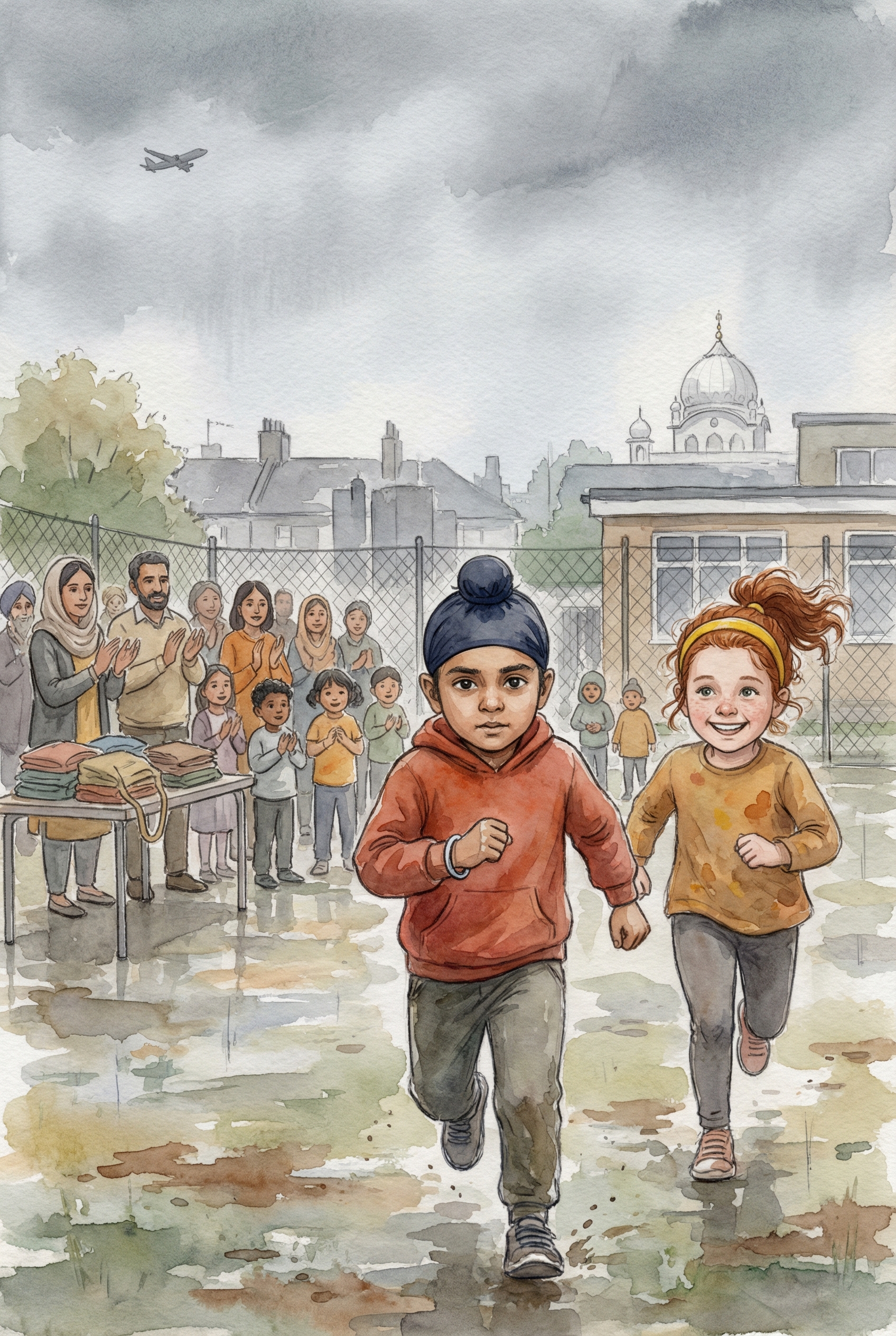
The morning was cold and grey — proper London grey, the kind where the clouds sit so low they feel like a ceiling. A plane rumbled overhead. The grass was damp.
But people came.
Ruby was there first, in her trainers and a yellow headband. Oliver arrived with his mum, carrying a tray of flapjacks. Mrs. Okafor came even though it was a Saturday. Dad set up the sponsor table near the gate. Mum came after her night shift, still in her coat, and stood with a flask of tea.
Then the sangat arrived.
The four aunties from the Gurdwara came with bin bags full of clothes — coats, jumpers, scarves, gloves. The uncle from The Broadway brought a box of socks, still in their packaging. Two teenagers Fateh Singh didn't recognise carried a folding table and set it up by the fence. They started sorting the clothes into piles — men's, women's, children's.
Dadi ji arrived last, walking slowly up the path in her white chunni. She was carrying a steel container.
"Cha," she said. "For everyone." She set the tea on the table and poured the first cup for Ruby's mum, who said, "Oh, you're an angel."
Dadi ji smiled. "I'm a Kaur. Close enough."
The run was simple. Three laps of the school field. About a mile. Ruby had measured it with her dad's phone. You didn't have to run — you could walk, jog, skip, whatever you liked. Oliver said he was going to sprint, but Oliver said that about everything.
Before the start, Mrs. Okafor gathered everyone in a circle. "This isn't a race," she said. "It's a run. You're not running against each other. You're running for someone you've never met." She looked at Fateh Singh. "Fateh, do you want to say something?"
He hadn't planned to. But he thought about the man in the doorway, and the words came.
"There's a man I saw on The Broadway," he said. "He was sitting in a doorway, reading a book. He didn't have any shoes. Just plastic bags on his feet." He paused. "I don't know his name. I don't know where he is now. But I keep thinking about him. That's why we're running."
Nobody spoke for a moment. Then the girl from Year Five squeezed her little brother's hand and said, "Let's go."
Fateh Singh stood at the starting line. Ruby on his left. Oliver on his right. Behind them, eleven other children — some from their class, some younger, the Year Five girl and her brother, a boy from Ruby's street who'd come because Ruby asked.
"Ready?" said Mrs. Okafor, holding up a whistle.
Ruby bounced on her toes. Oliver shook his arms like a boxer. Fateh Singh looked out across the field — the damp grass, the parents by the fence, the table of donated clothes, Dadi ji pouring cha for an uncle he didn't know.
Mrs. Okafor blew the whistle.
They ran.
Oliver sprinted. Of course he did. He was fifty metres ahead by the first corner, arms pumping, face fierce. By the second corner, he was walking, hands on his knees, saying, "I'm fine. I'm fine."
Fateh Singh ran with Ruby. Not fast. Steady. Their feet hit the grass at the same time. The cold air burned his lungs in a good way — the way cold water feels when you're properly thirsty. A plane passed above them, landing lights blinking through the grey. The grass was soft and wet under his trainers, and with every step, small flecks of mud kicked up behind him.
On the first lap, he noticed things. The uncle from the corner shop had come — he was standing by the fence in his brown jacket, clapping. Mrs. Kapoor from next door was there too, holding a thermos. The Year Five girl ran ahead of them, her little brother riding on her back for the first twenty metres before she put him down and he ran on his own, legs pumping, face delighted.
On the second lap, something happened.
He stopped noticing things. He stopped thinking about the sponsor sheet. He stopped thinking about the total. He stopped thinking about the Lego Space Shuttle and the empty piggy bank and the man in the doorway. He just ran. His feet, the grass, the cold air.
It was like the water jug in the Langar kitchen. His hands moved, the world moved, and the 'him' part went quiet.
On the third lap, the parents clapped. Oliver had recovered and was running again — not sprinting this time, just running, steady, alongside the boy from Ruby's street. Dadi ji was standing by the finish line with her tea, her white chunni bright against the grey morning. Mum was filming on her phone. Dad had his hands in his pockets, watching with that quiet look — the one that meant he was proud but wasn't going to say it out loud.
The last hundred metres. His legs were heavy. His patka was crooked. His chest burned. But Ruby was beside him, and behind them the field was full of children running — not against each other, but together, for someone they'd never met.
Fateh Singh crossed the line. His trainers were caked in mud. His hoodie was damp with sweat and drizzle.
Ruby crossed next to him. She was grinning. "We did it."
Oliver limped in thirty seconds later. "I definitely won the first lap," he said.
The Year Five girl's brother crossed last, walking the final stretch with enormous concentration, one foot carefully in front of the other. Everyone clapped. He bowed.
Telling Ruby
They sat on the bench afterwards, eating flapjacks. The field was emptying. Ruby's mum was folding the tablecloth. The teenagers were loading the bags of clothes into an uncle's van — the shelter would get them this afternoon.
"Final count," said Dad, walking over with the sponsor sheet. "Eighty-seven pounds in sponsorship. Plus Fateh's piggy bank — thirty-eight pounds forty. The Gurdwara committee confirmed they'll match the total. That's two hundred and fifty pounds and eighty pence."
Oliver punched the air. "Two hundred and fifty! That's massive!"
Ruby looked at Fateh. "You gave your piggy bank?"
"Yeah."
"The Lego money?"
"Yeah."
She was quiet for a moment. She peeled a bit of flapjack apart. "Do you miss it?"
He thought about this honestly. The coins in his hands last night. The weight of them. Four months of saving, fifty-pence piece by fifty-pence piece. He'd known exactly what he was giving up.
"Yeah," he said. "I do."
"So was it worth it?"
He looked at the bags of clothes being loaded into the van. Coats, jumpers, socks. Things that would keep someone warm tonight. He thought about the uncle from The Broadway and his box of socks. The aunties and their bin bags. The Gurdwara matching every pound. All those people, walking through the door he'd opened.
"The weird thing is," he said, "my piggy bank was thirty-eight pounds. But it turned into two hundred and fifty."
Ruby frowned. "That's maths, not weird."
"No, I mean — I gave thirty-eight. But because I gave it, other people gave too. And the Gurdwara matched it. My thirty-eight became everyone's two-fifty." He paused. "Dadi ji calls it Vand Chakna. Sharing what you have."
"Is that like Dasvandh? The one-tenth thing?"
He was surprised she remembered. He'd told her about it once, weeks ago, after a Gurdwara visit.
"Sort of. Dasvandh is giving a tenth of what you earn. But Vand Chakna is bigger — it's the idea that what you have isn't just yours. It's for sharing."
Ruby chewed her flapjack. "Like how your Dadi ji's tea wasn't just for her."
He laughed. "Exactly like that."
"That actually makes sense."
"Don't sound so surprised."
The Shelf
That evening, Fateh Singh sat on his bed.
The piggy bank was on his shelf. The same shelf where the Lego Space Shuttle was supposed to go. He'd planned it — the shuttle would sit between his Lego fire station and his Lego helicopter, and the piggy bank would go to the back because he wouldn't need it any more.
Instead, the shelf had the fire station, the helicopter, and the blue ceramic pig. Empty. Light. He picked it up with one hand — yesterday it had taken two.
He didn't put it away.
Downstairs, Dadi ji was watching her programme. Dad was in the kitchen, fixing the handle on the cutlery drawer. Mum was asleep — she had an early shift tomorrow. Through his bedroom window, the streetlight made its orange stripe across the wall. A plane rumbled over, low and steady.
He thought about the man in the doorway. He didn't know his name. He didn't know where he was tonight. He didn't know if the coats and the socks and the two hundred and fifty pounds would reach him — or if they'd reach someone else, someone he'd never meet.
That was the hard part. When he'd poured water in the Langar hall, he'd seen the faces — the elderly woman who nodded, the man with the rucksack, the baby with enormous eyes. This was different. He'd given, and the giving had gone out into the world like a stone dropped in water, and the ripples had spread past the point where he could see them.
He set the piggy bank back on the shelf. Empty, between the fire station and the helicopter. Where the Lego Space Shuttle was supposed to be.
It was lighter than anything on the shelf.
It was the heaviest thing in the room.
Discussion Questions
Let's Talk About It: Have you ever seen something that bothered you and didn't know what to do about it? What happened next?
Let's Think About It: Fateh Singh gave away his Lego savings. He says he misses the money but that his thirty-eight pounds "turned into two hundred and fifty." What does he mean? Is that just maths, or something more?
Let's Think About It: Dadi ji said "giving is easy — giving well is harder." What do you think she meant? What's the difference?
Let's Talk About It: The sangat at the Gurdwara donated clothes and matched the money the children raised. Why do you think so many people helped after Fateh Singh made his announcement?
Let's Try It: This week, find one thing you can share — your time, something you own, or something you can do for someone. Notice how it feels, and whether other people join in.
Word Meanings
| Word | Meaning |
|---|---|
| Ardas | A Sikh prayer — a humble request to Waheguru |
| Cha | Tea |
| Dadi ji | Paternal grandmother |
| Dal | A lentil dish |
| Dasvandh | Giving a tenth of what you earn to the community |
| Dastar | Turban |
| Gurdwara | Sikh place of worship — "the door to the Guru" |
| Langar | Free community kitchen at the Gurdwara where everyone eats together |
| Nani ji | Maternal grandmother |
| Pangat | Sitting together in rows, usually during Langar |
| Patka | A head covering worn by Sikh boys |
| parshada | Flatbread |
| Sangat | Congregation; the Sikh community |
| Seva | Selfless service — helping others without wanting anything in return |
| Sevadars | People who perform Seva — volunteers |
| Vand Chakna | Sharing what you have with others |
| Waheguru | God; the Wonderful Creator |
About This Story
This is the fourth story in the Fateh Singh series — five stories set in London, each woven around one of the five core values of Sikhi. In this story, Vand Chakna — sharing with others — is explored through a child's encounter with homelessness and the community action that follows. The charity run storyline reflects a growing movement of young people organising fundraisers in their communities, and the sangat's response mirrors the Sikh tradition of collective generosity — where one person's initiative becomes the whole community's effort.
Fateh Singh is Simran Kaur's cousin. Where Simran discovers her faith by feeling, Fateh Singh discovers his by asking. Together, they represent two paths to the same place.
Explore More
- Raising Children with the Wisdom of Japji Sahib — A guide to the five foundations of Sikhi, including Vand Chakna
- Fateh Singh and the Saturday Kitchen — The first Fateh Singh story, about Seva
- How to Be a Volunteer — The Art of Selfless Service — What Seva means and how to practise it