
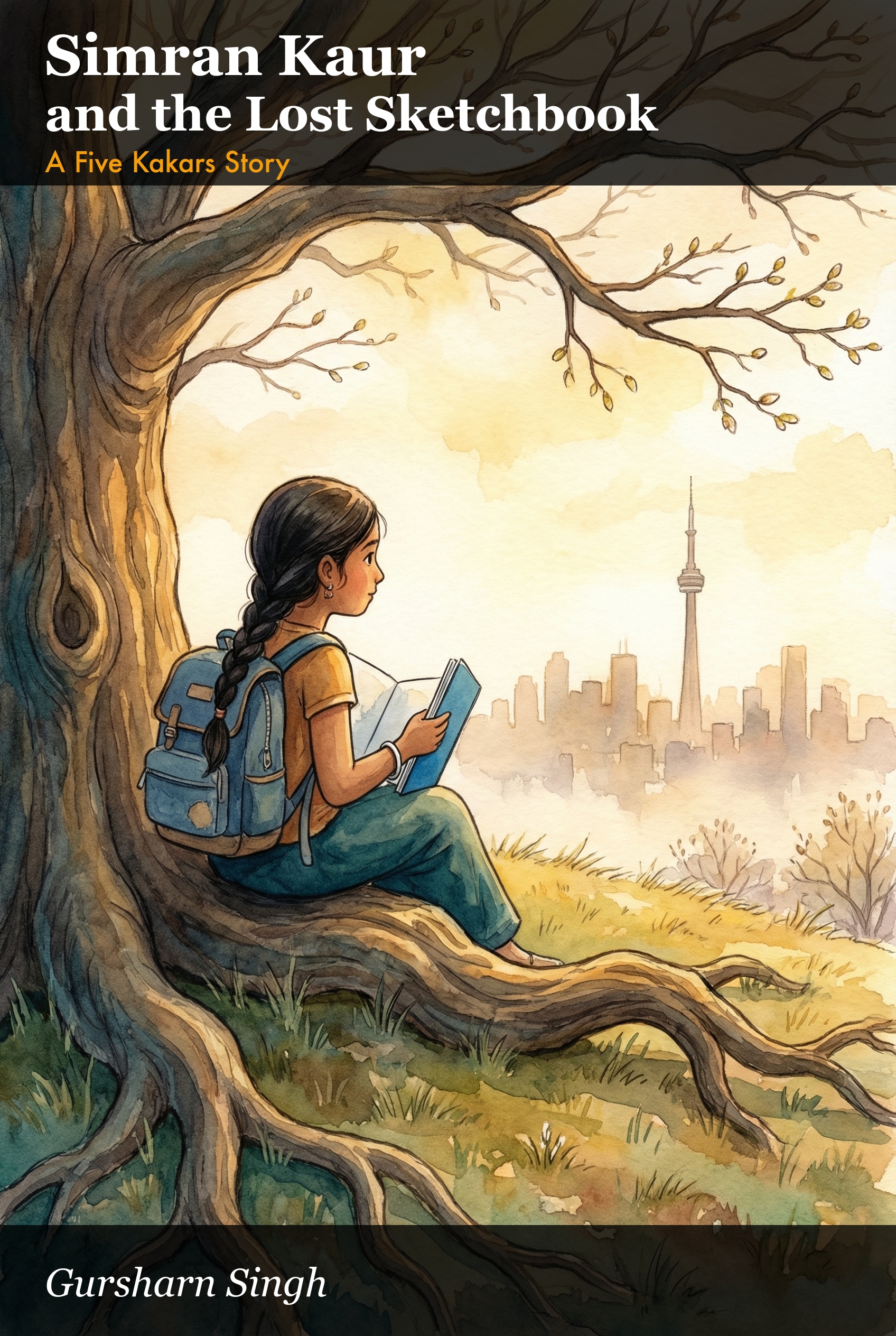
Simran loses her sketchbook in High Park and is sure it's gone, until a boy she has never met walks up a hill to bring it back. When he asks about the bracelet on her wrist, Simran explains her kara in her own words for the first time: a circle with no end, like a kindness that reaches people you've never met. A free Sikh story for ages 4–12.
Fourteen Red Doors
Simran Kaur counted everything.
Fourteen red doors on her street — she had counted them in September, October, and again this morning just to be sure. Twelve fridge magnets shaped like provinces. Seven streetlights visible from her bedroom window. Thirty-two steps from her front door to the school bus stop.
She counted because counting helped. It turned a big, noisy world into something she could hold.
Their street was the third one off Kennedy Road, in Springdale — the northeast part of Brampton where the houses were brick with wide driveways, the sidewalks were wide enough for the aunties to walk in pairs doing their sair on summer evenings, and the signs at the plaza had Gurmukhi alongside English. Punjabi music drifted from cars on Saturday mornings. The white dome of Gurdwara Dasmesh Darbar was visible over the rooftops two blocks north. Simran had counted its windows once: forty-eight.
Today was Saturday in March, and Maya was at the door by nine.
“Ready?” Maya said. She was carrying her sketchbook under one arm and wearing a coat two sizes too big — her mum’s old one, olive green, with pockets deep enough to hold pencils.
“Almost,” said Simran.
Maya came in and sat at the kitchen table, arranging her pencils, while Simran’s mum finished braiding Simran’s hair — thirty-eight strokes of the kanga, always thirty-eight. Simran’s dad was in the front hall tying his shoes. He had said on Thursday that he would take them wherever the birds were, and Dad did not say things like that unless he meant them.
“Maya,” said Mum, “how’s the bird project coming?”
“Twenty-three drawings so far.” Maya aligned her pencils by grade. “I’m submitting the best six to the school exhibition. The theme is things you notice. So I’m going to notice birds in High Park, because that’s where the herons are.”
“High Park it is,” said Dad from the hall.
Mum tied off the braid and rested her hand on Simran’s head for a second. “I’m at the Gurdwara this morning,” she said. “Come home and tell me what you counted.”
Ethan was waiting at the end of the driveway. He was in their class — he sat behind Simran and built things out of straws that almost stood up and then didn’t — and this morning he had his hands in his pockets and was already wearing his opinion on his face.
“Parks,” said Ethan, “are basically just flat grass with trees. You could do the same thing at the school field.”
“There are no herons at the school field,” said Maya, without looking at him.
“There are pigeons.”
“Pigeons don’t count.”
“That seems unfair to pigeons,” said Ethan. He fell into step beside them.
Dad walked a little ahead with the transit card already out, which was his way of not being in the middle of a conversation about pigeons.
Simran counted the houses to the bus stop: eleven.
The Bus
Seven stops from their neighbourhood to the High Park gate. Simran sat by the window and counted them. Dad sat in the seat behind with a book he wasn’t really reading, the way he did when he was letting them be their own group.
Outside, the city changed as they rode — the Punjabi grocery signs and the fabric shops gave way to coffee shops, then taller trees, then the wide green edge of the park. The Gurdwara’s dome was briefly visible between buildings as they turned onto the highway, and Simran counted: there, then gone.
Her own sketchbook was in her backpack. It was small and green and spiral-bound — her dad had given it to her in September — and it had forty pages, of which she had filled thirty-two. Each page had a date at the top, because Simran had made that rule for herself. She wrote things she noticed. Numbers, mostly, and observations. Not drawings, because Simran was not a drawer the way Maya was.
Page one said: I count things. It helps.
She had not shown anyone page one.
Maya leaned over. “Are you thinking about the herons?”
“I’m thinking about whether herons and geese use the same part of the pond.”
“Different parts,” said Maya immediately. “Herons are solitary. Geese are social. They don’t share territory well.”
“How do you know that?”
“I’ve been drawing birds for three months.”
Ethan, across the aisle, looked up from his phone. “What if the heron and the goose both want the same spot?”
“The heron wins. They’re bigger.”
“That seems unfair to the goose.”
“Nature isn’t a fairness system,” said Maya.
Simran looked at the window. Maya talked about birds like she knew them personally. Twenty-three drawings, six going to an exhibition. Simran had thirty-two pages of observations that nobody would ever read. That felt different — not worse, exactly, but something she couldn’t name.
She counted the stops again. Seven. Always seven.
The Park
High Park in March was mostly brown and grey, but the bare trees let you see the shape of things clearly — every branch visible, the sky between them wide and pale.
Dad found a bench on the path with a clear view of the water and told them to stay where he could see them. Then he took out his book again.
They went to the pond first. No herons. Twelve geese — Simran counted immediately — three ducks, and a crow walking in circles on a low branch that Ethan said was suspicious. Maya sat on a bench and started sketching the crow. Her pencil moved quickly; the crow appeared on the page in a few confident minutes.
Simran opened her sketchbook.
March 8. 12 geese, 3 ducks, 1 crow. Cold. No herons.
She watched the geese. They moved in a loose formation across the water, drifted apart, then drifted back together. She wrote: The group breaks up when there’s no direction. It only forms when they’re going somewhere.
Then she stopped and looked at that sentence. She wasn’t sure what she’d meant by it.
One goose had a grey smudge under its right eye, like a smear of ash. She counted its wing-beats as it crossed the pond: eleven. The others took thirteen or fourteen. She wrote: Goose with grey face: 11 wing-beats, shore to shore. Faster than the others?
“You’re counting the wing-beats?” said Ethan, who had come to look over her shoulder.
“Yes.”
“Why?”
“Because this one seems faster and I want to know if it’s always faster or just today.”
Ethan looked at the goose, then at the page. “That’s actually kind of interesting,” he said. It sounded like it surprised him.
The Stone Bridge
They crossed the stone bridge to the far side of the pond. The bridge was arched and old, and the sound changed underneath it — lower, more contained, like the water was talking to itself.
Simran counted twenty-two stones in the arch as she walked under it. Then she forgot the number and counted again: twenty-two.
On the far bank, Maya found a vantage point on the hill and settled in. Ethan sat on a rock and watched a family feeding the geese. Dad came over the bridge behind them and stood at the top of the bank where he could see all three. Simran walked along the bank, watching the grey-faced goose, which had crossed back and was on this side now.
She had set her backpack down at the bank’s edge. She wasn’t sure when she stopped watching the goose and started watching the pond instead, or when Ethan shouted her name — but suddenly she was running back and the bag was open on the ground and everything was wrong.
She unpacked it completely. Water bottle, one. Gloves, two. Lunch bag, three. Old sunscreen from last summer, four.
The green sketchbook was gone.
She checked again: same four things.
“It must have slid out,” said Maya, already scanning the path.
“Or someone picked it up,” said Ethan.
“Nobody takes a child’s sketchbook,” said Maya. “It’s worth nothing to anyone else.”
“Unless they wanted to read it.”
Simran felt something drop in her chest. Thirty-two pages. The grey-faced goose with eleven wing-beats. The sentence about the V-formation only working when you’re going somewhere. Page one: I count things. It helps.
She had not shown anyone page one.
The Search
They retraced. Simran counted her steps back to the bridge — one hundred and eight — then along to Maya’s bench, then to the stone bridge again. No sketchbook. Her dad called the park information centre. They didn’t have it.
“Someone probably picked it up thinking it was lost property,” said Maya. “They might hand it in.”
“The park is big,” said Ethan. “They might have already left.” He paused. “I think it’s probably gone, Simran. I’m sorry.”
Simran sat down on a bench. She looked at her hands.
He was probably right. She knew he was probably right. There were hundreds of people in the park today, and whoever had picked up the sketchbook — if they’d picked it up — could be anywhere by now. The probability of it coming back was small.
“I know,” she said. Her voice came out flat. “You’re probably right.”
It felt terrible to say. Saying it made it real in a way that searching didn’t.
“Thirty more minutes,” said Maya. “Systematic. Café, main gate, upper path.”
They looked. The café’s lost-and-found had nothing. The main gate had nothing. Dad pinned a paper notice to the board: Green sketchbook, lost near the pond, March 8. Please call— with Simran’s dad’s number.
By one o’clock they stood at the stone bridge again. Dad had his hand on Simran’s shoulder. She was not crying, but she was the kind of not-crying that is close.
“Can we put a note at the other gate?” she said.
“Already done,” said Dad.
She looked at the pond. Twelve geese on the far bank, the grey-faced one at the edge looking at the water. Eleven wing-beats shore to shore. She thought: at least she’d counted those before the sketchbook was gone. At least they were still true even without the page to put them on. You could count something and the counting happened even if you lost the record of it.
She counted the stones in the arch again. Twenty-two. She didn’t write it down anywhere. It was still true.
“We’ll come back next weekend if you want,” said Maya. She wasn’t offering this as comfort exactly — she was offering it as a plan. Maya believed in plans.
“The geese will probably still be here,” said Ethan. He was also trying. In his own way.
“The grey-faced one might be,” said Simran. She looked at the goose. It had not moved from the water’s edge. “I don’t know where they go.”
“South,” said Ethan. “I think. But these ones might stay.”
Simran nodded. She filed this away: some geese stay.
The Playground
On the way to the hill, they passed the playground at the park’s western edge. There were small children on the swings and a family eating lunch on a picnic bench. Dad stopped at a second information board and posted another note.
Simran sat on the edge of a low wooden structure and counted the swings. Six. All of them occupied.
Ethan sat next to her. He wasn’t looking at the swings — he was looking at his shoes, which meant he was thinking.
“Do you think people actually return things?” he said.
“Sometimes,” said Simran.
“I mean specifically. What percentage of lost things do you think get returned?” He looked up. “Honest answer.”
Simran considered. “Phones, probably more. Wallets with ID, maybe more. A child’s sketchbook full of counting and no name in it — I don’t know. Less.”
“That’s what I thought too.” Ethan pulled at a thread on his sleeve. “But whoever picked it up has opened it by now. That’s just what people do.” He looked up. “And if they’re the kind of person who notices things, they’d see it wasn’t rubbish. Somebody sat down and wrote all that on purpose. You’d be able to tell it mattered to someone, even if you didn’t know who.”
Simran looked at him. “You think the right person might find it.”
“I think there are more right people than we think.” He shrugged. “I could be wrong.”
Maya came over with her sketchbook. She had drawn the crow during the search without stopping — her hands kept going even when the rest of her was worried. “I think it comes back,” she said. “I don’t have evidence. I just think so.”
“That’s not how thinking works,” said Ethan.
“It’s how hoping works,” said Maya. “Which is different.”
Simran looked at her kara. The sun had gone behind a cloud and the steel was flat and grey. No bright line today. Just a circle.
“Come on,” said Dad from the information board. “Let’s eat on the hill.”
The Hill
They went up the hill for lunch because Maya said the light was best from there for sketching the pond, and because sometimes it helped to be higher than your problem.
From the top, Simran could see the whole morning laid out below — the pond, the stone bridge, the bench where Maya had sketched, the far bank where she’d lost the sketchbook. She could trace every step.
Ethan ate his sandwich. Maya drew. Simran sat with her back against a tree and her arms around her knees.
“If someone finds it,” she said to her dad, “would they give it back?”
“I don’t know,” said Dad. “I hope so.”
“There’s nothing in it they’d want.” She thought. “There’s just counting. And noticing. And page one says I count things. It helps.” She paused. “If someone read that, would they think it was worth returning?”
Dad didn’t answer right away. He was looking at the pond.
Simran turned her kara on her wrist. She had a strange thought: she could give the kara to whoever returned the sketchbook, as a thank-you. It was the most valuable thing she was carrying. It would be the most genuine thank-you she could imagine.
But she couldn’t give it. She knew that without being entirely sure why. It wasn’t like her gloves, which she could give. It wasn’t like the four dollars in her pocket. The kara was different. It was hers in a different way.
She looked at it. Steel. A circle. No beginning that she could find, no end.
Why couldn’t you give it away even if you wanted to?
She thought about it differently. If someone asked her: what is that bracelet? she would say: it’s a kara. Not I have a kara — it’s a kara. Like asking what is that? about her nose or her hair. It was part of the sentence that made her Simran.
Maybe that was the answer. You couldn’t give it to someone else the way you couldn’t give them your name.
She was still thinking about this — the circle, the name, the thing you couldn’t separate from yourself — when Ethan sat up.
“Someone’s coming up the path,” he said.
The Return
A boy was walking up the hill — older than them, maybe eleven or twelve, striped scarf, moving quickly like he had somewhere to be. Under his arm was a green sketchbook.
Simran stood up before she’d decided to.
The boy came to the top and held it out. “Is this anyone’s? I found it by the pond bank. The pages inside have dates and counting — I figured it was someone’s, not rubbish. You were the only kids I saw with books today.”
“That’s mine.” Simran took it. Her hands were shaking slightly.
She didn’t know what to say next. Thank you felt too small. She thought about the kara again — the instinct to give it — and the fact that she couldn’t.
“Thank you,” she said. “I didn’t think someone would bring it back.”
He shrugged. “It seemed like it mattered. The first page says it helps.” He looked at her wrist. “Can I ask about that bracelet? I kept noticing it by the pond.”
Simran looked down at the kara. She opened her mouth.
She knew facts about it: one of the Five Kakars, Guru Gobind Singh Ji, worn always. But standing on a hill in March with the boy waiting, the facts didn’t come first.
What came first was the shape.
“It’s a circle,” she said slowly. “No beginning, no end.” She looked at it. “I think it means — something that doesn’t stop. Something that goes all the way around.” She paused. “Waheguru’s love. That’s our word for God. A circle is how it works — it reaches every person. It doesn’t run out.”
The boy was quiet for a moment. “Is that why you can’t take it off?”
“I think — yes. Because the love doesn’t stop, so the reminder doesn’t stop either.”
He nodded, like he was putting something away carefully inside his head. “That makes sense.” Then he went back down the path.
Dad was very still. Maya had put down her pencil.
“That’s what it means,” Dad said quietly, not like a teacher — like someone confirming a thought he’d had for years.
Simran sat back down in the grass. She opened the sketchbook to the blank page after page thirty-two and wrote:
A boy walked up a hill to give a stranger’s sketchbook back. Nothing in it for him. Maybe that’s what the circle means — it goes all the way around to people you’ve never met.
Counting New Things
On the bus home, Maya was quiet in the way she was when something was settling inside her. Pencil held loosely. Not drawing yet.
“I think that’s the best possible ending to a bad morning,” she said.
“I thought it was gone,” said Ethan. “I was wrong.” He said it the same way he said other things — directly, without too much fuss.
Simran looked out the window. The white dome of Gurdwara Dasmesh Darbar came back into view as they crossed into Brampton, between the bare March trees. Seventeen traffic lights from High Park to their stop.
At home, Dad made chai and they sat at the kitchen table — Simran, Maya, Ethan, Mum and Dad — and Simran told the whole story again. When she got to the part about the kara, she said what she’d said on the hill: a circle, no beginning, no end, something that goes all the way around.
“That’s exactly it,” said Dad. He wrapped his hands around his mug. “The kara is a reminder that Waheguru’s presence is like a circle — it doesn’t stop, it doesn’t choose some people and not others. The reason you wear it always, not just at the Gurdwara, not just when someone might notice, is because that love is always there.”
“Is that why I couldn’t give it away?” said Simran. “Even as a thank-you?”
“Yes. It isn’t something you have. It’s something you are.”
Mum said: “The boy’s kindness was already part of the circle.”
Simran thought about that. The V-formation of geese that only forms when they’re going somewhere together. A boy walking up a hill because a sketchbook seemed like it mattered to someone. The kara turning in the March light while she tried to find words.
Later, in her room, she added one more line to the sketchbook:
Things that go all the way around: circles. Love. Today.
Then she counted the blank pages remaining. Fourteen. She had fourteen pages left to fill.
Gurbani Verse
ਨਾ ਕੋ ਬੈਰੀ ਨਹੀ ਬਿਗਾਨਾ ਸਗਲ ਸੰਗਿ ਹਮ ਕਉ ਬਨਿ ਆਈ ॥
Naa ko bairee nahee bigaanaa sagal sang ham ka-o ban aa-ee.
“No one is my enemy, no one is a stranger — with all, I am at peace.”
— Guru Arjan Dev Ji, Ang 1299, Sri Guru Granth Sahib Ji
Discussion Questions
Let’s Talk About It: Ethan said the sketchbook was probably gone and Simran agreed. It turned out he was wrong. When someone gives us an honest, realistic answer, is that helpful even when it’s wrong?
Let’s Think About It: Simran wanted to give her kara as a thank-you — but realized she couldn’t. What is the difference between something you have and something you are?
Let’s Talk About It: The boy walked up a hill to return a sketchbook to a stranger. There was nothing in it for him. Why do you think he did it?
Let’s Think About It: Simran wrote: the circle goes all the way around to people you’ve never met. What does that mean? Can you think of a time when a stranger’s kindness reached you?
Let’s Try It: This week, do something for someone that costs you a little but gives them something that matters. Afterwards, notice how it feels.
Word Meanings
| Word | Meaning |
|---|---|
| Gurdwara | A Sikh place of worship — “the door to the Guru” |
| Kanga | A small wooden comb — one of the five articles of Sikh identity |
| Kara | A steel bracelet worn on the wrist — one of the five articles of Sikh identity, representing the eternal circle of Waheguru’s presence |
| Kakar | One of five articles that initiated Sikhs wear or carry, given by Guru Gobind Singh Ji |
| Khalsa | The community of initiated Sikhs, founded by Guru Gobind Singh Ji in 1699 |
| Waheguru | The Wonderful Creator — the Sikh name for God |
About This Story
This is the first story in the Simran Kaur series — five stories set in Brampton and Toronto, each woven around one of the Five Kakars (the five articles of Sikh identity given by Guru Gobind Singh Ji to the Khalsa in 1699). In this story, the Kara — a steel circle worn on the wrist — is shown as what it truly is: not just something you wear, but something you are. A reminder that Waheguru’s love has no beginning and no end, and that the kindness of a stranger on a hill is already part of that circle.
Explore More
- The Five Kakars — Articles of Sikh Faith — What the Five Kakars are and why they matter
- Simran Kaur and the Knot — The second story in the Five Kakars series
- Hair Twins — A picture book celebrating Sikh identity