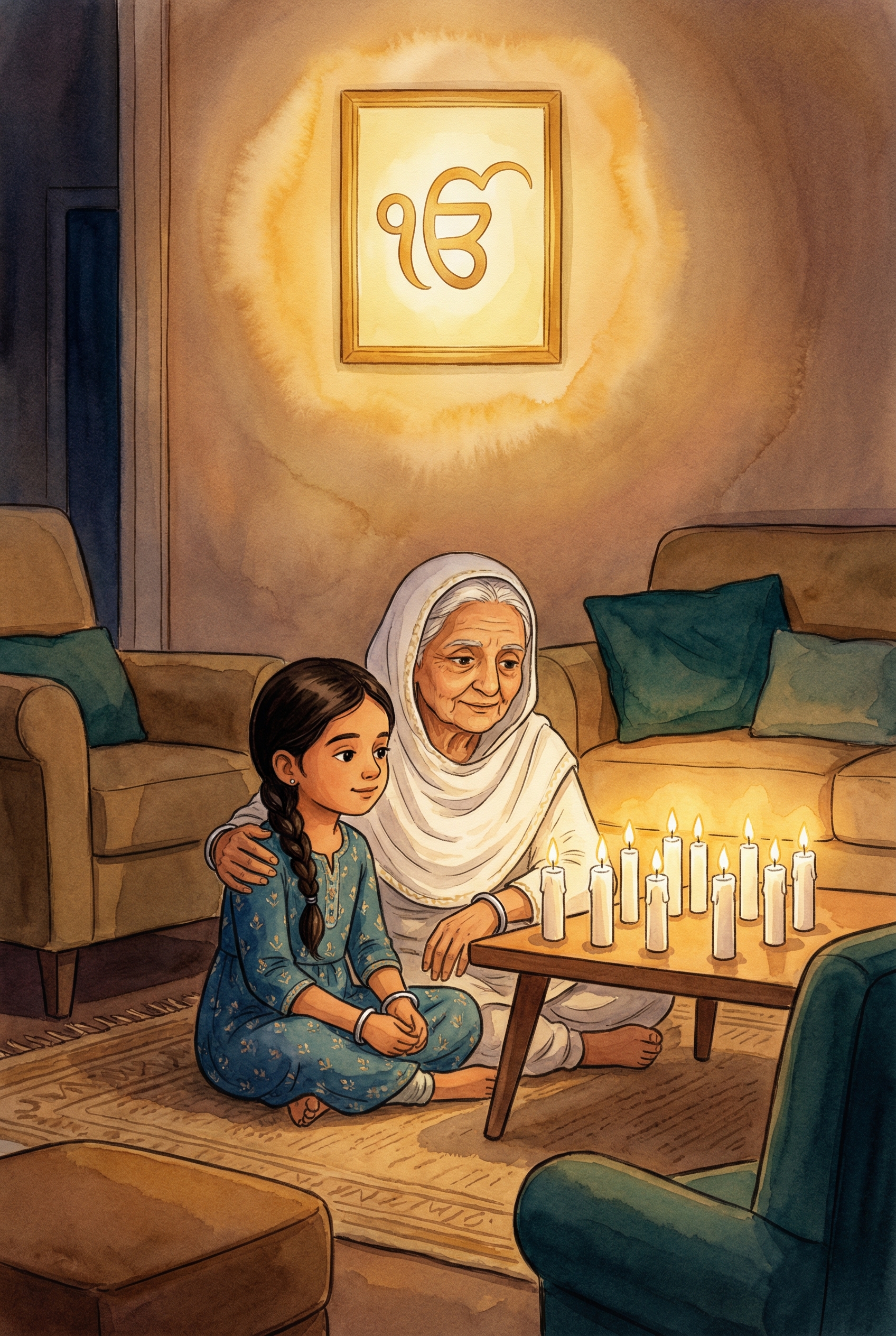
Ten Lights, One Flame
A grandmother lights ten candles and tells the story of the ten Sikh Gurus — ten enlighteners who carried one flame, each adding their own brightness to the world.
Too Many to Remember
Simran loved to count things.
She counted the stairs on the way to bed. Fourteen. She counted the birds on the wire outside her window. Seven. She counted the raisins in her cereal every morning, and she always told her mother the exact number.
One evening, Simran was sitting on the living room rug with Dadi Ji — her grandmother. They had just come back from the Gurdwara, the Sikh place of worship. A framed Ik Onkar hung on the wall, its golden letters catching the lamplight.
"Dadi Ji, how many Gurus were there?"
"Ten," said Dadi Ji.
Simran's eyes went wide. "Ten? That's too many to remember!"
Dadi Ji smiled. She reached for the small box of candles on the shelf. She set them in a row on the coffee table — ten white candles, standing like little soldiers.
"It is not as hard as you think," Dadi Ji said. She struck a match and lit the very first candle. The flame danced and glowed, warm and golden.
"Let me tell you a story about one flame — and the ten Gurus who carried it forward."
The First Light
"A long, long time ago," Dadi Ji began, "a baby was born in a village called Talwandi. His name was Nanak."
She touched the first candle gently.
"Even as a boy, Nanak asked questions nobody else would ask. 'Why are some people treated as less than others?' he wondered. 'Why do we pray with our lips but forget to be kind?'"
"When he grew up, he walked across the whole world — deserts, mountains, cities, forests — telling everyone the same thing: there is One Creator, and that Creator lives in every single person. Rich or poor. Man or woman. Everyone."
"He started a free kitchen called Langar, where anyone could sit together and eat — a king next to a farmer, a child next to a grandparent. Everyone equal."
Dadi Ji looked at Simran. "Guru Nanak lit this flame. He showed people that the truth is simple — be kind, work honestly, and remember the One who made us all."
The first candle flickered. Its light was small but steady.
The Light of Wisdom
Dadi Ji picked up the first candle and used it to light the second. Now two flames burned.
"Guru Nanak had a devoted student named Bhai Lehna. He served the Guru with such love and humility that Guru Nanak chose him to carry the flame next — and gave him the name Angad, meaning 'part of me.'"
"In those days, the holy writings were in Sanskrit — a language that only the Pandits, the learned priests, could read. Ordinary people could not understand the teachings for themselves. Guru Angad Dev Ji changed that. He refined and spread a new alphabet — Gurmukhi — so that anyone could read and write in their own language."
"Those are the very same letters you are learning at home. The very same alphabet in your workbook."
Simran looked at her Gurmukhi practice book on the table. She hadn't thought about who made those letters before.
"He also told people to keep their bodies strong," Dadi Ji said. "He built places where young people could wrestle and exercise. A strong mind and a strong body — both together."
The One Who Fed Everyone
The second candle lit the third.
"Guru Amar Das Ji received the Guruship in his later years, showing us that devotion to Waheguru has no age. He had one rule that changed everything."
"'No one sees me until they have eaten Langar first.' That was his rule. Even if a king came to visit — first, sit on the ground and eat with everyone else."
Dadi Ji raised an eyebrow at Simran. "Imagine telling a king to sit on the floor."
Simran giggled.
"He did it because he wanted to show that nobody is above anybody else. Not in Sikhi."
The Visionary of Ramdaspur
The third candle lit the fourth.
"Guru Ram Das Ji had a vision — a city where people of all backgrounds could live together in peace, centred around devotion to Waheguru. So he began to build it — a beautiful city with a sacred pool of water at its heart."
"Do you know what that city is called today?"
Simran shook her head.
"Amritsar. And Sri Harmandir Sahib — the beautiful Gurdwara that stands in the water — that is exactly where Guru Ram Das Ji began digging the pool, with his own hands."
"He also wrote the Lavan — the four verses that Sikhs walk around Sri Guru Granth Sahib Ji when they get married. Your mummy and daddy walked those four circles on their wedding day."
Simran touched her mother's wedding photo on the shelf. She had never known that.
The First to Give Everything
The fourth candle lit the fifth. But Dadi Ji's voice became quiet.
"Guru Arjan Dev Ji did something that had never been done before. He compiled the divine writings of the Gurus and other wise saints into the Adi Granth — bringing the Shabad, the Divine Word, together for all of humanity."
"Guru Arjan Dev Ji built Sri Harmandir Sahib with doors on all four sides — north, south, east, and west — so that anyone from any direction could walk in. No one was turned away."
"But a powerful emperor grew afraid of the Guru's message of love and equality, and of his growing community. He demanded the Guru stop his teachings. Guru Arjan Dev Ji refused to give up the truth."
Dadi Ji paused. "He gave his life rather than silence the truth. He was the first Guru to make that sacrifice."
The fifth candle burned brightly. Simran did not say anything. She just watched the flame.
Two Swords
The fifth candle lit the sixth.
"After his father's sacrifice, Guru Hargobind Sahib Ji knew that Sikhs needed both Simran — spiritual strength — and the courage to stand for justice. So he wore two swords — Miri and Piri — one for worldly responsibility and one for spiritual grace."
"He built the Akal Takht — the Throne of the Timeless One — right across from Sri Harmandir Sahib. One was for devotion to Waheguru. The other was for standing up in the world."
"He showed that you can be gentle and strong at the same time."
The Gentle Healer
The sixth candle lit the seventh.
"Guru Har Rai Sahib Ji had such deep love for Waheguru's creation that he walked through his garden holding his robes close, making sure not to harm even a single flower."
"He collected herbs and plants and used them to heal people who were sick. He opened a place of healing where anyone could come — no matter who they were."
"Some people think being gentle means being weak," Dadi Ji said. "Guru Har Rai Sahib Ji showed that gentleness is its own kind of strength."
The Youngest Guru
The seventh candle lit the eighth. Dadi Ji smiled at this one.
"Guru Har Krishan Sahib Ji became the Guru when he was only five years old. Five! Even younger than you."
Simran's jaw dropped. "Five?"
"Five. Even though his physical form was young, the Guru showed immense courage and divine wisdom. When a terrible sickness swept through the city of Delhi, he did not step away. He went out to help. He brought comfort to the sick and strength to the afraid."
"He showed that the light of the Guru does not depend on age or size. Even the youngest vessel can carry the brightest flame."
Simran sat up a little straighter.
The Protector of Dharma
The eighth candle lit the ninth. Dadi Ji's voice was gentle again.
"Guru Tegh Bahadur Sahib Ji revealed divine wisdom through Bani that teaches us about the nature of this world — how everything changes, but truth remains forever. He travelled far and wide, showing people how to live without fear."
"Then one day, people from a different faith came to him. They said: 'We are being forced to give up our beliefs. No one will help us.' Guru Tegh Bahadur Sahib Ji stood up for their right to worship freely."
"He gave his life so that all people could follow their own path to Waheguru. He is known as Shrisht di Chadar — the Protector of the Universe."
"So he protected everyone, even if they prayed differently?" Simran asked.
"Yes," Dadi Ji said softly. "He was Shrisht di Chadar — the Protector of the Universe. His light shone for everyone."
The Flame That Never Goes Out
The ninth candle lit the tenth. The last one.
"Guru Gobind Singh Ji was the son of Guru Tegh Bahadur Ji. He grew up knowing what his father had given. And he decided that the Sikhs needed to become fearless — not just inside, but in the world."
"On Vaisakhi day in 1699, he called out to a great gathering: 'Who will give their head for truth?' One by one, five brave people stood up. He called them the Panj Pyare — the Five Beloved Ones. And he gave them Amrit — the nectar of immortality and spiritual awakening."
"That day, the Khalsa was born — a family of people who would never be afraid to stand for what is right."
"And then," Dadi Ji said, leaning forward, "Guru Gobind Singh Ji did something no one expected."
Simran leaned forward too.
"He said the flame would not pass to another human form. Instead, the Shabad itself — the Divine Word — would be the eternal guide. He bestowed the Guruship upon Sri Guru Granth Sahib Ji."
Dadi Ji placed her hand over her heart. "Sri Guru Granth Sahib Ji is the living Guru — present at the centre of every Gurdwara, including ours. Every time we sit before it and listen, the flame is still burning."
One Light
Ten candles glowed on the coffee table. The room was warm and golden.
Simran looked at the candles for a long time. She counted them. Ten.
Then she looked more closely. The flames moved together, swaying in the same gentle breeze. Ten candles — but the light they made was one light. You couldn't tell where one flame ended and the next began.
"Dadi Ji," Simran said slowly, "it was always the same flame, wasn't it? Just passed from one to the next."
Dadi Ji's eyes shone in the candlelight. "Yes, puttar. One light. Ten carriers. And now it lives in Sri Guru Granth Sahib Ji — a flame that never goes out, because it lives in the Shabad."
Simran leaned against Dadi Ji's shoulder. The candles glowed. Outside, the stars were doing their own quiet counting.
"I think I can remember ten," Simran said.
Dadi Ji kissed the top of her head. "I think you can too."
Discussion Questions
Let's Talk About It: Simran thought ten Gurus was too many to remember. Have you ever felt like something was too big to learn — and then it turned out to be easier than you thought?
Let's Think About It: Dadi Ji says the flame "lives in the Shabad" now. What do you think she means? How can a flame live in the Divine Word?
Let's Talk About It: Each Guru added something special — letters, a city, a hospital, a code of courage. If you could add one thing to make the world better, what would it be?
Let's Try It: Simran loves to count things. Try counting something today — stairs, birds, or flowers — and see how many you notice that you didn't notice before.
Let's Think About It: Guru Tegh Bahadur Ji stood up for people who were not even Sikhs. Why do you think that was important?
Let's Try It: With a grown-up's help, light a candle and watch the flame. See how still it can be, and how it dances when you breathe near it. What does the flame remind you of?
Word Meanings
| Word | Meaning |
|---|---|
| Akal Takht | The Throne of the Timeless One — a place of Sikh leadership, built by Guru Hargobind Sahib Ji in Amritsar |
| Adi Granth | The first compilation of Sikh scripture, compiled by Guru Arjan Dev Ji — later expanded into Sri Guru Granth Sahib Ji |
| Amrit | The nectar of immortality — also the name for the ceremony of spiritual awakening where a person joins the Khalsa |
| Amritsar | A city in Punjab, India — home of Sri Harmandir Sahib |
| Gurdwara | A Sikh place of worship — "the door to the Guru" |
| Gurmukhi | The alphabet used to write Punjabi — developed by Guru Angad Dev Ji |
| Bani | Divine revealed poetry — the sacred writings within Sri Guru Granth Sahib Ji |
| Shrisht di Chadar | "Protector of the Universe" — a title given to Guru Tegh Bahadur Sahib Ji |
| Miri and Piri | The two swords of Guru Hargobind Sahib Ji — Miri for worldly responsibility, Piri for spiritual grace |
| Puttar | "Child" or "dear one" — an affectionate Punjabi term used by elders |
| Shabad | The Divine Word — the sacred teachings revealed through the Gurus |
| Simran | Remembrance of the Creator — connecting with Waheguru through meditation and devotion |
| Sri Guru Granth Sahib Ji | The living, eternal Guru of the Sikhs — the Shabad Guru (Divine Word) |
| Sri Harmandir Sahib | The sacred Gurdwara in Amritsar — built with doors on all four sides to welcome everyone |
| Khalsa | The community of initiated Sikhs, created by Guru Gobind Singh Ji in 1699 |
| Langar | A free community kitchen where everyone sits together and eats — no one is turned away |
| Lavan | The four wedding verses written by Guru Ram Das Ji — Sikhs walk around Sri Guru Granth Sahib Ji while they are sung |
| Dadi Ji | Grandmother (paternal) — a term of love and respect |
| Panj Pyare | The Five Beloved Ones — the first five Sikhs who offered their lives at the founding of the Khalsa |
| Vaisakhi | The day the Khalsa was founded in 1699 — a major Sikh celebration |
| Waheguru | The Wonderful Creator — God |
About This Story
The ten Sikh Gurus guided the Sikh community from 1469 to 1708 — a span of nearly 240 years. Sikhs believe that the same divine light (Jot) passed through all ten Gurus, making them one spirit in ten forms. When Guru Gobind Singh Ji bestowed the Guruship upon Sri Guru Granth Sahib Ji in 1708, he ensured that the Shabad — the Divine Word — would be the eternal Guru for all of humanity, for all time.
This story is an introduction to all ten Gurus for young readers. Each Guru's life is rich and complex — far more than a few sentences can hold. We encourage families to explore each Guru's story in greater depth as children grow. The candle metaphor in this story reflects the Sikh teaching that the light of Guru Nanak lived on in each successive Guru — Jot (divine light) passing from one to the next.
Explore More
- The Light of Truth: The Life of Guru Nanak Dev Ji — A deeper dive into the life of the first Sikh Guru
- The Devoted Disciple: The Life of Guru Angad Dev Ji — The story of the Guru who gave us the Gurmukhi alphabet
- Vaisakhi & Khalsa Sajna Diwas Quiz — Test your knowledge of the founding of the Khalsa