
Featured
The Many Colors of Harpreet Singh — Summary & Activities
· Reviewed by Gursharn Singh
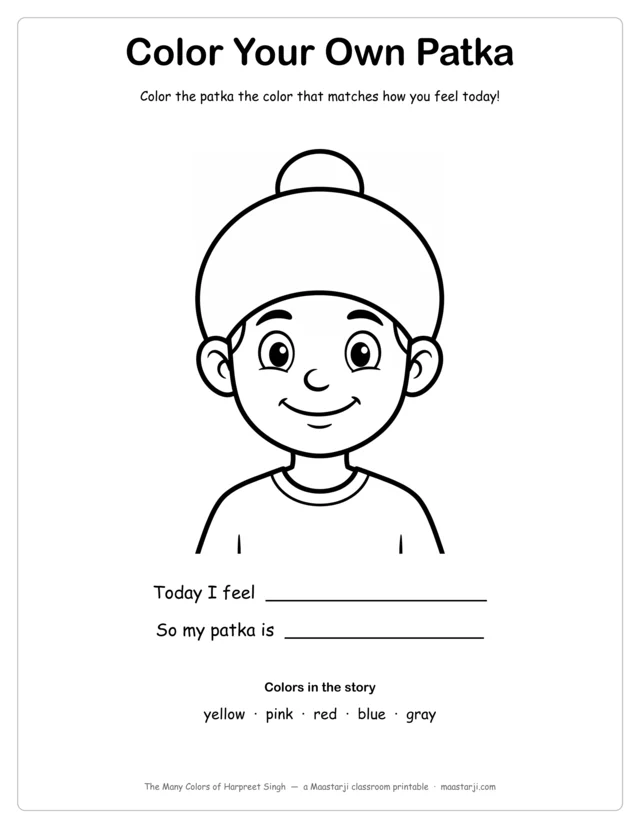
Free printable: Color Your Own Patka
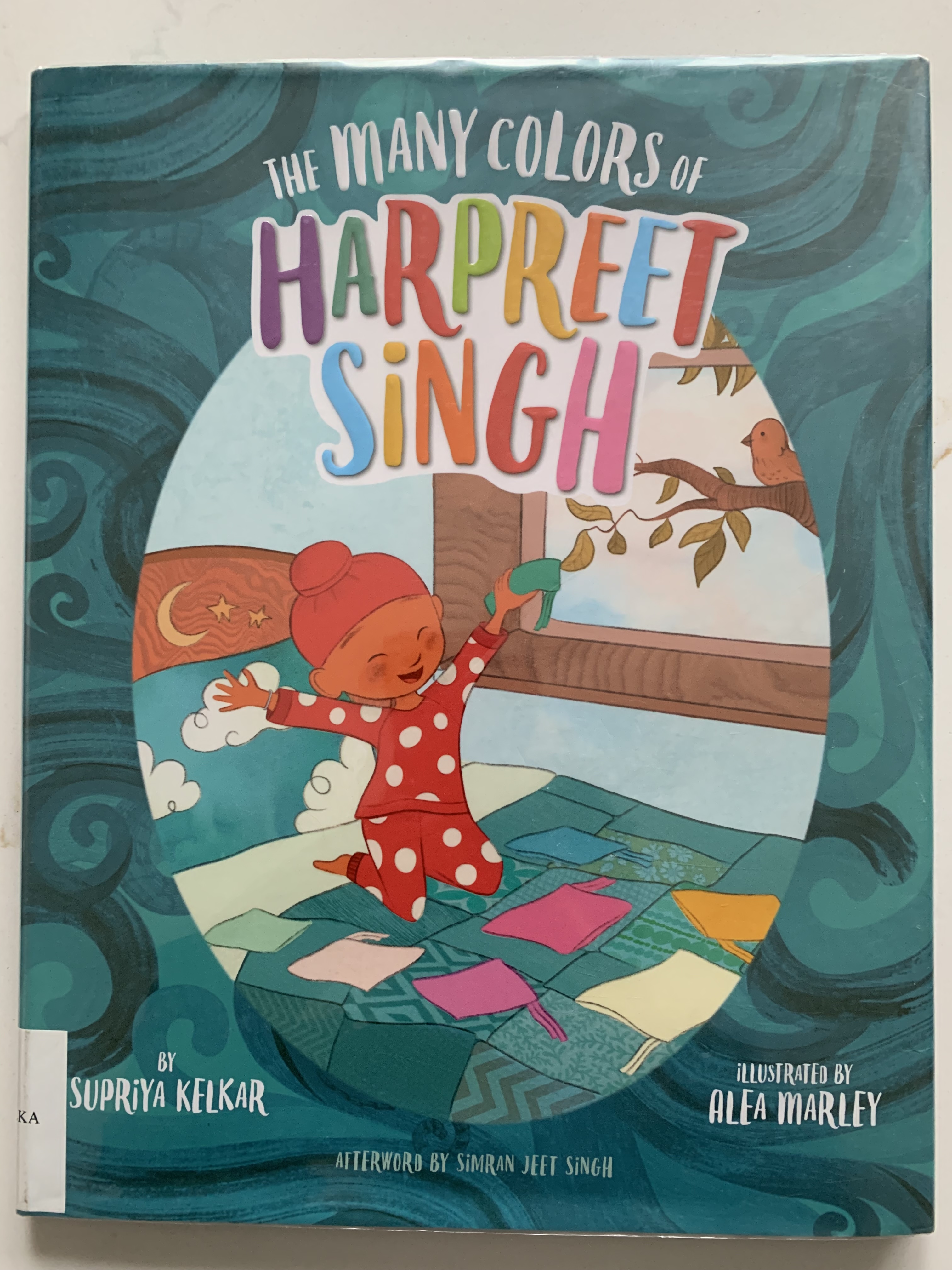
A young Sikh boy wears a different-colored patka (head covering) for every mood — until his family moves to a snowy new town and his colors fade. A new friend helps him find them, and his sense of belonging, again. This is The Many Colors of Harpreet Singh, a picture book by Supriya Kelkar, illustrated by Alea Marley — a read-aloud for ages 3–7 about identity, big feelings, and belonging.
This page is a resource hub for teachers, librarians, and families: a plain-language summary, discussion questions by grade, classroom activities, a “what is a patka?” explainer, free printables, and a list of books to pair with it.
Jump to: Summary · About the patka · Discussion questions · Activities & printables · Book pairings
Quick Summary
Harpreet Singh matches the color of his patka to how he feels — yellow for sunny, happy days, pink for celebrations, red when he needs to be brave, and blue for confidence on big occasions. His patkas are part of his Sikh practice and a way to wear his emotions where everyone can see them.
When Harpreet’s mom takes a new job in a small, snowy town across the country, everything changes. He’s nervous and sad about leaving the only home he’s known, so he stops wearing his bright colors. He chooses gray, then white — the color of wanting to disappear into the snow. At his new school he feels invisible, until he spots a classmate’s lost yellow hat in the snow. When Harpreet returns it, the girl — Abby — tells him she loves his patka. That small kindness reminds him how much he loves to show his feelings through color, and slowly his colors — and his sense of belonging — come back.
What it’s really about: moving to a new place, the courage it takes to be visibly different, and the way a single moment of acceptance can change everything. Children who have moved, started a new school, or ever felt unseen will recognize themselves in Harpreet’s story.
What Each Patka Color Means in the Story
In the book, Harpreet wears a different colored patka to match what he’s feeling. The color-to-emotion mapping is the heart of the story and gives children a vocabulary for feelings they can’t always name:
| Color | What it stands for |
|---|---|
| Yellow | Joy and sunshine — Harpreet’s everyday happy color |
| Pink | Celebrations and special occasions |
| Red | Courage and bravery — for moments he needs to feel strong |
| Blue | Confidence — for big days like the first day at a new school |
| Gray | Sadness and uncertainty |
| White | At first, wanting to be invisible after the move — by the end of the book, a joyful reminder of the snow where he met his friend Abby |
For parents and educators, this color-emotion map is the most useful tool the book offers. Children who struggle to name what they feel can point to a color and start the conversation from there.
What Is a Patka?
A patka is a small cloth head covering worn by young Sikhs to keep their kesh (uncut hair) tied and tidy. In Sikhi, hair is honored as a gift to be kept as it is, rather than cut — kesh is one of the Five Kakars, the five articles of faith. A patka is often the first head covering a Sikh child wears, before a full dastaar (turban) later on. In this story, Supriya Kelkar uses it beautifully — not as a marker of difference, but as a canvas for Harpreet’s personality and feelings. It’s both a Sikh practice and a deeply personal form of self-expression.
For teachers: you don’t need to go into religious depth with young students. It’s enough to say that Harpreet’s head covering is an important part of his identity — just as other children may have symbols or items that matter to their own families. Learn more in our guide to the Five Kakars.
Discussion Questions by Grade
Use these after a read-aloud — pick the ones that fit your group. They support Common Core ELA Reading Literature standards (RL.K.3, RL.1.3 — describing characters, settings, and major events) and social-emotional learning goals around naming and managing emotions.
Grades K–2
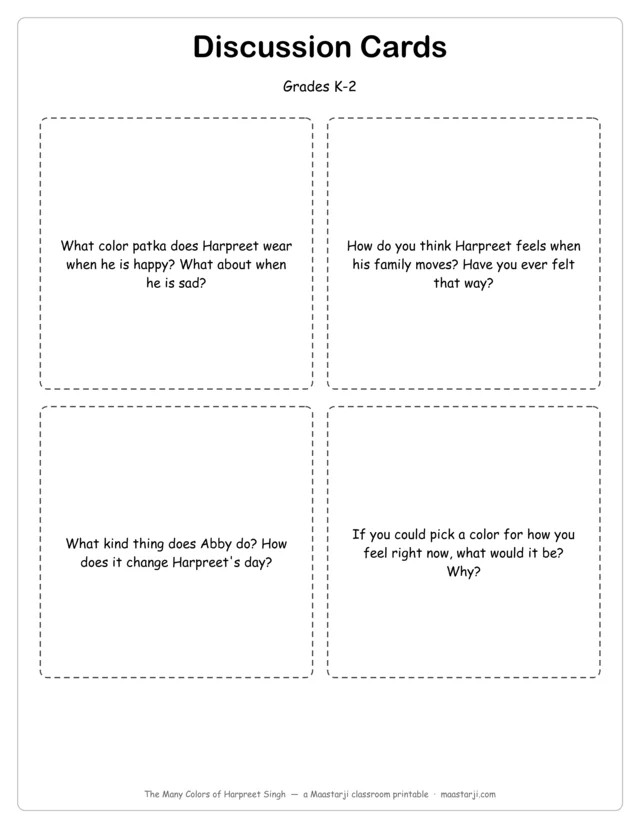
- What color patka does Harpreet wear when he’s happy? What about when he’s sad?
- How do you think Harpreet feels when his family moves? Have you ever felt that way?
- What kind thing does Abby do? How does it change Harpreet’s day?
- If you could pick a color for how you feel right now, what would it be? Why?
Grades 3–5
- Why do you think Harpreet chooses white — the color of disappearing — instead of his bright patkas?
- How does the author show Harpreet’s feelings through color instead of just telling us?
- The illustrations show Harpreet eating different food from his classmates at lunch. Why do you think the author and illustrator included that detail?
- How can we help a new student feel welcome, the way Abby helped Harpreet?
For Sikh families (home use)
- Harpreet wears his patka in many colors. What does wearing a dastaar or patka mean in our family?
- Have you ever felt shy about something that makes us Sikh — long hair, going to the Gurdwara, or speaking Punjabi? What helped you feel proud?
- Kesh (uncut hair) is one of the Five Kakars. Waheguru gave us our bodies and our identities just as they are — how does Harpreet’s story connect to accepting Hukam, the will of the Creator?
Classroom and Home Activities
Most of these need only paper and crayons. The examples below show a coloring page, color mood chart, and discussion cards for grades K–3.
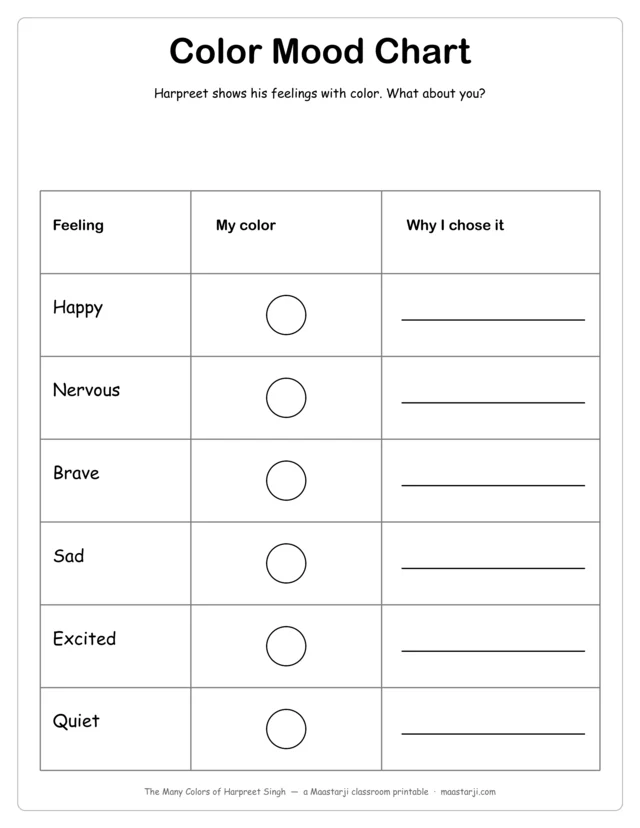
1. Color mood chart. Children pick a color for each feeling — happy, nervous, brave, sad, excited, invisible — and explain their choices. There’s no right answer; it opens a conversation about how the same color can mean different things to different people. Supports Common Core RL.K.4 / RL.1.4 (words that suggest feelings) and SEL self-awareness.
2. Color your own patka. Children color a blank patka in the color that matches their mood today, then finish the sentence “I feel ___ because ___.” A great morning check-in or reading response. Grab the free Color Your Own Patka sheet from our coloring section. Supports Common Core W.K.2 / W.1.2 and Visual Arts.
3. Color-emotion word wall. After reading, build a class word wall organized by color — yellow gets “sunny,” “happy,” “energetic”; gray gets “nervous,” “unsure,” “quiet.” Builds vocabulary and emotional literacy together. Supports Common Core L.K.5 / L.1.5 (word relationships and shades of meaning).
4. “A new place” writing prompt. “Harpreet had to be brave when he moved somewhere new. Write or draw about a time you had to be brave.” For younger writers, use the frame “I felt ___ (color) because ___.” Supports Common Core W.K.3 / W.1.3 and SEL self-management.
5. Gurmukhi name extension (Maastarji). “Harpreet” in Gurmukhi is ਹਰਪ੍ਰੀਤ. After reading, introduce children to the script with our free Gurmukhi tracing worksheets — especially nice for Sikh heritage classes and Friday schools.
Authentic Sikh Representation
Both author Supriya Kelkar and illustrator Alea Marley represent Sikh identity with care and accuracy — from Harpreet’s joora (top bun) to his colorful patkas. For young Sikh boys who wear patkas to school and sometimes feel different, seeing Harpreet wear his with pride is quietly powerful. Alea Marley’s illustrations are vibrant and welcoming, and the diversity among Harpreet’s new classmates reflects the multicultural classrooms many children know. The lunchroom spread — where Harpreet has roti and dal while his classmates eat sandwiches and cake — says more about feeling different than pages of prose could.
The 32-page book also includes a thoughtful afterword by Dr. Simran Jeet Singh explaining Sikh identity and the significance of the turban in terms young children — and non-Sikh teachers and parents — can understand and share with confidence.
A Sikh Parent’s Take
Finding children’s books that authentically represent our faith and culture can be hard, which is why this one means so much. The Many Colors of Harpreet Singh doesn’t explain Sikhi away or make Harpreet’s patka a problem to solve — it lets him be a whole, joyful kid whose head covering is simply part of him, the way his laugh or his favorite color is part of him. For our children it’s a mirror; for everyone else’s, it’s a warm, gentle window. Supriya Kelkar doesn’t ask the reader to understand Sikhism — she asks the reader to understand Harpreet. That’s the right order.
Recommended for: classroom and library collections (grades K–3), SEL and Back-to-School units, Sikh and multicultural families, and any conversation about identity, big feelings, and belonging. It’s also a natural fit for Diversity & Inclusion Month (October), Anti-Bullying Week (November), and Asian Pacific American Heritage Month (May).
Books to Pair With The Many Colors of Harpreet Singh
Building a unit on moving, belonging, or feelings? These picture books pair naturally:
- My Two Blankets by Irena Kobald & Freya Blackwood (2015) — a newcomer learns a new language and finds comfort, told through the metaphor of a favorite blanket.
- The Color of Home by Mary Hoffman & Karin Littlewood (2002) — a Somali boy in London draws the colors of the home he misses. Pairs powerfully with the color-as-emotion theme.
- The Color Monster by Anna Llenas (2018) — colors stand in for tangled-up feelings; an ideal companion to the color mood chart activity above.
- Each Kindness by Jacqueline Woodson (2012) — a new girl is left out, and the narrator learns what that costs. A harder, honest conversation, best for grades 2–4.
A Maastarji pairing: for a Sikh-centered companion, try our free illustrated story Fateh Singh and the Shortcut — about seva (selfless service) for ages 4–12.
About the Creators
Supriya Kelkar (author) grew up in the U.S. Midwest and learned Hindi as a child by watching Hindi films with her family. She’s an award-winning author and screenwriter whose books center South Asian and Indian American experiences with warmth and specificity. (supriyakelkar.com)
Alea Marley (illustrator) is a children’s illustrator based in England who loves scenes rich in plant life, texture, pattern, and color. She’s drawn to diverse books because she believes every child deserves to see themselves in the stories they read. (aleamarley.co.uk)
Practice the Colors
After reading, practice the Punjabi color words from the story on our Punjabi Colors vocabulary page — it includes a free crossword and quiz for ages 5–10.
Further reading: Kate Jung’s scholarly review of this book for WOW Review (Worlds of Words, University of Arizona, 2023, CC BY-NC-SA 4.0) offers a classroom-focused analysis and additional book pairings.
Frequently Asked Questions
- What is The Many Colors of Harpreet Singh about?
- It is a picture book by Supriya Kelkar about a young Sikh boy named Harpreet who matches the color of his patka (head covering) to his mood — yellow for joy, pink for celebrations, red for courage, gray for sadness. When his family moves across the country to a small, snowy town, the colors disappear and Harpreet starts wearing only white. The story follows him as he meets a classmate named Abby and slowly finds his colors — and his place — in a new home.
- What age is The Many Colors of Harpreet Singh appropriate for?
- The book is recommended for ages 3 and up. It works especially well for children ages 3–7, from preschool through Grade 2, as both a read-aloud and a tool for parents and teachers to discuss feelings, moving, and belonging.
- What does each color of Harpreet's patka mean in the story?
- Yellow stands for joy, pink for celebration, red for courage, blue for confidence on big days, and gray for sadness. White begins as the color of wanting to be invisible after Harpreet's family moves, but by the end of the book it becomes a happy color — a reminder of the snow where Harpreet met his new friend Abby.
- Why does Harpreet wear a patka?
- A patka is a small head covering worn by Sikh boys to keep their kesh (uncut hair) clean and tied. Kesh is one of the Five Kakars — the five articles of faith Guru Gobind Singh Ji gave the Khalsa in 1699. The book includes an afterword by Dr. Simran Jeet Singh that explains the significance of the turban for young readers.
- Who wrote and illustrated The Many Colors of Harpreet Singh?
- The book was written by Supriya Kelkar and illustrated by Alea Marley. It was published by Sterling Children's Books in 2019.
- Is The Many Colors of Harpreet Singh suitable for non-Sikh families?
- Yes. While the book offers powerful representation for Sikh children, the universal themes of moving, making friends, and using colors to express emotions make it valuable for any family. The afterword on Sikh identity and the turban is written so non-Sikh readers can share and discuss the book confidently.
Join the Discussion
Have thoughts about this book? Share your feedback or discuss with others on X.
Discuss on X