I Am a Sikh
When Ruby asks Fateh Singh what it means to be a Sikh, he doesn't have the words. But over one weekend in Southall, the answer finds him — in every kara he sees.
The Question
It happened on a Friday, right after lunch.
Mrs. Okafor's class was sitting in a circle on the carpet. They had been talking about families — where people came from, what languages they spoke at home, what they ate for dinner. Oliver said his nan made the best roast potatoes in Hounslow. Amira said her mum spoke Arabic when she was on the phone to her aunties.
Then Ruby turned to Fateh Singh.
"What are you?" she asked.
It wasn't a mean question. Ruby was never mean. She was just Ruby — direct, curious, the kind of person who asked things other people only thought.
"I'm a Sikh," Fateh said.
Ruby tilted her head. "What does that mean?"
Fateh opened his mouth. Then he closed it again. He looked down at his hands. He knew what a Sikh was — sort of. He went to the Gurdwara. He wore a patka. Dadi ji woke up before the sun and sat very still in the dark. Dad never cut his hair.
But he couldn't put it into words. Not the kind that explained it properly.
"It means..." he started. "We go to the Gurdwara. And we eat Langar. And..."
He trailed off. Ruby waited. Then Mrs. Okafor moved the circle on to someone else, and the moment passed.
But the question didn't.
It followed Fateh home on the bus. It sat next to him at the kitchen table while he ate his after-school roti with butter. It was still there when he climbed the stairs and stared at his half-built Lego spaceship without picking up a single brick.
What does that mean?
He didn't have a good answer. And Fateh Singh did not like not having a good answer.
The Quiet Hum
That evening, Dadi ji sat in the front room after dinner. The television was off. The house was still. She had finished her Rehras Sahib and was doing Simran — whispering "Waheguru, Waheguru, Waheguru" — over and over, so quietly it was almost a vibration, filling the room like something warm.
Fateh stood in the doorway and watched. He did this sometimes — watched Dadi ji when she didn't know he was there. She looked different during Simran. Calmer. Like the whole house could fall down around her and she wouldn't notice.
On her right wrist, her kara caught the light from the table lamp. It was a thin one made of iron. She never took it off.
Fateh looked down at his own wrist. His kara was smaller — they had got it from the Gurdwara Sahib when he was four. It was snug now. He'd need a new one soon.
He padded into the room and sat on the carpet beside her chair. He didn't say anything. Dadi ji's whisper went on — Waheguru, Waheguru — steady, low, like a vibration that had no beginning and no end.
After a while she stopped and looked down at him.
"You're quiet tonight," she said. "That is unusual."
He almost asked her. What does it mean to be a Sikh? But something told him to wait. Dadi ji never answered that kind of question with words anyway. She answered it by doing things.
"I'm just listening," he said.
Dadi ji smiled. She closed her eyes and went back to her Simran. Fateh stayed on the carpet and listened to the name of the Creator until his eyes grew heavy.
The Patka
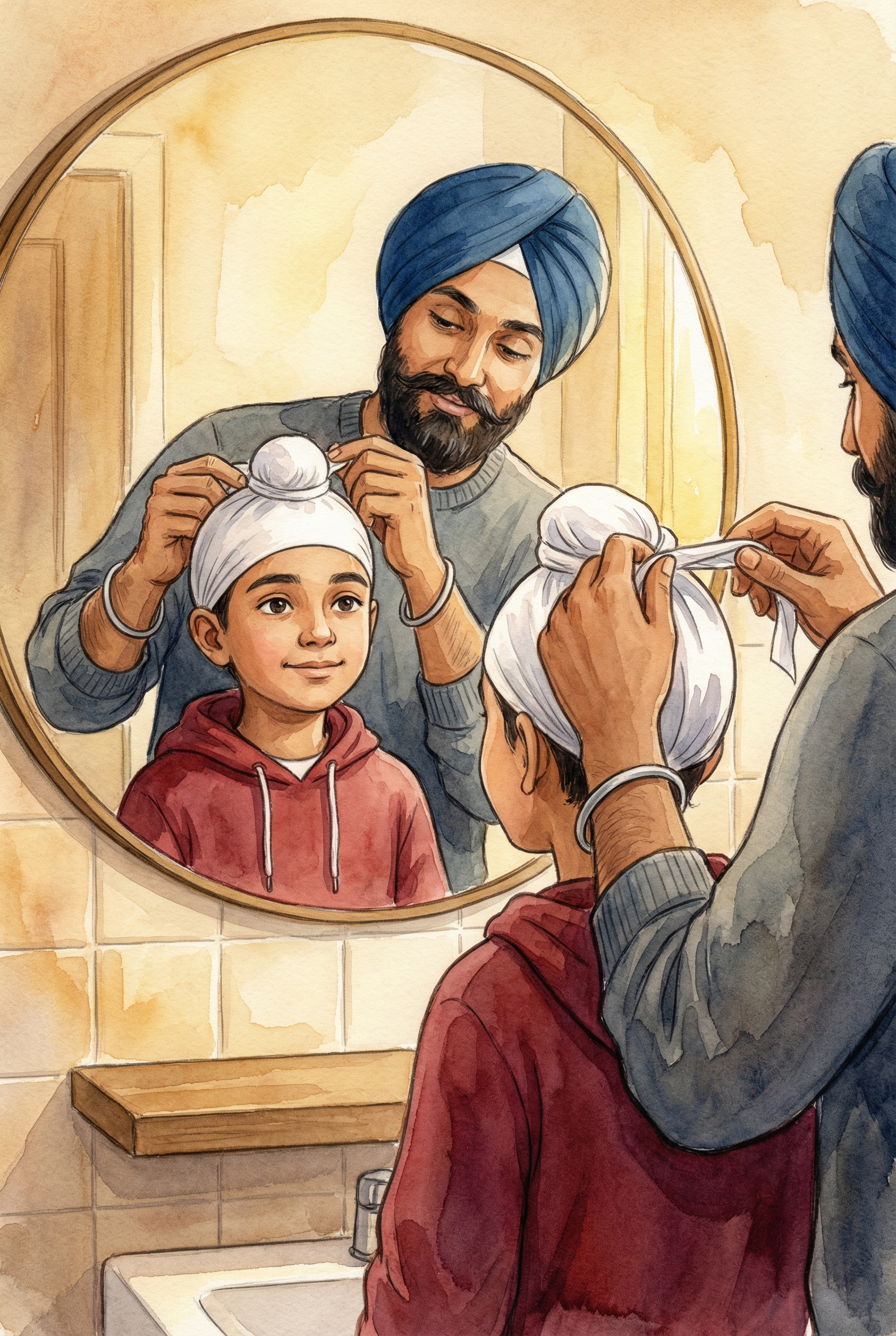
Saturday morning. Dad stood behind Fateh in the bathroom mirror, tying his patka.
Dad's hands moved quickly — fold, smooth, tuck, tie. He had done this a thousand times. His fingers were rough from work, but they were gentle with the fabric, steady and sure, the way hands get when they've practiced something out of love.
"Hold still," Dad said. "You're wriggling."
"I'm not wriggling. I'm adjusting."
"Same thing."
Fateh watched Dad's hands in the mirror. There it was again — the kara on Dad's wrist, catching the bathroom light with each fold. Dad's was thicker than Dadi ji's. Heavier. It slid and glinted as he worked.
"Dad," Fateh said. "Why do we wear a Dastaar?"
Dad tucked the last fold in and smoothed it flat. "Our hair is a gift from Waheguru," he said. "We keep it natural and long. And the patka or Dastaar keeps it safe and tidy — like a crown." He adjusted it one final time. "And the kara?" He held up his wrist. "It's a circle. No beginning, no end. It reminds us that Waheguru is always with us. And it reminds us to do good with our hands."
He held up his wrist so the kara sat between them in the mirror — his big one, Fateh's small one, side by side.
"There," Dad said. "You look sharp."
Fateh looked at himself. Red hoodie. Patka. Kara. He looked like Dad. He looked like Dadi ji. He looked like the people he saw every Saturday walking down The Broadway towards the Gurdwara.
He looked like himself.
The Circle
The Gurdwara was busy. It was always busy on Saturdays.
Fateh and Dadi ji walked through the main hall, where the sangat — the whole community — sat together on the floor. Fateh bowed his head to the floor before Sri Guru Granth Sahib Ji, and felt the heavy question from Friday lighten, just a little. He sat down beside Dadi ji. Kirtan was going on, and the sound filled the hall and settled in his chest the way Dadi ji's whisper had settled in the front room.
They went to the langar hall afterwards. Fateh helped carry steel plates. He knew the drill — stack, carry, lay them out along the rows where people sat in pangat, everyone together, side by side.
A sevadaar — a volunteer — handed him a jug of water. She was young, maybe a university student, with her hair in a long braid and a chunni over her head. She smiled at him. On her wrist — a kara.
Fateh poured water for an old uncle with a white beard. He poured water for a little girl who said "thank you." He poured water for a man in a suit who looked tired, and for a woman with three children who all reached for their cups at the same time.
Nobody asked who anyone was. Nobody checked. Everyone sat in the same row and ate the same dal and parshada from the same steel plates.
Fateh looked down at the jug in his hands. At the kara on his wrist. At the rows and rows of people sitting together.
Something clicked — quiet and clear, like a Lego brick snapping into exactly the right place.
The Answer
Monday morning. The playground was cold and loud. Ruby found Fateh by the fence, where he was kicking a tennis ball against the wall.
"Did you think about it?" she asked.
"Think about what?"
"What it means. Being a Sikh."
He caught the ball with his foot. He had thought about it. All weekend, without really trying, he had thought about it.
"It means we remember the Creator," he said. "We call the Creator Waheguru — the One who made everything. My Dadi ji does it every day. She sits really still and whispers the Creator's name, and it's like... she can feel the Creator all around her."
Ruby nodded slowly.
"And we share. At the Gurdwara there's this massive kitchen called Langar, and anyone can come and eat. You don't have to be a Sikh. You don't have to be anything. You just sit down and someone gives you food."
"For free?"
"For free."
"That's well good," Ruby said.
Fateh looked down at his kara. He twisted it once around his wrist.
"And we wear this Kara," he said. "It's a circle. My dad says it means no beginning and no end — like the Creator is always there. And it reminds you to do good things with your hands."
He held up his wrist. Ruby looked at it — the small iron bracelet, plain and bright against his school jumper.
"Everyone in my family has one," Fateh said. "My Dadi ji. My Dad. My cousin Simran in Toronto. It's like... we're all connected. Even when we're far away."
He paused. There was one more thing — the thing he'd felt in the langar hall, pouring water for strangers.
"And it means we try to see the same Divine Light in everyone," he said. "No matter who they are."
Ruby thought about this for a moment. Then she said: "That's actually a really good answer."
The bell rang. They walked back towards class — Ruby with her football under her arm, Fateh with his hands in the pockets of his red hoodie. The kara pressed cool against his wrist, the way it always did. The way it always had.
But today he noticed it.
Discussion Questions
Let's Talk About It: Has anyone ever asked you a question about yourself that you didn't know how to answer? What did you do?
Let's Think About It: Fateh notices the kara on Dadi ji's wrist, Dad's wrist, the sevadaar's wrist, and his own. Why do you think seeing it on so many people helped him understand what being a Sikh means?
Let's Talk About It: Ruby said the Langar was "well good." If you took a friend to the Gurdwara, what do you think they would notice first?
Let's Try It: Look at your kara (or ask someone in your family about theirs). Can you explain what it means to a friend, the way Fateh did?
Let's Think About It: At the end of the story, Fateh says the kara "always had" been there, but today he "noticed it." What do you think changed?
Word Meanings
| Word | Meaning |
|---|---|
| Chunni | A scarf or headcovering, worn by women and girls |
| Dal | A thick lentil dish, commonly served in Langar |
| Dastaar | A turban — the full head covering worn by Sikhs as a crown of their faith |
| Gurdwara | A Sikh place of worship — "the door to the Guru" |
| Joora | A knot or bun where uncut hair is gathered on top of the head |
| Kara | A strong, steady iron bracelet worn by Sikhs — a circle with no beginning and no end, reminding us of the Creator's presence and to do good with our hands |
| Kesh | Uncut hair — a gift from Waheguru, kept natural and long |
| Kirtan | Devotional singing of hymns from Sri Guru Granth Sahib Ji |
| Langar | A free community kitchen at the Gurdwara where everyone eats together |
| Matha Tekna | Bowing your forehead to the floor before Sri Guru Granth Sahib Ji — a sign of love and respect |
| Pangat | Sitting together in rows to eat Langar — everyone equal |
| Parshada | Flatbread, a staple food made fresh in Langar |
| Patka | A small cloth tied over the hair, worn by Sikh boys — a young person's version of the Dastaar |
| Rehras Sahib | The evening prayer recited by Sikhs |
| Sangat | The Sikh community or congregation |
| Seva | Selfless service — helping others without wanting anything in return |
| Sevadaar | A volunteer who does Seva |
| Simran | Remembering the Creator — a quiet, focused devotion |
| Sri Guru Granth Sahib Ji | The living, eternal Guru of the Sikhs — present at the centre of every Gurdwara |
| Waheguru | The Wonderful Creator — the Sikh name for God |
About This Story
This is the fourth story in the Fateh Singh series, set in Southall, West London. Like the earlier stories — The Quiet Morning (Simran), The Saturday Kitchen (Seva), and The Shortcut (Kirat Karni) — it follows six-year-old Fateh Singh as he discovers a Sikh value through everyday experience rather than formal teaching.
For many children growing up in the Sikh diaspora, the question "What are you?" comes early — from classmates, neighbours, or friends who are simply curious. This story offers one way a child might find their answer: not from a textbook, but from watching, listening, and noticing what was already there all along.
Explore More
- Fateh Singh and the Quiet Morning — Fateh discovers what Simran means by waking up before dawn with Dadi ji
- Fateh Singh and the Saturday Kitchen — Fateh learns about Seva by helping at the Gurdwara Langar
- Why Sikhi Matters More Than Ever — A parent's guide to raising confident Sikh children in the diaspora