Featured
Fateh Singh and the Shortcut
When Fateh Singh's team copies a winning wind turbine design from YouTube, they build something perfect — but can't explain how it works. Watching Dad spend a whole weekend fixing a bent bicycle instead of buying a new one, Fateh starts to understand why honest work matters more than a perfect result.
The Tapping
The tapping woke Fateh Singh.
Not the pressure cooker — that was Dadi ji's sound, Saturdays at six, hissing from the kitchen downstairs. This was different. Metal on metal, steady and patient, coming from the back garden. Tink. Tink. Tink. Like someone working out a problem, one tap at a time.
He pulled the duvet to his chin. His alarm clock said 7:42. Saturday. No school. No Mrs. Okafor asking him to sit properly. No changing out of pyjamas until at least nine. Just Lego and toast and maybe the rest of that nature documentary if Mum wasn't using the telly.
The tapping didn't stop.
He padded downstairs in his socks.
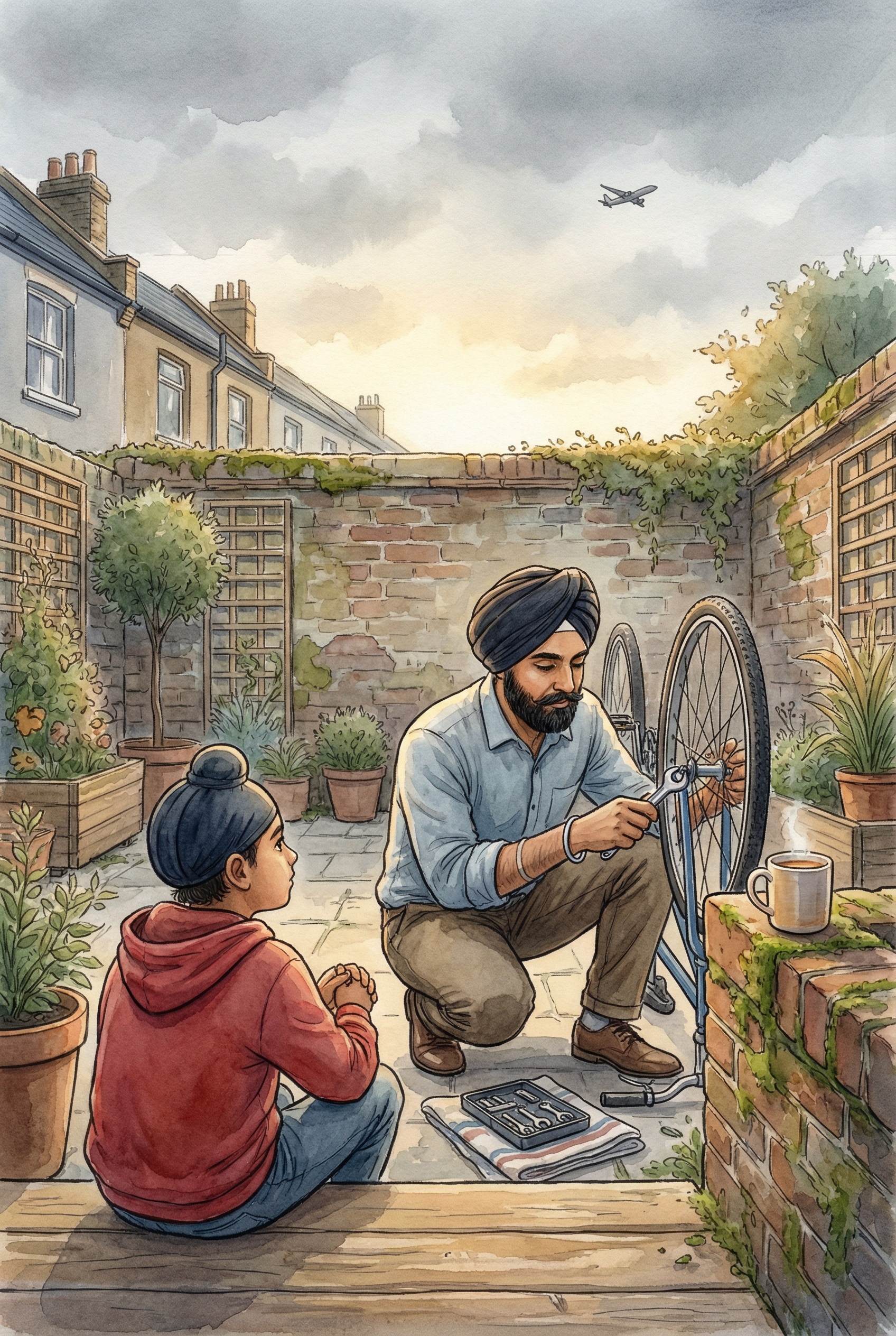
Dad was in the back garden with the bicycle upside down on the patio. The front wheel was bent — badly bent — from where Fateh had ridden it into a kerb on Tuesday, chasing Ruby past the sweet shop on The Broadway. He'd scraped his knee. The bike had scraped its wheel. Nobody died, but Mum had said "Just go to Halfords. Get a new one. Forty quid and done."
Dad had said no.
Now Dad was crouching next to the bike, running his finger along each spoke, listening. His toolkit lay on an old towel — spanners in a neat row, a spoke wrench, a small hammer. A cup of tea sat on the garden wall, going cold. The morning was grey and still, the way London mornings were in March, and a plane rumbled overhead on its way into Heathrow, low enough that the kitchen windows hummed.
"It's not broken," Dad said, though nobody had asked. "It just needs straightening."
Fateh sat on the back step and pulled his red hoodie sleeves over his hands. The zip didn't quite close at the top. It never had.
"But why don't you just buy a new one?" he said. "Mum said they're forty quid."
Dad didn't look up. He was turning a spoke with the wrench, slowly, listening to how the wheel responded. "Because this one isn't broken. It just needs fixing."
"But why spend the whole weekend on it when you could spend ten minutes in a shop?"
Dad paused. He held the spanner in one hand, a spoke in the other. "Because ten minutes of buying isn't the same as a weekend of fixing."
"But why does it matter? If nobody can tell whether you fixed it or bought a new one?"
Dad put down the spanner. He looked at Fateh — properly, the way he did when the question had finally landed somewhere important.
"I would know," he said.
The words sat between them. Small and heavy, like a pebble you can feel in your shoe.
Dad picked up the spanner and went back to work. Tink. Tink. Tink. Fateh counted the spokes. Twenty-eight. If Dad spent two minutes on each one, that was fifty-six minutes just on the spokes. Plus brake pads. Plus painting. The whole weekend, gone.
He watched for another minute — the steady hands, the slow patience — then went inside for toast.
The Challenge
Monday morning. Mrs. Okafor was standing at the front of the classroom holding something that looked like a small fan attached to a stick.
"STEM Week," she said, and wrote it on the whiteboard in capital letters. "This week, every class is doing a design challenge. Ours is this."
She held up the fan-on-a-stick.
"A wind catcher. You'll design and build something that catches the wind and spins a wheel. You can use any materials — cardboard, plastic bottles, straws, paper, tape. Whatever you can find at home or in the art cupboard. Teams of three. The best designs will be tested on Friday, and the winning team presents at assembly."
The classroom buzzed. Fateh sat up straighter. He liked problems — liked the moment when you figured out the answer, the clean click of understanding. In his notebook, he was already drawing: a circle, blades, an axle through the middle.
"Team up," said Mrs. Okafor.
Ruby was next to him before he'd put his pencil down. "Us," she said. It wasn't a question.
Oliver appeared from the desk behind them. "Three," he said, holding up three fingers.
Mrs. Okafor gave them a box of materials: cardboard, two plastic bottles, wooden skewers, a paper cup, a roll of tape, and a bag of plastic straws.
At break, they sat in the corner of the playground and brainstormed. Ruby drew a picture of blades that looked like a propeller. Oliver suggested cutting the plastic bottle in half and using it as a scoop. Fateh tried to think about what would catch the most wind.
"What if we angle the blades?" he said. "Like, tilt them so the wind pushes against them sideways."
"How do we make them stay tilted?" Ruby asked.
They tried. The cardboard was too floppy. The straws were too thin. The tape didn't hold the angles. By the end of lunch, their prototype looked like a crushed spider — bent straws poking out of a paper cup at miserable angles, the whole thing listing sideways on the desk.
"This is rubbish," said Oliver.
Ruby kicked the table leg. "We need a better idea."
That evening, Fateh sat at the kitchen table after dinner, his laptop open. He typed: best wind turbine design kids competition.
The results loaded. Videos. Diagrams. Step-by-step instructions from schools that had done the exact same challenge. He clicked on one.
The Video
The video was three minutes long.
A team from a school in Manchester had won their STEM challenge with a turbine made from a plastic bottle, four cardboard blades, and a wooden skewer through a bottle cap. The blades were cut at a precise angle — the video showed a protractor lined up at thirty degrees — and attached to the bottle cap with hot glue. A straw held the axle in place. When they put it in front of a fan, it spun fast and smooth, a blur of white cardboard.
It was clever. It was clean. It worked.
Fateh watched it three times.
The next morning, he brought his laptop to school in his rucksack. At break, he showed Ruby and Oliver.
"Look," he said, pressing play. "They won with this. Four blades, thirty degrees, bottle cap bearing. We could build the same thing."
Oliver's eyes lit up. "That's sick. We'd definitely win."
Ruby watched the video with her arms crossed. "But... isn't that copying?"
"It's not copying," said Oliver. "It's research. Scientists do research all the time."
"Scientists don't copy someone's exact design and pretend they made it," Ruby said.
"We're not pretending. We're just... using a good idea." Oliver looked at Fateh. "Right?"
Fateh looked at the paused video. The Manchester team's turbine, frozen mid-spin. Perfect. Efficient. All they had to do was build the same thing.
He thought about the crushed-spider prototype on Mrs. Okafor's desk. Their own design. Messy. Broken. Going nowhere.
"It's not copying," Fateh said slowly. "It's being smart about it. Why start from scratch when someone's already worked it out?"
Ruby looked at him. She opened her mouth, then closed it.
"Fine," she said. "But I'm not happy about it."
They built it that afternoon. Oliver's mum had a hot glue gun. Fateh measured the blade angles with a protractor from the maths cupboard. Ruby cut the blades — four matching rectangles of cardboard, each one precise. They followed the video step by step.
By Thursday, it was done.
The turbine sat on their desk. Four white blades, angled at thirty degrees, mounted on a bottle cap with a skewer through the middle. When Oliver blew on it, the blades spun smoothly. No wobble. No crushed spider.
"We're going to win," said Oliver.
Fateh looked at the turbine. It was perfect. That was the problem.
The Bicycle
Saturday. Dad was still on the bike.
The wheel was straight now — Fateh could see that much. But Dad had moved on to the brake pads. They were worn down, the rubber cracked and thin. He'd ordered new ones and was watching a YouTube tutorial on his phone, propped against the garden wall, the video pausing every few seconds while he tried the next step with his hands.
Fateh sat on the step. The morning was cold. Dadi ji was inside, cooking something that smelled of cumin and onions. Mum was asleep — she'd come off the night shift at two.
"Dad," said Fateh. "We're doing a STEM challenge at school. Wind turbines."
"Yeah? How's it going?"
"Good. We found a really good design."
Dad's hands paused on the brake cable. "Found a design?"
"Yeah. On YouTube. A school in Manchester won with it."
Dad didn't say anything for a moment. He threaded the cable through the housing, pulled it tight, tested the lever. It clicked. He adjusted it.
"So you're building their design," he said. Not a question.
"It's research," Fateh said. The word felt different this time. Smaller.
Dad nodded slowly. He went back to the brake pads.
Fateh watched him work. The patience. The care. Each pad tested, adjusted, tested again. Dad was learning from a YouTube video too — but he wasn't copying. He was watching how someone else did it, then figuring it out on his own bike. If the cable didn't fit quite right, he adjusted. If the angle was wrong, he tried another way.
"Dad?"
"Mm."
"When you watch those videos, do you copy what they do?"
Dad looked up. "I watch how they do it. Then I do it my way, on my bike. Sometimes it doesn't work and I have to figure out why." He threaded a cable tie through the housing. "That's the bit you learn from."
"What if you just did exactly what they did?"
"Then I'd know how to fix their bike. Not mine."
That night, Fateh lay in bed and thought about the wind turbine. Four blades at thirty degrees. A bottle cap bearing. A wooden skewer axle.
He could describe every part. But if someone asked him why thirty degrees — why not twenty, or forty — he wouldn't know. If someone asked why four blades instead of three, he wouldn't know. If the blades broke and he had to fix them differently, he wouldn't know where to start.
He knew what the turbine looked like.
He didn't know how it worked.
The Questions
Friday. Testing day.
Mrs. Okafor set up a desk fan at the front of the classroom. One by one, each team brought their turbine forward, placed it on the table, and watched.
Lily's team had built something from paper cups and lollipop sticks. It spun slowly, wobbling, and one cup fell off. They laughed and tried to fix it with tape.
Marcus's team had used a plastic bottle cut into curved blades. It spun fast but made a horrible rattling sound, like a broken blender. Mrs. Okafor covered her ears and smiled.
Then it was Fateh's team.
Oliver carried the turbine to the front. He placed it on the table. Mrs. Okafor turned on the fan.
The blades spun. Smooth, fast, silent. A perfect white blur. No wobble. No rattle. The whole class went quiet.
"Impressive," said Mrs. Okafor. She turned the fan off. The blades slowed and stopped.
"Tell me about your design," she said. "Why did you choose this blade angle?"
Silence.
Fateh's stomach tightened. He looked at Oliver. Oliver looked at Ruby. Ruby looked at the floor.
"It's... thirty degrees," said Oliver.
"Why thirty?" said Mrs. Okafor. Not suspicious — just curious. The way a teacher asks when she wants you to show what you've learned.
"Because..." Oliver stopped. His mouth opened and closed. "Because it works?"
Mrs. Okafor waited.
Fateh counted on his fingers — four blades, thirty degrees, bottle cap bearing. He could list every part. He just couldn't explain any of them.
"We researched it," he said. His voice came out thin. "We found that angle works well."
"And why does it work well? What happens to the wind when it hits the blade at that angle?"
His mind was blank. Not the kind of blank where you've forgotten something. The kind where there was never anything there to forget.
"We... didn't get to that part," he said.
Mrs. Okafor nodded. She wasn't angry. She wasn't disappointed. She just moved on to the next team.
But Fateh's face was hot. He sat down and stared at his hands. Oliver was quiet. Ruby was quieter. Around them, the class was testing turbines and laughing and arguing about blade shapes, and Fateh felt as if he was watching it all through glass.
At lunch, Ruby found him on the bench outside.
"We didn't learn anything," she said. She wasn't accusing. She was stating a fact, the way Ruby did — straight, no padding.
"I know."
"Everyone else learned. Even Lily's team — their turbine fell apart, but now they know how to make a better one." She bounced her tennis ball once. "We just built someone else's."
She caught the ball. "What are we going to do?"
He didn't answer. Not yet.
Bhai Lalo's Bread
That evening, Dadi ji found him sitting on the stairs.
She was carrying a cup of tea and her reading glasses. She stopped and looked at him the way she always did when he was quiet — with her head tilted, as if the silence itself had something to say.
"What happened?" she said, sitting down beside him.
He told her. The YouTube video. The copied design. The perfect turbine that spun without a wobble. Mrs. Okafor's questions. The silence that followed. Ruby's face, looking at the floor.
Dadi ji sipped her tea.
"You know," she said, "there's a sakhi from the life of Guru Nanak Dev Ji. When he was travelling, he came to a village and stayed with a poor man called Bhai Lalo."
She said it the way she said everything — as if the sakhi had wandered into the conversation and sat down.
"Bhai Lalo was a carpenter. He worked with his hands. His food was simple — roti and dal, made from what he'd earned that day.
"Now, in the same village there was a wealthy man called Malik Bhago. He invited Guru Nanak Dev Ji to a great feast. The food was rich — the best dishes, the finest ingredients. But Guru Nanak Dev Ji refused. He stayed with Bhai Lalo and ate the simple food instead."
"Why?" said Fateh.
"Because Bhai Lalo's food was honest. It came from his own hands, his own work. Malik Bhago's wealth came from taking advantage of poor people. The food wasn't earned honestly." She paused. "The sakhi says that Guru Nanak Dev Ji picked up the roti from each of them. When he squeezed Bhai Lalo's roti, milk came out. When he squeezed Malik Bhago's roti, blood dripped from it."
Fateh looked at her. "Is that really what happened?"
"It's how the sakhi is told," Dadi ji said. "To show that honest work and dishonest work don't taste the same — even when dishonest looks better."
She sipped her tea. She didn't say anything else.
Fateh thought about their turbine. Perfect. Spinning. No wobble. If you squeezed it, what would come out?
"Our turbine was like Malik Bhago's food," he said quietly. "It looked good. But it wasn't ours."
Dadi ji put her hand on his knee. "That's a hard thing to see about yourself, Fateh. Most grown-ups never manage it."
"What should I do?"
"What do you think?"
He knew. He didn't like it. But he knew.
Starting Over
Monday morning. Fateh arrived early.
He found Oliver and Ruby before the bell and told them: "I think we should start again."
Oliver stared at him as if he'd suggested something impossible. "Start again? We've only got till Friday."
"I know."
"We'll lose."
"Probably."
Oliver looked at Ruby for backup. Ruby was chewing her lip, the way she did when she was thinking hard.
"He's right," she said. "We don't know how our turbine works. That's the whole point of the challenge — to learn something. We didn't learn anything."
"We learned how to follow instructions," said Oliver.
"That's not the same," said Fateh. "My dad watches YouTube videos about fixing bikes. But he doesn't just copy what they do — he watches, and then he figures it out on his own bike. If it doesn't work, he tries something different. That's the bit you learn from."
Oliver looked at the ceiling. He looked at the floor. He looked at the turbine sitting on the display shelf — perfect, white, still.
"Fine," he said. "But if we come last, I'm blaming you."
They started that lunchtime.
No YouTube. No templates. Just the materials box, their own hands, and the question: what catches wind?
They tried six blades. Too heavy — the whole thing sagged and couldn't spin. They tried two. Not enough — the wind slipped past. Three was better. They angled the blades by hand, guessing, testing, adjusting. Twenty degrees: the fan barely moved them. Forty degrees: the blades caught too much air and the whole thing shuddered like a washing machine.
Thirty degrees worked best. But this time, Fateh knew why. He could feel it — the way the wind slid across the blade at that angle, pushing sideways into a spin instead of hitting flat and pushing backwards. He understood it because he'd tried the wrong angles first.
Ruby worked out the bearing. She'd tried a bottle cap, but it kept jamming. Instead she threaded the skewer through two straws taped to a cardboard frame. It wobbled. She added a second frame and spaced the straws apart. The wobble stopped.
"Why does that work?" asked Fateh.
"Because one straw is a point," she said. "Two straws apart are a line. Lines are more stable than points." She grinned. "I just made that up. But it's true."
Oliver designed the blades. His first set was too small. His second set was too big. His third set was cut from a plastic bottle — curved, not flat — and when they caught the air, they hummed.
By Thursday, the new turbine sat on their desk.
It was not perfect. The frame was lopsided. One blade was slightly shorter than the others. A piece of tape was visible on the bearing. The whole thing leaned gently to the left.
But when Oliver blew on it, it spun. And when Mrs. Okafor walked past, Fateh could have told her exactly why.
The Red Bike
Saturday. Dad was in the garden.
The bicycle stood upright on the patio — not upside down, not broken. Upright, on both wheels, the frame gleaming red. Dad had painted it earlier in the week, working in the evenings after dinner, covering the old scratched blue with a careful coat of Fateh's favourite colour.
It wasn't perfect. There was a drip of paint near the left pedal — a small red tear where the brush had paused too long. One spoke was still slightly off — Dad said it would always carry a memory of that kerb on Tuesday. The handlebars had a thin scratch where the spoke wrench had slipped.
But the wheels turned smoothly. The brakes worked. Every spoke, every pad, every bolt had been checked by Dad's hands.
"Go on," Dad said. "Take it out."
Fateh climbed on. His feet found the pedals. He pushed off.
Down the terraced street. Past Mrs. Kapoor's, where she was sweeping her front step and waved without stopping. Past the tabby cat on the wall, blinking slow. The wind was cold on his face. A plane rumbled overhead, low and steady, its landing lights blinking through the grey.
He rode past the sweet shop on The Broadway — the smell of hot jalebi drifted out, warm and sweet, mixing with the cold morning air. Past the Gurdwara Sahib, the white dome pale against the clouds. Past the corner where the 207 bus turned, nearly empty on a Saturday morning.
When he got home, Dad was tidying the tools.
"Good?" Dad asked.
"Good," said Fateh.
That afternoon, the class tested the turbines one last time. Lily's team had redesigned theirs — four paper cups on a pinwheel, steady and clever. Marcus's team had fixed the rattling. Everyone had learned something.
Fateh's team placed their turbine in front of the fan. Mrs. Okafor turned it on. The three blades spun — not as fast as the copied design, not as smooth, humming slightly where Oliver's plastic blades caught the air.
"Tell me about this one," said Mrs. Okafor.
"Three blades," said Fateh. "Not four. Three is lighter, so it starts spinning faster."
"Why this angle?"
"Thirty degrees. We tried twenty and forty first. Twenty isn't enough — the wind slides past. Forty is too much — it pushes the blade backwards instead of sideways."
Oliver added: "The bearing is two straws, spaced apart. Ruby worked that out. One straw wobbles. Two make a line."
"A line is more stable than a point," said Ruby.
Mrs. Okafor looked at them for a moment. Then she nodded.
They didn't win. Lily's team won — their paper-cup design was clever and original and spun the longest. Oliver pretended to be annoyed, but by lunch he was already talking about what they'd change next time.
That evening, Fateh FaceTimed Simran. She was in Toronto, sitting cross-legged on the sofa, eating an apple.
"We rebuilt our whole project," he said. "The new one's worse."
"Why'd you rebuild it?"
"Because the first one wasn't ours. We copied it from a video."
She chewed her apple and thought about this. "So now you have a worse one that's yours?"
"Yeah."
"That sounds like something your dad would say."
He laughed. She was right.
After they hung up, he went downstairs. The house was warm and smelled of Dadi ji's cooking. Through the kitchen window, the red bicycle leaned against the garden wall — one small drip of paint near the pedal, one slightly bent spoke, a scratch on the handlebars where the wrench had slipped.
Every bit of it was Dad's.
From the kitchen, a sound. Tink. Tink. Tink. Dad was fixing the dripping tap — the one Mum had been asking about for weeks. The same steady hands. The same patience.
Fateh listened for a moment. Then he went upstairs, sat at his desk, and looked at the Lego spaceship. The cargo bay still needed doors. He had an idea — not from a video, not from a template. Just a rough idea he'd have to work out with his own hands.
It would probably go wrong the first time. Maybe the second.
But by the third, he'd know why.
Discussion Questions
Let's Talk About It: Have you ever been part of a group that took a shortcut? What happened?
Let's Think About It: Dad said "I would know" — even though nobody else could tell the difference between a fixed bike and a new one. Why do you think that mattered to him?
Let's Think About It: The team's copied turbine spun perfectly, but they couldn't explain how it worked. Why is understanding something just as important as making it work?
Let's Talk About It: Ruby said "We didn't learn anything." What do you think the team learned the second time around that they missed the first time?
Let's Try It: This week, build or make something with your own hands. It doesn't have to be perfect — just yours.
Gurbani Verse
ਘਾਲਿ ਖਾਇ ਕਿਛੁ ਹਥਹੁ ਦੇਇ ॥ ਨਾਨਕ ਰਾਹੁ ਪਛਾਣਹਿ ਸੇਇ ॥
One who eats what he earns through his earnest labour and from his hand gives something in charity — O Nanak, he alone knows the True way of life.
Guru Nanak Dev Ji — Ang 1245, Sri Guru Granth Sahib Ji
Punjabi Glossary
| Word | Meaning |
|---|---|
| Dadi ji | Paternal grandmother |
| Dal | A lentil dish |
| Gurdwara | Sikh place of worship — "the door to the Guru" |
| Guru Nanak Dev Ji | The first Sikh Guru, founder of Sikhi |
| Jalebi | A sweet, spiral-shaped dessert |
| Sakhi | A true incident from the life of Sikh Gurus |
| Kirat Karni | Earning an honest living through hard work |
| Bhai Lalo | A humble carpenter who earned his living through honest work; a devoted follower of Guru Nanak Dev Ji |
| Malik Bhago | A wealthy man in Sikh history whose riches came from dishonest dealings |
| Roti | Flatbread |
About This Story
This is the third story in the Fateh Singh series — five stories set in London, each woven around one of the five core values of Sikhi. In this story, Kirat Karni — honest living through hard work — is explored through a school design challenge and a father who fixes things with his own hands. The wind turbine storyline was inspired by a real experience: a team of children who copied a YouTube design for a competition and had to discover why doing the work yourself matters more than winning.
Fateh Singh is Simran Kaur's cousin. Where Simran discovers her faith by feeling, Fateh Singh discovers his by asking. Together, they represent two paths to the same place.
Explore More
- Raising Children with the Wisdom of Japji Sahib — A guide to the five foundations of Sikhi, including Kirat Karni
- Fateh Singh and the Saturday Kitchen — The first Fateh Singh story, about Seva
- Fateh Singh and the Quiet Morning — The second Fateh Singh story, about Simran