
Free Punjabi Family Tree Worksheet
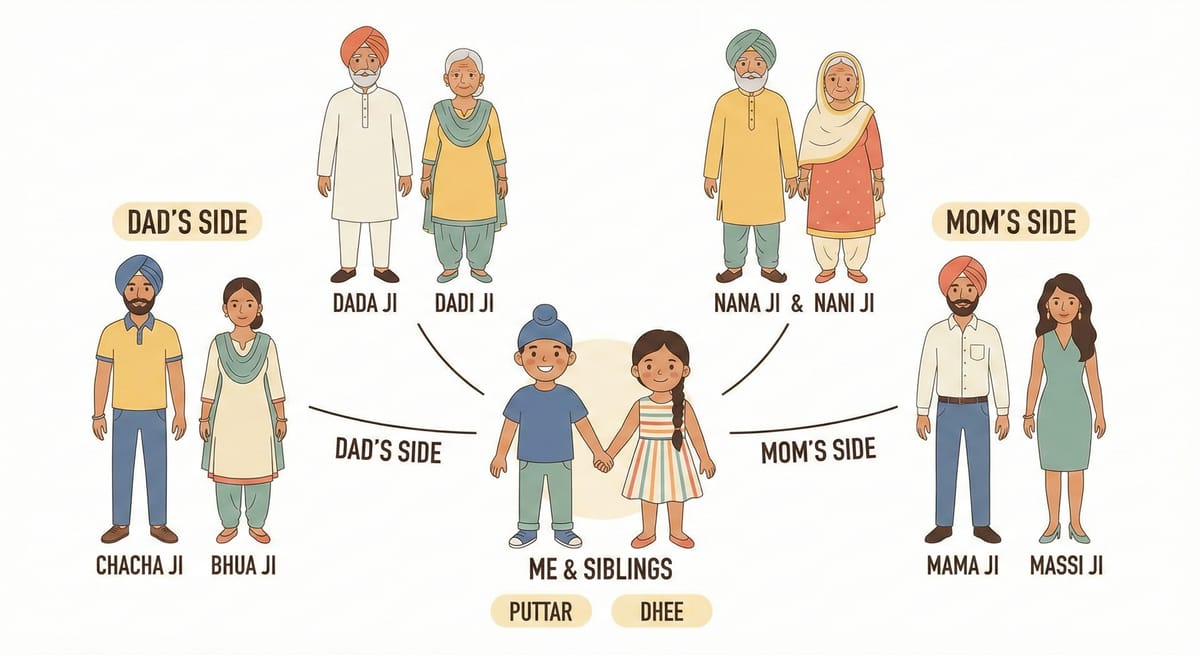
A printable worksheet where your child writes the names of their family members next to each Punjabi title — Dada Ji, Nani Ji, Chacha Ji, Massi Ji, and more. Helps children learn traditional kinship terms by connecting them to real people they love.
Download Free PDFFree to download No ads No login Made by Sikh parents and educators
Also from Maastarji

What's in the Worksheet
The worksheet covers all major Punjabi family relationship titles — both sides of the family. Your child writes in each person's name, creating a personalised family tree they will actually recognise and remember.
Dad's Side (Paternal)
Mum's Side (Maternal)
How to Use This Worksheet
1. Download and Print
Download the free PDF and print on standard US Letter (8.5″ × 11″) or A4 paper. Set printer margins to "None" for the best fit. Print as many copies as you need — one per child works best.
2. Fill in Your Family
Write the names of your family members next to each Punjabi title. Start with grandparents — Dada Ji, Dadi Ji, Nana Ji, Nani Ji — since children usually know them by a name already.
3. Practice Saying the Titles
Read each title aloud together. Remind your child to add "Ji" — it is the Sikh honorific that shows respect. Try it in a sentence: "Let us call Chacha Ji for dinner."
4. Display It
Pin the completed worksheet on the fridge, the bedroom wall, or a learning board. Seeing the names daily is the fastest way to make them stick. Laminate it for longer use.
Why Punjabi Family Names Matter for Diaspora Kids
In English, a father's brother and a mother's brother are both just "Uncle." In Punjabi, they are Chacha Ji and Mama Ji — two entirely different roles, each carrying its own meaning, its own warmth, and its own place in the family structure.
For children growing up in the diaspora — in Canada, the UK, the US — this richness is often the first casualty of distance. Extended family lives in different cities or countries. Visits are rare. Without regular contact, the Punjabi titles drift into the generic English "Auntie" and "Uncle," and the specific relationships they named quietly disappear.
This worksheet is a small act of preservation. By writing a real person's name next to each Punjabi title, a child is not memorising an abstract vocabulary list — they are mapping their own family. Dadi Ji is not just a word; she is the grandmother whose name the child just wrote. Massi Ji is the specific aunt who shares her mother's soul.
The Sikh tradition holds family as the foundation of spiritual life. Guru Arjan Dev Ji wrote: ਤੂੰ ਮੇਰਾ ਪਿਤਾ ਤੂੰ ਹੈ ਮੇਰਾ ਮਾਤਾ — "You are my Father, and You are my Mother." Seeing the Divine in every relationship begins with knowing what those relationships are.
More Free Resources
Punjabi Family Names Guide
Full guide to all Punjabi relationship titles — with Gurmukhi, meanings, and practice sentences.
Sikh Relationships Quiz
Test your child's knowledge of Punjabi family titles with this free interactive quiz.
All Printable Worksheets
Browse the full collection of free printable Sikh and Gurmukhi learning materials.
Learn Punjabi for Kids
Explore the full Punjabi language learning section — vocabulary, letters, and more.
Frequently Asked Questions
- Is this Punjabi family tree worksheet really free?
- Yes — completely free with no sign-up, no email gate, and no ads. Download the PDF directly and print as many copies as you need. Share it with family, friends, or your Gurdwara Sahib class.
- What age is this worksheet suitable for?
- The worksheet is designed for children aged 4 to 10. Younger children (4–6) will need a parent to help fill in the names — that conversation is part of the learning. Older children (7–10) can fill it in independently with some guidance.
- What Punjabi family relationship words are on the worksheet?
- The worksheet covers both sides of the family. Paternal side: Dada Ji, Dadi Ji, Taya Ji, Tayi Ji, Chacha Ji, Chachi Ji, Bhua Ji, Phuphar Ji. Maternal side: Nana Ji, Nani Ji, Mama Ji, Mami Ji, Massi Ji, Massar Ji.
- Can I use this worksheet in a Gurdwara Sahib or classroom?
- Yes — please do. The worksheet is free to print and distribute in any educational setting: Gurdwara Sahib classes, heritage schools, home classrooms, or community events. No permission is required.
- What is the difference between Taya Ji and Chacha Ji?
- Both are your father's brothers, but the distinction matters in Punjabi culture. Taya Ji is your father's older brother — accorded the highest respect next to the grandfather. Chacha Ji is your father's younger brother, traditionally the affectionate, playful second-father figure.
- Why does Punjabi have so many different words for aunts and uncles?
- Unlike English, which uses a single word for both sides, Punjabi has a distinct title for every relationship. This reflects a community-centred culture where each relative has a specific role — which side of the family they come from, and whether they are older or younger, all shapes how a child relates to them. The names are not just labels; they are a map of belonging.