
The boy who lost an eye to smallpox took Lahore at nineteen, united the Sikh misals, and ruled Punjab for forty years without ever wearing a crown. A free Sikh history story for ages 4–12 about Maharaja Ranjeet Singh, the Lion of Punjab, told from a Khalsa point of view.
The Boy with One Eye
On a cold November morning in 1780, a baby boy was born in a small town called Gujranwala in the heart of Punjab. His parents, Sardar Mahaan Singh and Mata Raj Kaur, named him Ranjeet — Victor of Battles. He was the only son of the Sukerchakkia chief, and people came from far and wide to see him.
But before his second birthday, a terrible sickness called smallpox swept through Punjab. Many children did not survive. Little Ranjeet did. He lived — but he lost his left eye, and his face was marked forever.
When the boy was old enough to understand, some children pointed and whispered. But his mother would tell him often — and the old soldiers and the granthi would tell him too — that the one eye he had left was enough; that with it he would learn to see what others missed.
He never forgot those words.
Ranjeet learned to ride a horse almost as soon as he could walk. The old soldiers in his father’s court placed a matchlock gun, a sword, and a spear in his hands and taught him to use each one well. He learned the names of the Ten Gurus and the meaning of Ik Onkar — One Creator. He listened more than he spoke.
His grandfather had ridden with the great Sikh Sardars who fought the Mughal armies. His great-great-grandfather, Buddha Singh, had been a companion of Guru Gobind Singh Ji himself. The blood of the Khalsa ran in him.
Father Is Gone
Ranjeet was ten years old when his father, Sardar Mahaan Singh, fell. He had ridden his whole short life for the Sukerchakkia Misal, and the Khalsa honoured him the way a warrior is honoured — with raised swords and the chant of Waheguru Ji Ka Khalsa, Waheguru Ji Ki Fateh.
The whole misal gathered. The sardars turned to the boy — the only son of their fallen chief — and looked at him the way warriors look at the next warrior. Ranjeet stood before his father’s seat with his head up. He did not weep. He was a Khalsa boy, and he stood the way he had been taught to stand.
His mother, Mata Raj Kaur, became regent, helped by an old advisor called Diwan Lakhpat Rai. But the real teacher of those years was his mother-in-law, the fearless Mai Sada Kaur of the Kanhaya Misal. She had no son of her own. She saw something in this quiet, one-eyed boy that the others did not see. He was a boy who listened — and a king who listens, Mai Sada Kaur knew, is rarer than gold.
She let him ride beside her into council meetings. She let him sit and hear the old chiefs argue. She did not lecture him. She let him watch. By twelve, he was riding into small skirmishes. By fifteen, he was leading them. By seventeen, he had begun to gather the scattered Sukerchakkia villages back under one flag.
Punjab in those years was held by twelve Sikh misals, each with its own sardar and its own banner. For a hundred years before Ranjeet Singh was born, the Khalsa had been pushing back the foreign raiders. Banda Singh Bahadur had broken the Mughal grip at the Battle of Sirhind, raised the first Khalsa Raj over the lands he won, and struck the first sovereign coin ever minted in the names of Guru Nanak Dev Ji and Guru Gobind Singh Ji. After him, Jassa Singh Ahluwalia and the Dal Khalsa had driven Ahmad Shah Abdali back across the Indus. The sardars had taken Lahore and struck their own coin again in the name of the Gurus. The bleeding of seven centuries had been slowed. The door to Punjab had been held.
But it had not yet been closed — and the twelve misals, brave as they were, were still twelve. From the west, Afghan armies still came over the Khyber Pass when they thought they could.
Ranjeet listened. He watched. He was waiting.
The Gates of Lahore
In 1799, Ranjeet Singh was nineteen years old.
Lahore was the greatest city in Punjab — its walls thick, its bazaars famous, its mosques and gardens known from Kabul in the west to Delhi in the east. But Lahore was suffering. Three chiefs of the Bhangi Misl — Chet Singh, Sahib Singh, and Mohar Singh — ruled it badly. They taxed the merchants until trade stopped. They quarrelled with one another. The people of Lahore — Sikh, Hindu, and Muslim alike — had had enough.
A group of Lahore’s leading citizens travelled in secret to Ranjeet Singh’s camp. Among them were Muslim qazis, Hindu shopkeepers, and Sikh sardars. They asked him to come and take their city.
“Sarkar,” they said, “we will open the gates ourselves.”
Ranjeet Singh did not march in like a conqueror. With Mai Sada Kaur’s horsemen behind him, he rode quietly to Lahore on the seventh of July, 1799. Just as the citizens had promised, the Lohari Gate swung open from the inside. He entered the city without a single battle in the streets.
Sahib Singh and Mohar Singh fled the city. Chet Singh took shelter inside the Lahore Fort. Mai Sada Kaur stepped in and made peace between them — and Ranjeet Singh, instead of punishing the man he had just defeated, gave Chet Singh a piece of land to live on in dignity for the rest of his days.
He issued strict orders to his soldiers: no citizen of Lahore was to come to the slightest harm. No looting. No threats. The bazaars were to stay open. The people of Lahore — Sikh, Hindu, and Muslim — were to go about their work as they always had.
The next day he held an open assembly. He called the leaders of every community of the city — the Muslim Mian Mohkam Din, the Hindu Hakeem Hakim Rai, the Sikh Bhai Gurbakhsh Singh, and many others — and honoured each of them by name. To Mian Mohkam Din, the elder who had organised the petition that brought him to Lahore, he gave the title Baba — Grandfather. Money was set aside to rebuild the outer walls of the city and the fort.
He was nineteen years old, and Lahore was his.
No Crown
Two years later, in 1801, the sardars gathered in Lahore for a ceremony. They wanted to crown Ranjeet Singh as Maharaja — King of Punjab.
A descendant of Guru Nanak Dev Ji himself, Baba Sahib Singh Bedi, came to bless the young ruler. The sardars brought silks and jewels. Some had even prepared a golden throne.
When Ranjeet Singh saw it, he gently waved it away.
“This Government,” he told them, “is run through the grace of Guru Nanak Dev Ji, the true prophet, to whom all of us together are devoted. I am only a servant of the nation.”
He refused to be crowned. He refused to wear a crown for the rest of his life. He took the simple title Sarkar Khalsa — the Government of the Khalsa — and called himself only Singh Sahib.
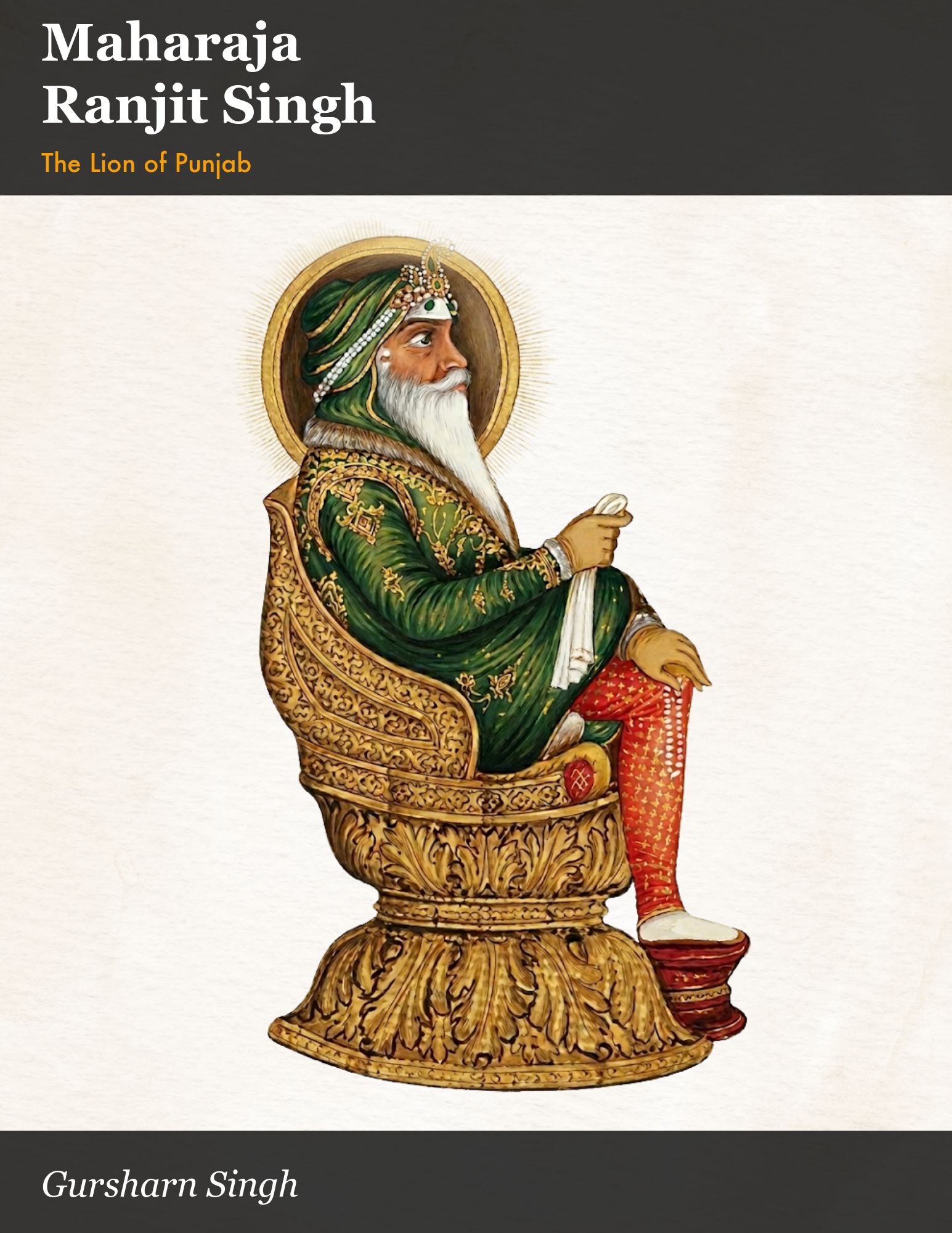
The chair he sat on was a beautiful one, made in his court — a golden seat covered with carved petals. But he did not sit on it the way a Mughal king sat enthroned. He sat cross-legged on it, one hand on his knee, the other stroking his long white beard. Foreign visitors who expected a haughty king on a high seat met instead a quiet man who looked them in the eye and asked them questions. (After his death, the British carried that golden chair away to London. It is still there today, in a museum.)
Coins struck during his reign did not carry his face. They carried a verse in Persian that named the gifts of the Gurus — Abundance, power, victory, and help without delay — these are the gifts of Nanak and Guru Gobind Singh. The kingdom did not belong to him. He was only its servant.
The Khalsa Army
To protect a kingdom, you need an army. Ranjeet Singh built one of the finest armies in all of Asia.
He called it the Fauj-i-Khas and the Sikh Khalsa Army. It was not a tribe of warriors riding wherever they pleased. It was a real army — paid on time, fed well, trained every day. Soldiers wore matching uniforms. Cavalry charged in formation. Cannons fired together. Infantry stood in disciplined lines.
He hired generals from far away to teach his soldiers the newest fighting styles. From Napoleon’s old armies in Europe came General Allard, General Ventura, and General Avitabile. From America came Colonel Gardner. They drilled the troops in European tactics. But Ranjeet Singh laid down clear terms for every foreign officer who joined him: they had to keep their beards, smoke no tobacco, and swear loyalty to the Sarkar Khalsa above any old country of their own — even if that meant fighting one day against the people they had come from. The Khalsa Army was the Guru’s army. It would learn from anyone. It would not change for anyone.
His soldiers were Sikh, Hindu, and Muslim. Pathans from the hills served in his cavalry. Gurkhas from the mountains marched in his ranks. Their commanders, however, were almost all Sikhs of the Khalsa.
And what commanders they were.
Hari Singh Nalwa was a giant of a man with a giant of a name. As a young soldier in the Maharaja’s hunt he had killed a tiger single-handed with sword and shield — that is how he earned the name Nalwa. He led the army into Kashmir, into Multan, into Peshawar. Across the river Indus, mothers would quiet their children at night by whispering, “Hush, or Hari Singh will come.” No general before him had ever made the invaders afraid.
Akali Phula Singh was the head of the Nihangs — the warrior-saints of the Khalsa. He wore a tall blue dumalla turban stuck with steel chakkars and a sword across his back. He was a Jathedar of Sri Akal Takht Sahib, the highest seat of Sikh authority in Amritsar. He feared no man. He charged at the head of the Khalsa cavalry into the great battle of Naushehra against the Pathans, and gave his life there for the Sarkar Khalsa.
There were others. Sham Singh Atariwala, calm and brave. Diwan Mokham Chand, a Hindu commander Ranjeet Singh trusted with his life. Misr Diwan Chand, the captor of Multan. Fateh Singh Ahluwalia, his blood brother in turban-exchange.
This was not just an army. It was a brotherhood of the brave.
A Kingdom for Everyone
A kingdom is more than an army. A kingdom is how people live.
In Ranjeet Singh’s Punjab, a Sikh peasant, a Hindu shopkeeper, and a Muslim weaver could walk the same street and not fear each other. The Maharaja’s court showed Punjab what was possible.
His foreign minister was a Muslim — Fakir Azizuddin, a doctor, a poet, a man who spoke Persian, Arabic, and Punjabi with equal grace. When foreign ambassadors came, it was Fakir Azizuddin who met them on the Maharaja’s behalf. His finance minister was a Hindu — Diwan Dina Nath. His most trusted military commander for years was the Hindu Diwan Mokham Chand. His chief artillery officer, Ghaus Khan, was a Muslim. His scholars were of every faith.
He restored the Sri Harimandir Sahib in Amritsar — the holiest place of the Sikhs — and covered its upper walls with gold. But he did not stop there. He repaired Hindu temples that had been broken. He gave grants to Muslim shrines and mosques that had fallen into ruin. He honoured the dargah of Sai Mian Mir in Lahore — the Muslim saint who had once laid the foundation stone of the Sri Harimandir Sahib at Guru Arjan Dev Ji’s invitation.
What he was doing was very simple. He was living the teaching that Guru Nanak Dev Ji had given to the world long before him:
Gurbani Wisdom
ਗੁਰਮੁਖਿ ਏਕ ਦ੍ਰਿਸਟਿ ਕਰਿ ਦੇਖਹੁ; ਘਟਿ ਘਟਿ ਜੋਤਿ ਸਮੋਈ ਜੀਉ ॥
By the Guru’s grace, see all with the same one eye — for in every heart, the Lord’s light is contained.
— Guru Nanak Dev Ji, Sri Guru Granth Sahib Ji, Ang 599
In the year 1813, a great jewel came into Ranjeet Singh’s hands. Its name was Koh-i-Noor — Mountain of Light — the most famous diamond in the world. For five hundred years it had passed between conquerors, soaked in war. Ranjeet Singh did not lock it in a treasury. On the great days of state, he wore it openly on his person for all to see. To him it was not treasure. It was a sign that the wealth of Punjab — looted again and again by foreign raiders — had finally come home.
His mother had told him long ago that one eye would be enough. With it he had learned to see what others missed. He had learned to see that a Hindu, a Muslim, and a Sikh, when you look at them with the One Eye of Ik Onkar, are simply three children of the same Creator.
The Lion at Jamrud
For seven hundred years, the story of Punjab had been the same. From across the Khyber Pass, in the rocky mountains beyond the Indus river, foreign armies would come. Ghazni had come. Ghori had come. Babur had come. Nadir Shah had come. Ahmad Shah Abdali had come — again and again. They burned, they took, they left.
Ranjeet Singh decided this story would end.
Hari Singh Nalwa led the Khalsa Army north. They crossed the Indus river — for the first time in centuries, an army was crossing it going west instead of east. They took the city of Attock. They took Peshawar. They climbed into hills where Punjabi soldiers had never set foot.
And then, at the very mouth of the Khyber Pass, on a rocky hill called Jamrud, Hari Singh Nalwa built a fort.
It was a simple fort. Stone walls. Cannons facing west. The Khalsa flag of saffron and blue flying above it. But what it meant was huge.
For the first time in centuries, the door to Punjab was closed and the Khalsa held the key.
In April 1837, a large Afghan army marched down through the Khyber to take the fort back. Hari Singh Nalwa was inside it. He was already ill. His soldiers begged him to stay back. He refused. He rode out at the head of his men. The fort held. The Afghans were turned away. But Hari Singh Nalwa was wounded in the battle and died soon after — his last command being to keep his death a secret from the Afghans until they retreated, so they would not return.
The fort held.
After Jamrud, no foreign army ever marched into Punjab again through the Khyber. The flow of seven centuries — the looters from the west — was finally reversed. For the first time, Pathan tribes in the hills paid tribute to a Punjabi ruler instead of raiding him. People in Lahore spoke the name of Hari Singh Nalwa with quiet pride. Children sang songs about him.
Ranjeet Singh had done what no ruler of Punjab or Hindustan had managed in seven centuries.
The Eye That Closed
Maharaja Ranjeet Singh died on the twenty-seventh of June, 1839. He was fifty-eight years old.
For forty years he had ruled Punjab. He had ruled with one eye, no crown, and a seat he sat on cross-legged like his own people. He left behind a kingdom that stretched from Tibet in the east to the Khyber Pass in the west, from Kashmir in the north to Sindh in the south. The British, who had quietly watched him for decades from across the Sutlej river, had never dared to attack him while he lived. The Afghans had stopped raiding. The Pathans paid tribute. The bazaars of Lahore and Amritsar were full of merchants from every country.
But after he closed his one good eye, the kingdom he had built did not last.
A small group of his own ministers — the Dogra brothers Gulab Singh, Dhian Singh, and Suchet Singh, who had risen to high office in his court — turned to plotting. They quarrelled with the Sandhanwalia chiefs. They secretly wrote letters to the British. Sons and grandsons of the Maharaja were killed one after another. In just ten years, the Khalsa Army was tricked into two wars with the British that they fought bravely but lost through the treachery of their own commanders. By 1849, the kingdom Ranjeet Singh had built was gone. The British took Punjab. The Koh-i-Noor was carried away to London.
This is the part of the story that hurts.
But the kingdom that lasted only a few decades changed the world for ever.
For four short decades, Punjab had shown what a Khalsa Raj could look like. A kingdom where a Sikh ruler placed a Muslim minister at his right hand and a Hindu minister at his left. A kingdom where mosques were rebuilt and temples were restored and the Golden Temple shone in gold. A kingdom where the wealth of Punjab stayed in Punjab. A kingdom where for the first time in seven centuries, the people slept without fear of raiders. A kingdom where the king sat cross-legged on his seat the way his people sat in their own homes.
Maharaja Ranjeet Singh had lived the teaching of Guru Nanak Dev Ji: that under the gaze of Akal Purakh there are no Hindus and Muslims and Sikhs — only one light, in every heart, seen with one eye. He had lived what Guru Gobind Singh Ji had built the Khalsa to do — to defend the weak, to rule justly, and to bow before no crown but the One Creator’s.
A British observer named McGregor, who watched the Maharaja closely in his old age, wrote that he still sat cross-legged on his chair, one hand resting on his knee, the other stroking his long white beard — that his favourite topic of talk was the army of the Khalsa — that every afternoon he had the Granthis come and read aloud to him the words of Sri Guru Granth Sahib Ji — and that after a victory in battle, however fiercely the enemy had fought, he was never cruel and never bloodthirsty. He would listen, McGregor wrote, very still, with his one good eye.
That is the king we should remember.
The eye that saw no difference between people. The eye that watched, and waited, and learned. The eye of the one-eyed boy from Gujranwala — who became the Lion of Punjab.
Discussion Questions
Let’s Talk About It: Maharaja Ranjeet Singh refused to wear a crown. He sat cross-legged on his seat — never the way a Mughal king sat enthroned. Why do you think he did that? What do you think it told his people about the kind of ruler he wanted to be?
Let’s Think About It: Ranjeet Singh’s mother told him as a boy that “the eye you have left is enough — with it you will learn to see what others miss.” What do you think she meant? Can you think of a time when something that looked like a problem turned out to be a strength?
Let’s Try It: The Maharaja’s court had a Muslim foreign minister, a Hindu finance minister, and Sikh generals. Draw a picture of his darbar (court) with people of different faiths seated together. Under your picture, write one rule of fairness that you would want in your own kingdom.
Word Meanings
| Word | Meaning |
|---|---|
| Misal | One of the twelve independent Sikh confederacies that ruled different parts of Punjab in the 1700s |
| Banda Singh Bahadur | The first Sikh military commander after Guru Gobind Singh Ji; in the early 1700s he led the Khalsa into the Mughal heartland, broke the Mughal grip at the Battle of Sirhind (1710), raised the first Khalsa Raj over the lands he won, and minted the first sovereign coin ever struck in the names of Guru Nanak Dev Ji and Guru Gobind Singh Ji |
| Dal Khalsa | ”The Army of the Khalsa” — the combined fighting force of all the Sikh misls in the 1700s. The misls would come together as the Dal Khalsa to face foreign invaders, then return to their own territories |
| Jassa Singh Ahluwalia | A great Sikh sardar of the 1700s and one of the supreme commanders of the Dal Khalsa; he led the Khalsa in driving Ahmad Shah Abdali back across the Indus |
| Sardar | A Punjabi word for a chief or leader; often used for respected Sikh men |
| Mata | ”Mother” — used with respect before a woman’s name |
| Putt | A Punjabi word of affection meaning “son” or “child” |
| Granthi | A person who reads from and cares for Sri Guru Granth Sahib Ji in the Gurdwara |
| Ik Onkar | The first words of Sri Guru Granth Sahib Ji — “One Creator” — the central teaching of Sikhi |
| Akal Purakh | ”The Timeless One” — a name for the One Creator in Sikhi |
| Khalsa | The community of initiated Sikhs created by Guru Gobind Singh Ji in 1699 |
| Sarkar | Punjabi/Persian word meaning “government” or “the one in charge” |
| Sarkar Khalsa | ”The Government of the Khalsa” — what Maharaja Ranjeet Singh called his rule |
| Sangat | The community of Sikhs gathered together |
| Akal Takht | ”The Throne of the Timeless One” — the highest seat of Sikh authority, in Amritsar, established by Guru Hargobind Sahib Ji |
| Jathedar | The leader of a group of Sikhs; the head of one of the five Takhts |
| Nihang | A Sikh warrior-saint who wears blue robes and a tall turban; the army of the Khalsa |
| Dumalla | The tall, layered turban worn by Nihang Sikhs |
| Chakkar | A round steel weapon worn on the turban or thrown in battle |
| Sri Harimandir Sahib | ”The House of the Lord” — the holiest Sikh shrine, also called the Golden Temple, in Amritsar |
| Darbar | A royal court where the ruler meets ministers, soldiers, and visitors |
| Hindustan | The name used in Punjabi, Persian, and Sikh sources for the lands east of Punjab — the Mughal heartland around Delhi and the plains beyond. During Maharaja Ranjeet Singh’s reign, Punjab was an independent country, the Sarkar Khalsa, separate from Hindustan |
| Khyber Pass | A narrow mountain pass between Afghanistan and what is now Pakistan; for centuries the road by which invaders came down from the west into Punjab and Hindustan beyond |
| Koh-i-Noor | ”Mountain of Light” — a famous diamond now kept by the British royal family |
| Waheguru | ”Wonderful Lord” — a name Sikhs use for the One Creator |
About This Story
Maharaja Ranjeet Singh ruled Punjab from 1799 to 1839, building what is often called the Sikh Empire or the Sarkar Khalsa. During his reign, Punjab was an independent sovereign country, separate from Hindustan to the east and from Afghanistan to the west — ruled from Lahore, with its own army, its own coinage, and its own foreign policy. Born in Gujranwala (in what is now Pakistan), he lost his left eye to smallpox as an infant. At ten he inherited the leadership of the Sukerchakkia Misal. At nineteen he took Lahore. By his early twenties he had begun unifying the twelve quarrelling Sikh misals into a single state.
His kingdom was the first in seven centuries to halt the long history of foreign invasions through the Khyber Pass. Under his great general Hari Singh Nalwa, the Khalsa Army crossed the Indus, took Peshawar, and built the fort at Jamrud that finally closed the western gate of Punjab. His court included Sikh, Hindu, and Muslim ministers, and he was known across Asia and Europe for his religious tolerance, his disciplined administration, and his refusal to wear a crown.
After his death in 1839, his empire fell within a decade — undone partly by the treachery of court factions, including the Dogra brothers who had risen under him, and finally annexed by the British East India Company in 1849. The Koh-i-Noor diamond, which he had worn as an armband, was sent to London.
Much of what was written about Ranjeet Singh in English came from British officers and historians of the time, who naturally told the story from their own side. This book is written from a Khalsa point of view — drawing on Punjabi historians, especially Sohan Singh Seetal’s The Sikh Empire and Maharaja Ranjeet Singh — to tell our children, in our own voice, the story of the one-eyed boy from Gujranwala who became the Lion of Punjab.
Explore More
- The Light of Truth: The Life of Guru Nanak Dev Ji — The teacher whose words “There is no Hindu, there is no Muslim” laid the foundation of the kingdom of equality Ranjeet Singh would later build
- The Brave 22: The Story of Bhai Tara Singh Ji Wan — A Sikh warrior of the misal era, from the generations of Khalsa fighters that came before Maharaja Ranjeet Singh
- Ten Lights, One Flame — The story of the Ten Gurus, whose teachings the Sarkar Khalsa was built to protect