
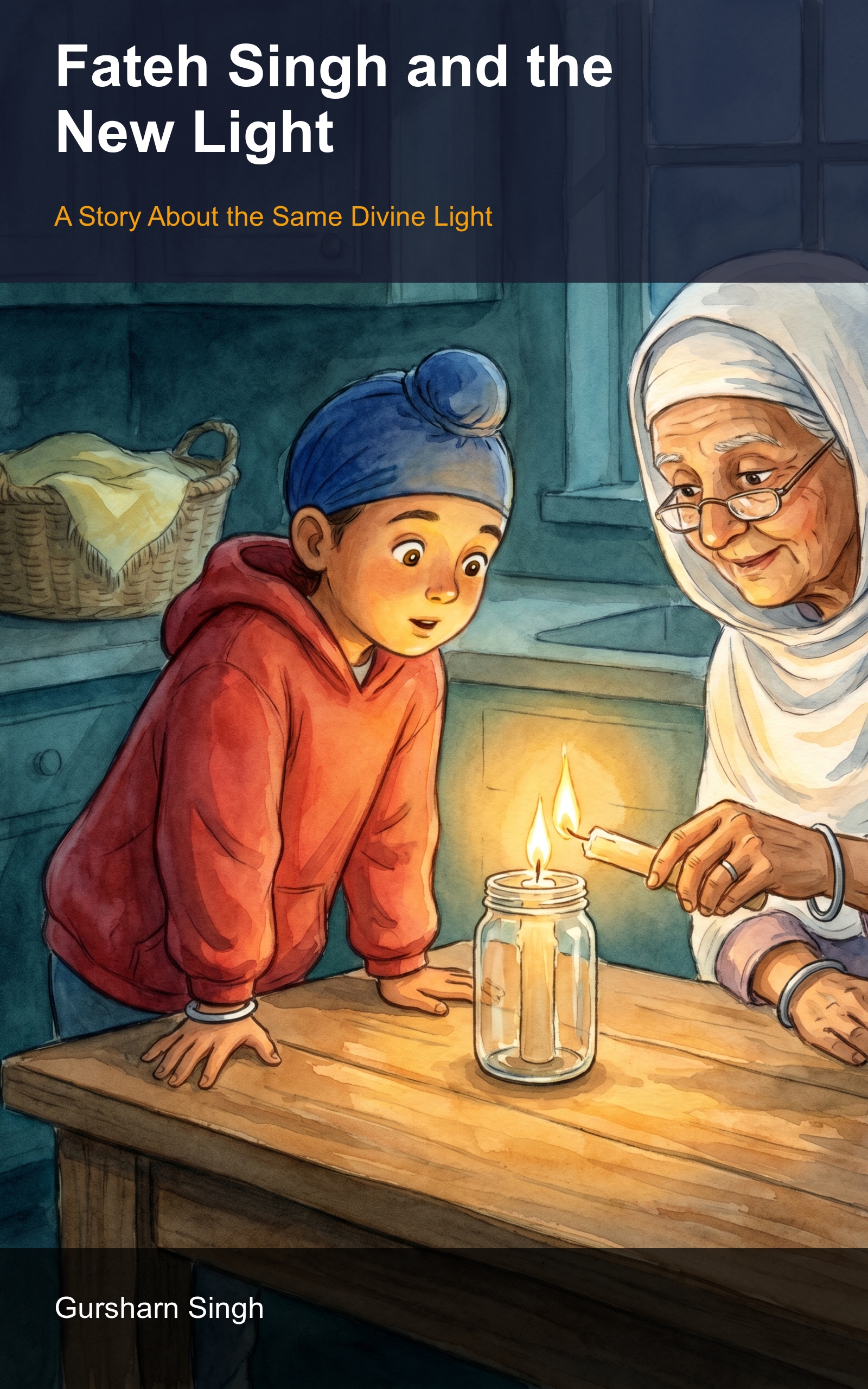
Fateh Singh and the New Light is a free illustrated Sikh story for ages 4–12 about a new baby, jealousy, and the same divine Light in everyone. When baby Jot Kaur comes home, the whole house turns towards her and Fateh starts to feel invisible, until one night he takes back a blanket that used to be his. Dadi ji doesn’t scold him. She lights a second candle from the first.
The Hospital Bag
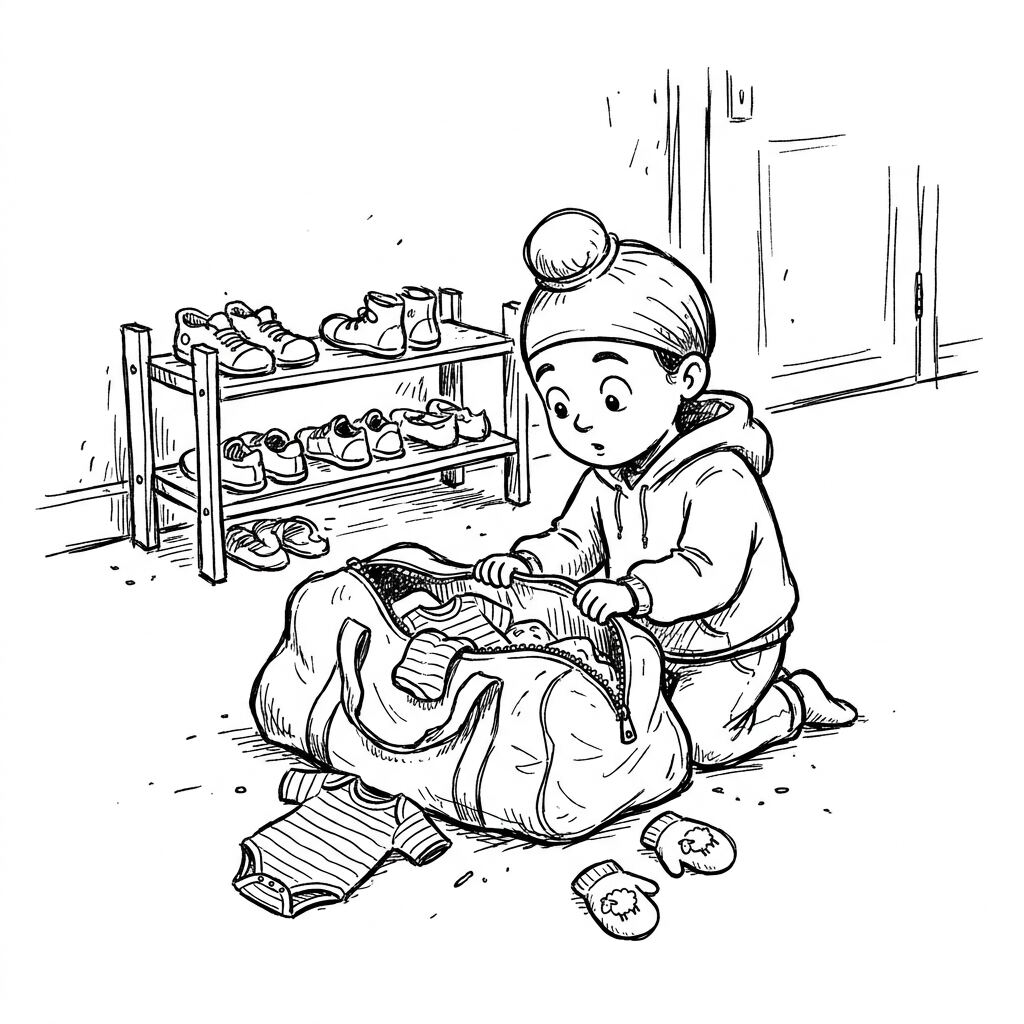
The hospital bag stood by the front door for three weeks before anyone used it.
It was navy blue with a broken zip pull that Dad had fixed with a paper clip, and it leaned against the shoe rack like a guest who wouldn’t sit down. Mum packed it. Then she unpacked it and packed it again. Then Dadi ji unpacked it and packed it properly.
Fateh Singh had unzipped it once, when nobody was looking. Inside: vests folded into squares no bigger than postcards. Mittens the size of his thumbs. Nappies. Mum’s slippers, the grey ones. A blanket so soft his fingers couldn’t decide if they were touching it.
“But why does the baby need mittens in June?” he asked, one evening.
“Because babies come out not knowing how to keep warm,” said Mum. “They have to learn everything. Warm. Day. Night. Everything.”
“But why don’t they know already?”
“You didn’t,” said Dadi ji, who missed nothing. “You wore the same mittens. You looked like a small angry potato.”
“I did not.”
“There are photographs.”
That was June. Fateh Singh was six, and the summer stretched out in front of him like a road. He had plans. The Lego spaceship on his desk had finally got its cargo bay sorted, and he was building something new — something secret, small, with a square head and feet that gripped a shelf. A robot. A present. Because somewhere past the hospital bag and the tiny vests and Mum’s tiredness, there was a baby coming, and Fateh Singh had decided the baby would need a guard for her shelf, to keep watch while she slept.
He was, at this point, completely in favour of the baby.
The bag went to the hospital on a Tuesday night. He woke to the landing light on and voices moving downstairs — Dad’s keys, Mum breathing slow and careful, the front door clicking shut. He knelt at his window and watched the car’s red lights go down the street, past Mrs. Kapoor’s, around the corner, gone.
Dadi ji was standing in his doorway in her white chunni.
“Go back to sleep, Fateh,” she said. “When you wake up, you’ll be somebody’s big brother.”
He lay in the dark and listened to the planes coming into Heathrow, one every minute or two, low and steady, like the sky breathing.
He counted eleven before he fell asleep.
The House of Whispers
Jot Kaur came home on a Thursday, and she was smaller than the bag they’d packed for her.
Dad carried the car seat in with both hands, level, like it was full of water. Mum came in slowly, holding the door frame. And inside the car seat, under the blanket that was too soft to feel, was a face — small and cross and crumpled, like a fist that hadn’t decided whether to open.
“Fateh,” whispered Mum. “Come and meet your sister.”
He came and met her. She was asleep. Her whole face was busy with sleeping — eyebrows moving, lips moving, working hard at it.
“She’s very small,” he said.
“She’ll grow,” said Dad.
That was Thursday. By Saturday, the house had changed its voice.
The whole house whispered now. The telly whispered. The doors were closed slowly, with two hands. Even Dadi ji’s pressure cooker — which had hissed every Saturday morning of Fateh Singh’s entire life, six o’clock, regular as the planes — stayed silent that weekend. The kitchen felt wrong without it, like a clock that had stopped.
And the aunties came.
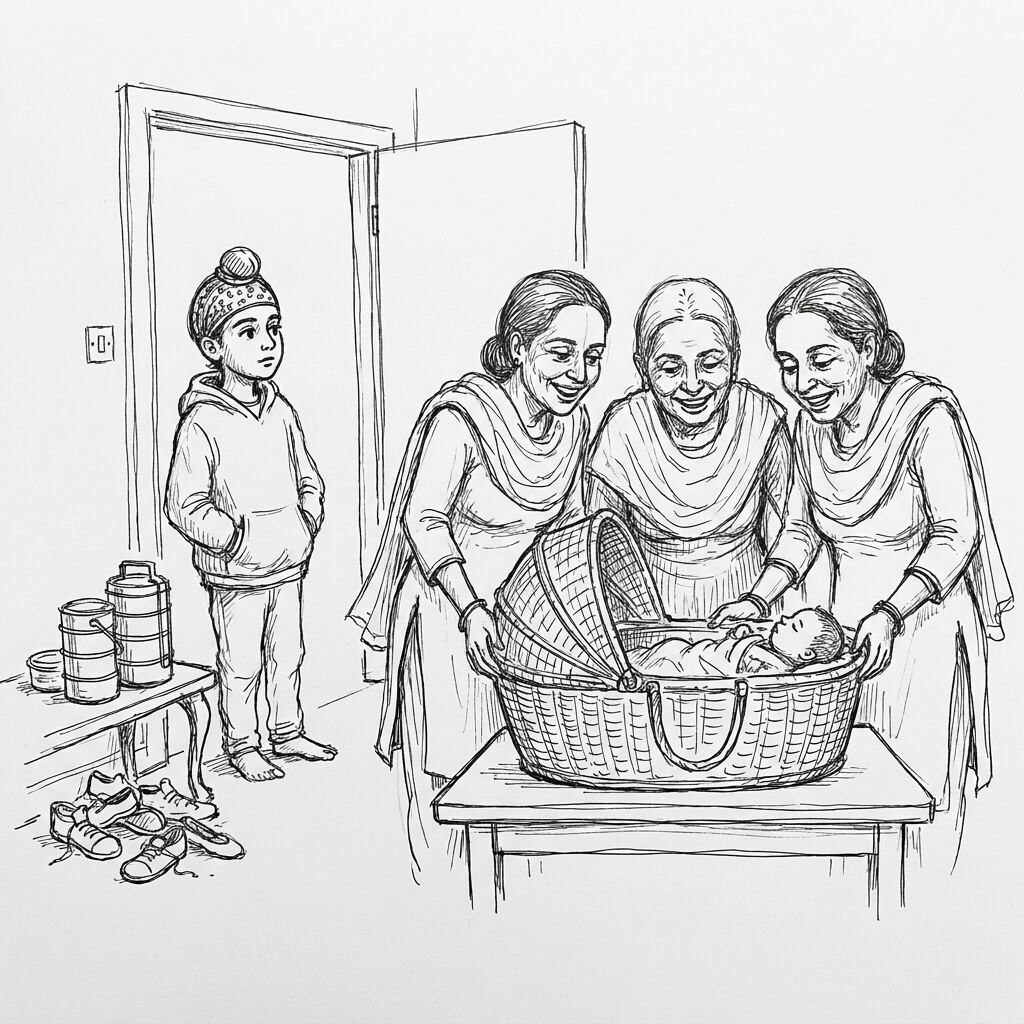
They came in twos and threes, carrying steel containers, leaving their shoes in a drift by the door. They crossed the front room straight to the basket and bent over it the way people bend over something precious, and the room filled with the sounds people make at babies — hai, and oh-ho, and long soft words in Punjabi that dipped in the middle.
“She has your Dad’s nose.”
“She has your Mum’s frown.”
“She has Dadi ji’s ears, look. Look at the ears.”
Nobody said she had Fateh’s anything.
Fateh Singh stood at the edge of the room in his red hoodie with the robot in his pocket. He’d finished it on Friday — square head, gripping feet, a little brick heart inside the chest where nobody could see it. He was waiting for a gap in the grown-ups, a space to step into and say: I made her this. It’s a guard robot. It keeps watch.
The gap never came.
“Gentle, Fateh,” said an auntie, when he leaned in to look.
“Wash your hands first, beta,” said another.
“Not so close. Not so loud. Mind her head.”
He hadn’t touched anything. He hadn’t said anything. He went up to his room and put the robot on his own shelf, between the fire station and the helicopter, facing the wall.
The Shrinking House
The house didn’t get smaller. It just started belonging to someone else.
It happened in pieces, so quietly that he couldn’t have pointed at any one piece and said: there, that’s the problem.
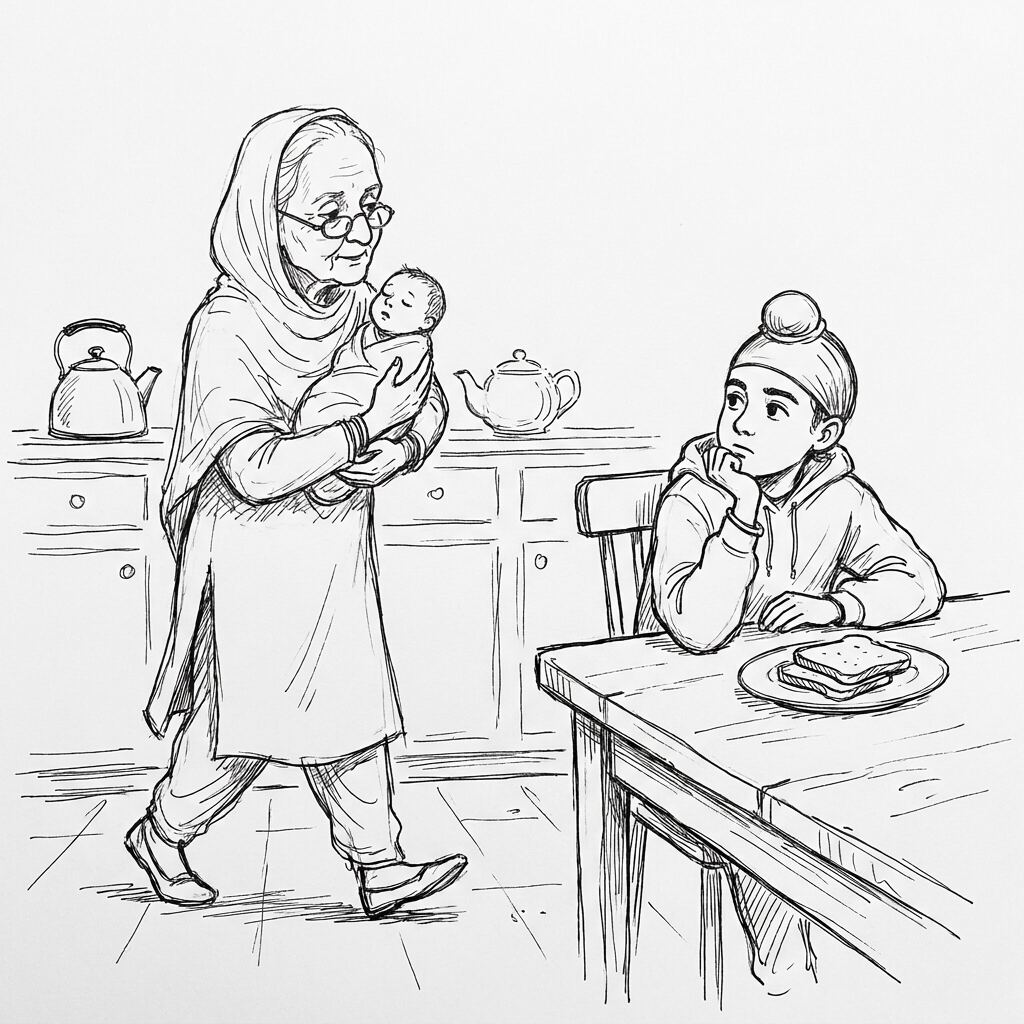
After school there was still toast, buttered right to the corners, the way he liked. But the ten minutes that came with it were gone. Dadi ji used to sit across from him while he ate and ask one question about his day — just one, always a good one — and listen to the whole answer. Now she walked the kitchen, up and down, with Jot against her shoulder, patting a slow rhythm on the baby’s back, and the one good question never came.
Dad still tied Fateh’s patka in the bathroom mirror every morning. But his hands moved fast now, and his eyes kept sliding sideways to the baby monitor balanced on the towel rail, where Jot’s sleeping crackle rose and fell like weather. One morning the patka came out crooked, the fold sitting wrong above Fateh’s left ear.
Dad didn’t notice.
Fateh didn’t tell him.
Mum was asleep at four in the afternoon, which was against every rule of the universe. When she was awake, she was feeding Jot, or winding Jot, or looking at Jot with her whole face soft in a way that made something pull tight in Fateh’s chest, high up, near the collar of his hoodie.
“Mum. But why does she eat so many times? Nobody eats that many times.”
“Later, Fateh.”
“But why does she cry when nothing’s even wrong—”
“Later, Fateh. Please.”
Later had become the busiest word in the house.
On Sunday an auntie he only half knew pinched his cheek in the hallway and said, “Not the baby of the house any more, hain?” — and laughed, as if this was wonderful news, as if it was a present she was giving him.
And then there was the blanket.
Mum brought a box down from the loft, and the box smelled of dust and a summer from before he could remember. Inside, under a pair of tiny mittens — the angry-potato mittens — was a blanket. Yellow, gone soft and thin with washing, with grey elephants marching trunk-to-tail around the edge.
“Oh,” said Mum, in a voice like finding money in a coat. “Fateh, look. This was yours. You wouldn’t sleep without it. You used to hold one elephant by the trunk — this one, look, the flat one.”
He looked at the flat elephant. He didn’t remember it. His hand remembered something, maybe — a smallness, a warmth — but he didn’t.
That evening, Mum tucked the yellow blanket around Jot Kaur in her basket. It fit her exactly. The elephants marched around her like a little grey fence, and she slept inside them with her fists up by her ears.
It looked right around her. That was the worst part.
Fateh Singh went upstairs and took the helicopter apart. Piece by piece, into the box, until it was nothing.
He didn’t build anything instead.
The Yellow Blanket
On Thursday, he finished the cargo bay doors.
He’d been planning them since spring — proper doors, on a real hinge, that opened and shut with a click you could feel in your fingers. The first try had jammed. The second had fallen off. The third try worked perfectly, and the click was so good he did it eleven times in a row.
He ran to the top of the stairs. “I finished the doors! The cargo doors! They actually—”
“Shhh!” From the front room, three voices at once, like geese. “She’s just gone down!”
He stood at the top of the stairs with the spaceship in his hands.
Then he went back into his room and closed his own door. Quietly. On its ordinary hinge.
That night, Jot cried through dinner and after dinner and through the start of Dadi ji’s programme, which nobody was watching anyway. When she finally slept, the whole house seemed to lean back and shut its eyes at once. Mum dozed on the sofa. Dad stood in the kitchen drinking tea like it was medicine.
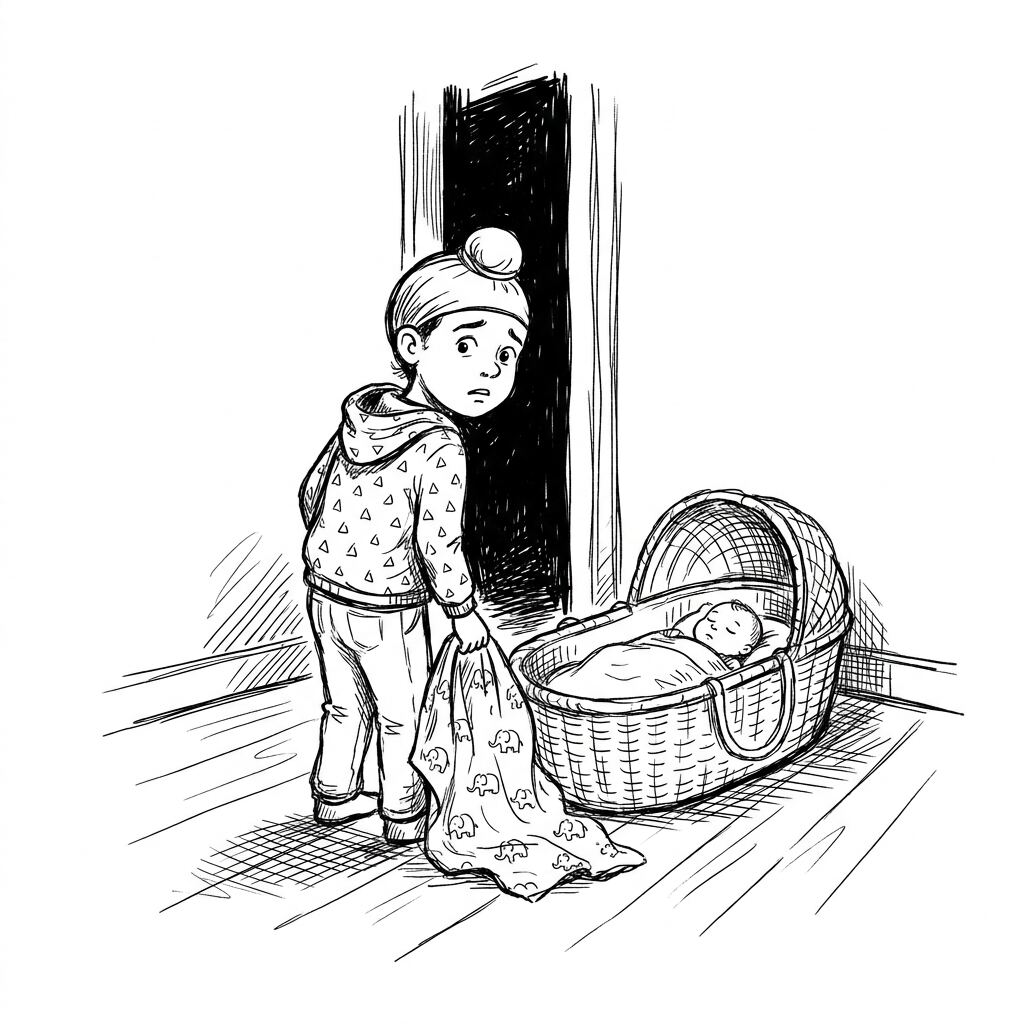
Fateh Singh went up to the landing. The door of Mum and Dad’s room was open. Inside, in the basket, Jot Kaur slept with her fists up, and the yellow blanket had slipped half off her, one corner trailing on the carpet, elephants spilling towards the floor.
It used to be his.
He took it. He didn’t let himself think while his hands were doing it — he just gathered it up, soft and almost nothing, and walked it to his room and pushed it under his bed, behind the box of spare bricks, where the darkness kept things.
Then he lay on top of his bed with his heart going like he’d run the charity laps again.
Jot woke at midnight and cried. She woke at two and cried. The crying came through the wall, thin and furious, and underneath it he could hear Mum’s voice, worn down to a hum, and the floorboards taking Dad’s weight, up and down, up and down.
Fateh Singh stared at the ceiling, where the streetlight made its orange stripe.
“I wish you could go back to the hospital,” he whispered.
The ceiling said nothing. The words just stayed in the room. That was the thing he found out about words, that night — even the quiet ones, even the ones nobody hears. They don’t go anywhere. They sit on your chest, and they’re heavier on the way back in.
In the morning, Dadi ji came to wake him for school. She bent to pick his hoodie up off the floor — and stopped.
One corner of yellow was sticking out from under the bed. One grey elephant, the flat one, looking out at the room.
Dadi ji looked at it for a long moment. Three seconds. Four. Then she looked at Fateh Singh — not angry. Not even surprised. It was the look she had when she was listening to a silence, the way other people listen to talking.
“Breakfast,” was all she said.
All day at school, through maths and wet break and Mrs. Okafor reading to the class, the elephant looked out from under his bed at nothing, and Fateh Singh thought about it looking.
Two Candles
The lights went out at ten to seven.
No bang, no flicker. The telly swallowed its picture, the fridge stopped humming, and the house went so quiet that Fateh could hear next door’s radio through the wall, and beyond it the long hush of the evening, planes and traffic and somebody’s dog.
“Power cut,” said Dad’s voice in the dark, from the kitchen. Upstairs, Mum called something about the baby monitor. A phone torch clicked on and went up the stairs two at a time.
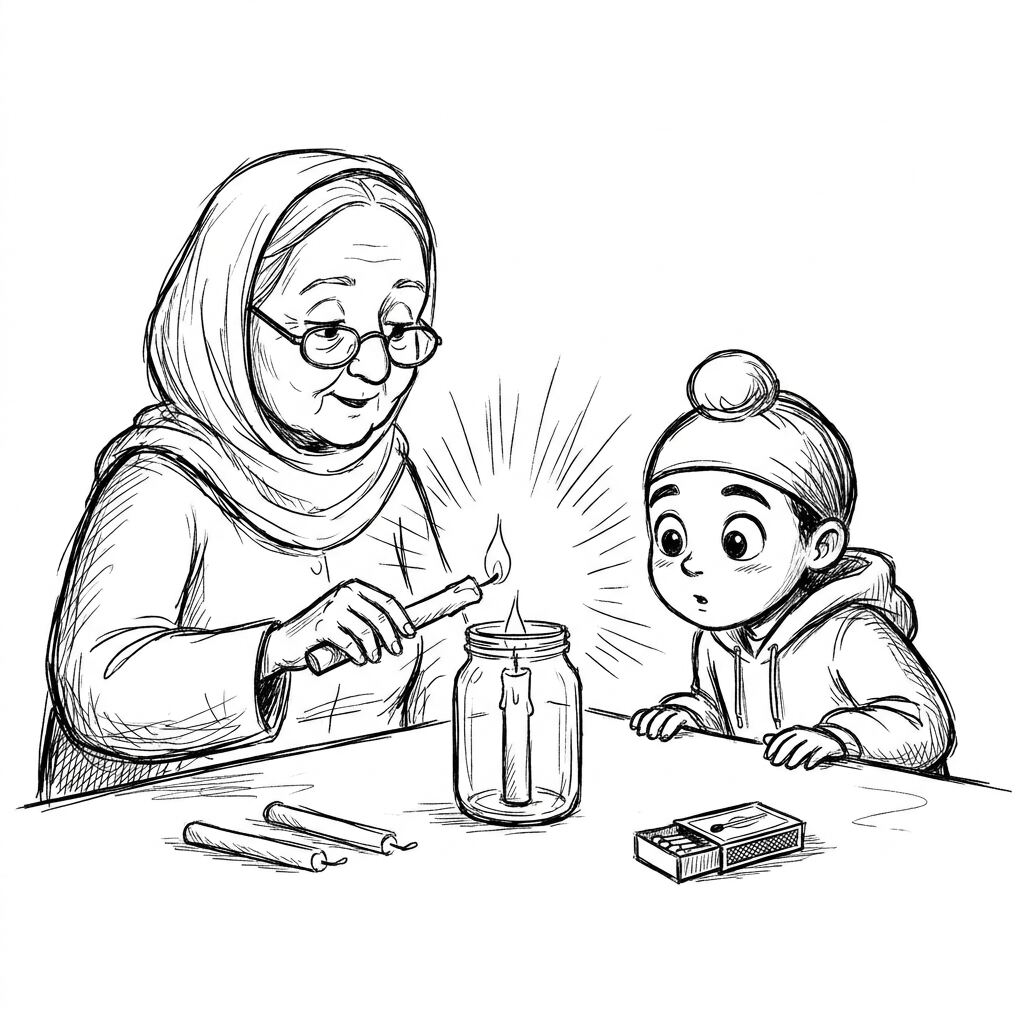
Dadi ji didn’t use a torch. She went to the third drawer down — the one with the batteries and the takeaway menus and the string too short to keep but too long to throw away — and came out with candles and a box of matches, as if power cuts were a thing she’d been expecting her whole life and was mildly pleased to see again.
She stood one candle in a jam jar and lit it. The kitchen came back — soft and gold and moving slightly, shadows breathing on the walls.
“Fateh. Sit.”
He sat at the table. She took a second candle and held it sideways, and tipped its wick into the first flame.
“Watch the first candle,” she said. “Tell me what it loses.”
He watched. The first flame leaned, touched the new wick, and stood straight again. Now there were two flames. He looked at the first one carefully, the way he checked his Lego instructions, step against picture.
“Nothing,” he said. “It didn’t lose anything.”
“Hm.” She lit a third candle from the second. Then a fourth from the third, and stood them in a row of jam jars down the middle of the table, until the whole kitchen was warm and gold and the dark had been pushed right back into the corners.
“Still nothing?”
“It’s the same as it was.” He frowned. “The room’s brighter, though.”
Dadi ji sat down across from him — sat down properly, the way she used to after school, her hands folded, all her attention pointed at him like a lamp.
“When you were born,” she said, “your Mum and Dad brought you home from the same hospital. Through this same front door.” She nodded towards the dark hallway. “Tell me. Did your Dadi start loving your Dad any less, because there was suddenly a new boy to love?”
“That’s different.”
“Why?”
Fateh Singh opened his mouth. For six years he had been the boy who asked but why — he could ask it five times in a row, he could ask it until grown-ups ran out of answers and looked at each other over his head.
He didn’t have an answer. Not even a bad one.
“When you share chips,” he said at last, slowly, “everyone gets fewer.”
“True,” said Dadi ji.
“And pocket money. And when Ruby shares her crisps she counts them out, exactly, so it’s fair. Everything gets smaller when you share it.”
“Most things,” said Dadi ji. “Most things work like that — the more people you share with, the less you keep.” She turned her head and looked down the row of candles, all of them lit from the first one, all of them burning, the first one tallest and unbothered. “And some things are like this. The more you light, the brighter the room.”
She got up, because upstairs Jot had started crying again, the thin sound winding down through the dark house. At the kitchen door she stopped, with the candlelight moving on her white chunni.
“The trick, Fateh,” she said, “is knowing which kind of thing you’re holding.”
She went up. He sat for a long time at the table, in the bright room, watching the first candle not lose anything.
The Name in the Prayer
They had taken Jot to the Gurdwara Sahib when she was nine days old, to be named.
Fateh remembered it in pieces. The main hall, busy with Sunday. Mum holding Jot in the too-soft blanket, Dad’s best dastaar, Dadi ji’s hand on his shoulder. The Ardas, everyone standing, fifty people and one new baby. Then the Bhai Sahib opened Sri Guru Granth Sahib Ji and read the Hukamnama aloud, and the first letter of the first word was ਜ — jajja — and Mum and Dad put their heads together over it for a moment that felt long and wasn’t.
“Jot Kaur,” Dad had said.
“Jot Kaur!” the Bhai Sahib announced, and the jaikara came back off the walls — Jo Bole So Nihal! Sat Sri Akal! — so big and sudden that Jot startled in her blanket, both fists flying up.
At the time, Fateh had mostly noticed the karah parshad, warm in his cupped hands.
Nobody had told him what the name meant. Or maybe somebody had, and he hadn’t been listening. There had been a lot of telling, that week, and none of it to him.
He found out on an ordinary Tuesday, three days after the power cut.
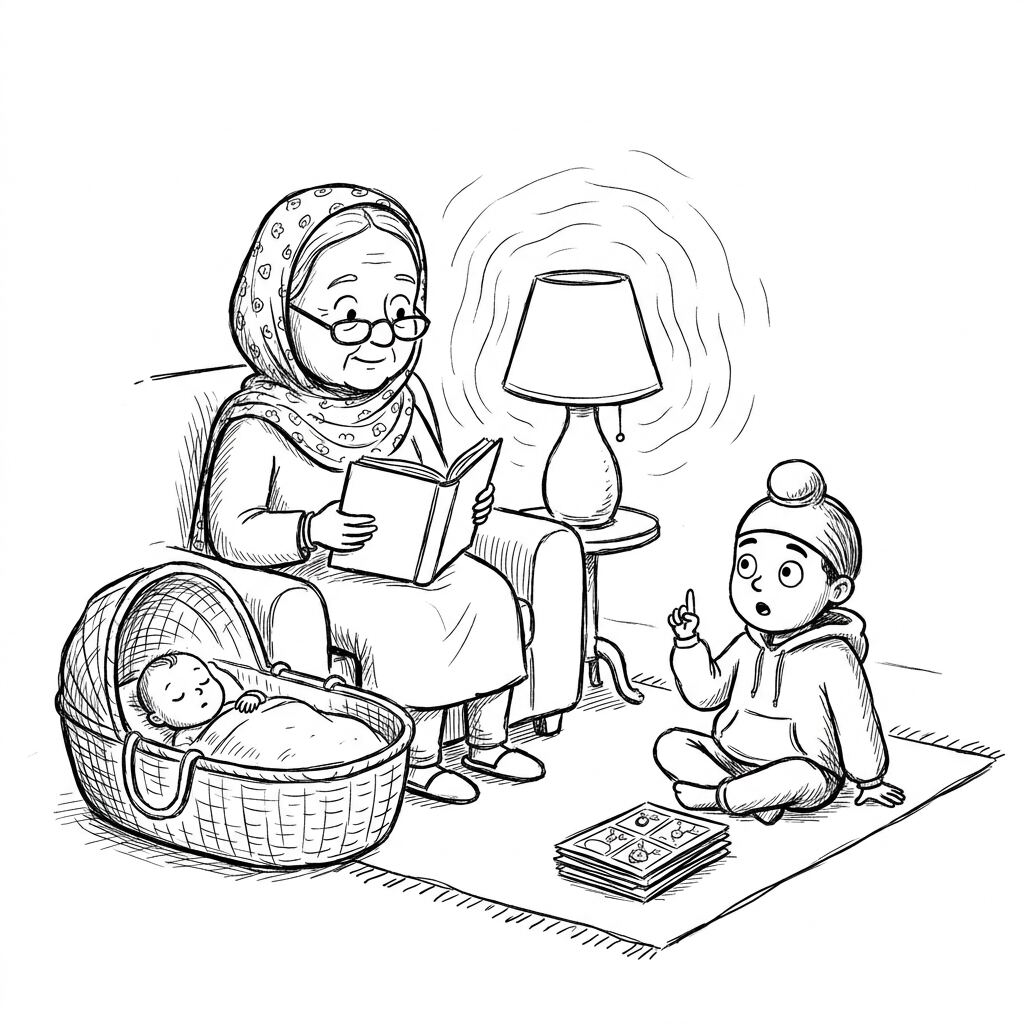
It was evening. The house was doing its new quiet. In Mum and Dad’s room, the small lamp was on — the gold one — and Dadi ji sat on the low chair beside the basket with her Gutka Sahib open and her reading glasses on, the ones with the thin gold frames. She was reciting Kirtan Sohila, the night prayer, the way she did over Jot every evening now, low and unhurried, while the baby fussed herself down towards sleep.
Fateh sat on the carpet by the door, not exactly listening. He’d brought a comic he wasn’t exactly reading. Dadi ji’s voice rose and fell, rose and fell, the river-sound he’d known his whole life — and then a word surfaced out of the river and looked straight at him.
Jot.
“ਸਭ ਮਹਿ ਜੋਤਿ ਜੋਤਿ ਹੈ ਸੋਇ —”
Sabh meh jot, jot hai soe.
He sat up. The comic slid off his knee.
“Dadi ji.” He kept his voice to the house’s new whisper, but only just. “Dadi ji. The prayer just said her name.”
Dadi ji finished the pauri before she answered — she never left a prayer half-said. The river reached the place where it rested, and only then did she look at him over the gold rims.
“Jot,” she said, “means light.”
“Her name means light?”
“Her name was waiting in the prayer all along.” She closed the Gutka Sahib on its ribbon. “Guru Nanak Dev Ji is describing the whole sky as one great Aarti — the sun and moon as lamps, the stars as pearls. And then he says: sabh meh jot — amongst all, there is Light. The same Light. In everyone.” She looked down into the basket, where Jot had gone still at last, fists up by her ears inside the fence of grey elephants — because the blanket was back; he had put it back that Saturday, smoothed flat, and nobody had said a word. “The same Light in her.”
She looked up, over the glasses.
“The same Light in you.”
Fateh Singh sat on the carpet and felt the click — the quiet, clean click of a brick going into the one place it fits. The candles. The row of jam jars down the table. The more you light, the brighter the room.
“One flame,” said Dadi ji, explaining nothing more, picking up her Gutka Sahib. “Many candles.”
The lamp made its small gold room around the three of them — the grandmother, the boy, the sleeping baby with light hidden in her name — and downstairs the front door clicked, and Dad’s keys landed in the bowl, and the house breathed.
Four in the Morning
The crying woke Fateh Singh.
Not the planes, not the wind, not Dadi ji’s door. Crying — thin and ragged and furious, the kind that has been going on a while and means to go on longer. He lay in the orange-striped dark and listened. The clock said 4:07.
He got up.
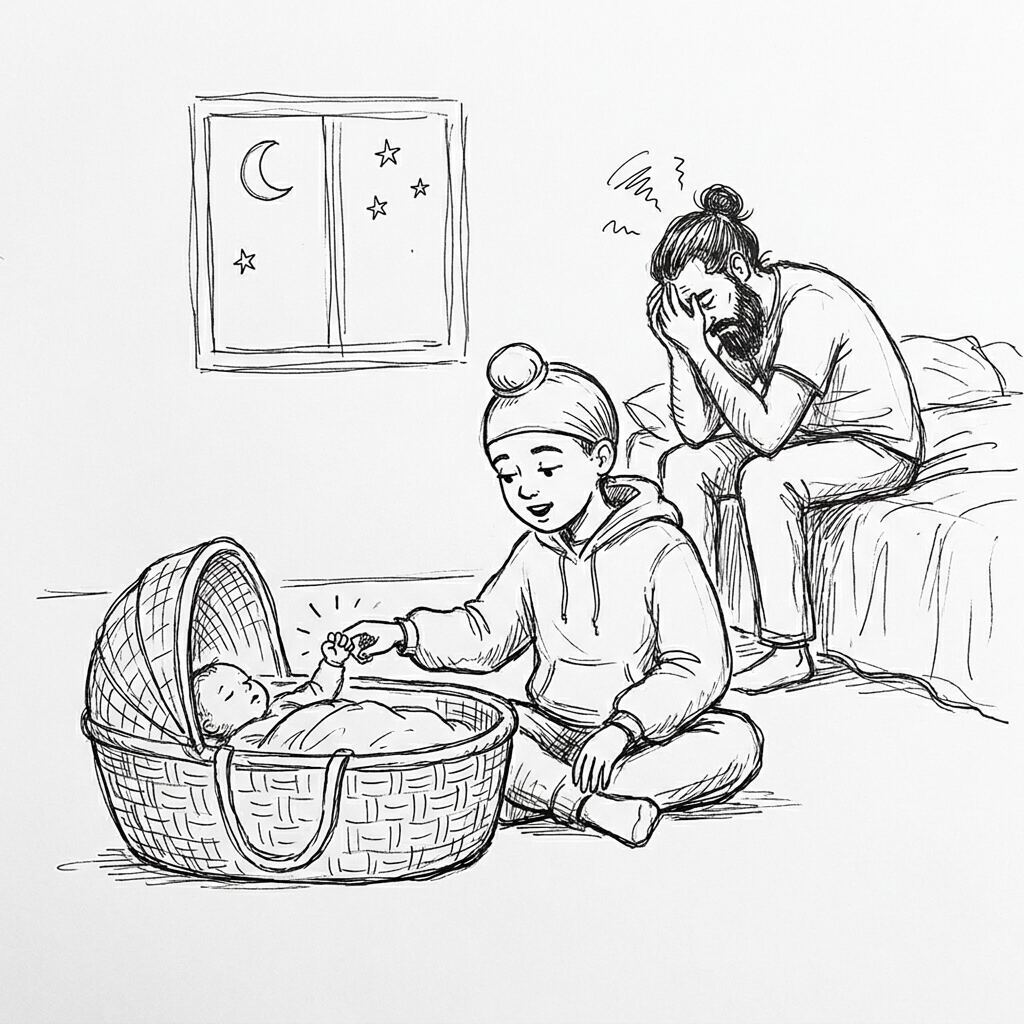
The landing was dark, but Mum and Dad’s door stood open. Inside, the lamp was on. Mum sat against the headboard with her eyes closed — not asleep, just resting them, the way she used to after night shifts, in the old life of three weeks ago. Dad was walking the carpet with Jot against his shoulder, up and down the same six steps, and his face was grey as the window.
Jot cried like the world had wronged her. Maybe it had. She was three weeks old and the world was enormous, and nobody had taught her warm yet, or day, or night.
Through the wall, very faint, Fateh could hear Dadi ji’s murmur. Four o’clock. Japji Sahib. Everyone in the house was at their post.
The yellow blanket was already around her — she’d cried her way half out of it, one grey elephant trailing over Dad’s arm. There was nothing he could bring her. He stood in the doorway anyway.
“Fateh,” said Dad, over the crying, too tired for whole sentences. “It’s four in the morning, beta.”
“I know.” He came in and sat down on the floor by the basket, cross-legged. “I know what time it is.”
He hadn’t planned anything. But the crying was a storm, and a long time ago — months ago, a whole lifetime of the old house ago — Dadi ji had given him a rope for storms.
He began to recite.
Quietly, under his breath, the first pauri of Japji Sahib — feeling for each word the way you feel for the next step on a dark staircase. He wasn’t doing it at the baby, exactly. He was doing it because it was four in the morning and the words were the steadiest thing he had, and his voice was the only thing in the room not worn through.
The crying snagged. Hiccupped. Went on — but slower, like a washing machine at the end of its spin.
Dad stopped walking. Very carefully, the way you move when something is finally going right, he lowered Jot into her basket. Her face was still working at being furious, but her eyes had found the direction the sound came from, and her fists had come down from her ears.
Fateh kept going. Second pauri. Third. The sounds were hard in places, and he had to slow down and feel for them, and the slowing down seemed to be part of what worked.
“Don’t stop,” Dad whispered.
So he didn’t. He recited his five pauris to the end, and then started again from the beginning, and somewhere in the second time through, Jot Kaur went to sleep — really asleep, her whole face unclenching, like a fist deciding at last to open.
The room let out its breath. Mum had slid down the headboard, gone. Dad sat on the end of the bed with his head in his hands, not sad — just landing, like a plane at the end of a long way.
Fateh Singh stayed where he was. The dark outside the window had softened at its edges, not light yet, but thinking about it. The first 207 of the morning sighed past the end of the road. Through the wall, Dadi ji’s voice murmured on, steady, the river under everything.
In the basket, in her sleep, Jot’s hand had found his finger and gripped it.
Her whole hand fit around one of his fingers. It was smaller than a Lego brick and stronger than it had any right to be.
“You can keep that too,” he whispered — the finger, the blanket, all of it.
The Same Light
“You look like you slept in a bin,” said Ruby.
It was Monday break. She was bouncing her tennis ball off the playground wall, catching it without looking, which was showing off, and she knew it.
“My sister thinks night-time is a suggestion,” said Fateh.
“When my cousin’s brother was born,” Ruby said, “my cousin cried for a month. He asked if they could take the baby back to the shop.”
“The shop?”
“He was three. He thought babies came from Argos.” She caught the ball. “Were you like that?”
He thought about lying. Ruby’s face was open and waiting, and it would have been easy to say no, I was great, I’m a great big brother.
“I took something back,” he said. “A blanket. It was mine when I was a baby, and they gave it to her, and I took it back and hid it under my bed.”
Ruby considered this with the seriousness she gave to penalties and crisps. “Did you get in trouble?”
“No. Dadi ji saw. She never said anything.” He kicked a stone, gently, just to move it. “That was worse, kind of. And then she showed me this thing with candles.”
He told her — the power cut, the jam jars, the second candle lit from the first, watch what it loses. Ruby listened with her head tilted, the ball still in her hand.
“So when your mum’s holding the baby all day,” she said slowly, testing it, “you don’t actually get less.”
“It’s not chips,” he said. “Nobody gets less. The room just gets brighter.”
Ruby bounced the ball once, caught it. “Your Dadi ji should run the school,” she said, which from Ruby was roughly a medal.
That afternoon, when he got home, Dadi ji was at the kitchen table — sitting down, properly, with Jot asleep against her shoulder and two slices of toast buttered right to the corners. She asked him one question about his day. Just one. A good one.
And she listened to the whole answer.
That evening he FaceTimed Simran in Toronto. She answered upside down, hanging off the sofa, and the first thing she said was: “Show me the baby. Not you. The baby.”
“Nice to see you too.”
“You I’ve seen for six years. Show me my new cousin.”
He carried the phone in and held it over the basket. Jot was awake, doing her serious staring at the ceiling, fists conducting some slow music nobody else could hear. Simran went quiet for a moment, the way even Simran did.
“She’s got your frown,” she said at last. “Poor kid. Has she met the fox?”
“She’s three weeks old.”
“Tell her about the fox anyway. Nobody’s too small for the fox.”
After they hung up, the house settled into its night-shape around him. Bath, teeth, landing light. Down the hall, the lamp came on in Mum and Dad’s room, and presently Dadi ji’s voice began — Kirtan Sohila, the night prayer, the one with his sister’s name hidden inside it like a brick heart inside a robot’s chest. Sabh meh jot. He could pick the words out every time now, the way you can always find your own name on a page.
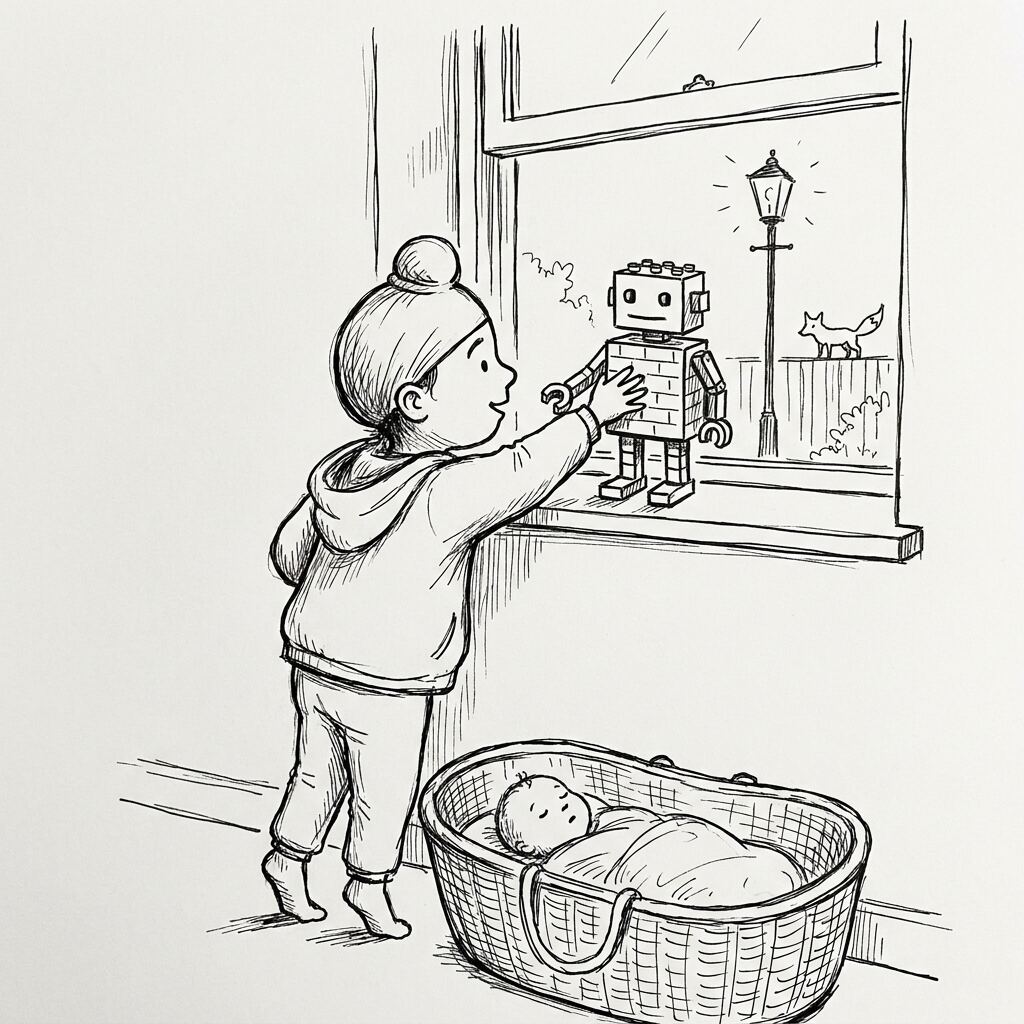
Fateh Singh went to his shelf, between the fire station and the space where the helicopter used to be, and took down the guard robot.
He carried it in and stood it on the windowsill above the basket, feet gripped tight, square head turned to face the room. Mum looked up and saw it, and her eyebrow went up — the eyebrow he’d inherited — but she didn’t say anything, and neither did he. It had been built for this shelf since before Jot had a name. It had just waited on the wrong one for a while.
The streetlight laid its orange stripe across the carpet, the same stripe as every night of his whole life. Tomorrow, before dawn, the fox would come — slipping through the gap in the fence panels while the garden was still silver, sitting down in the middle of the frost like it owned the place. One day, when Jot was big enough, he would wake her early. He’d take her down to the kitchen window in the dark, and teach her how to be still, really still, the hardest thing. It would take ages. She would wriggle.
He had wriggled too.
But the fox would wait. The fox had always waited.
And there was no hurry. The light wasn’t going anywhere.
Teaching Notes: The Same Light in All
Sikhi begins with Ik Onkar — One Creator — and Guru Nanak Dev Ji’s teaching that one divine Light shines within every person. The verse at the heart of this story, “Sabh meh jot, jot hai soe” (Amongst all there is Light — and that Light is the same One), comes from the Aarti in Kirtan Sohila, the prayer Sikhs recite each night before sleep. It is the foundation of Sikh equality: the same Light in every face means no person is above or below another — including, as Fateh Singh discovers, the small loud person who just moved into your house.
In a classroom or at home, this story pairs naturally with the arrival of a new sibling, a new classmate, or any moment when a child fears there isn’t enough love or attention to go around. Dadi ji’s two-candle demonstration is easy and safe to recreate with an adult holding the candles: light one from the other and ask, what did the first one lose? For families, the story also models how to meet a child’s jealousy — Dadi ji sees the hidden blanket and never scolds; she teaches with light instead of shame.
Discussion Questions by Grade
Grades K–2
- When everyone crowded around the baby, how do you think Fateh felt? What did he do that showed it, without saying it?
- What did the first candle lose when it lit the second candle?
- Fateh put the blanket back all by himself, without being told. Why do you think he did that?
Grades 3–5
- Dadi ji says most things get smaller when you share them — but some things, like candlelight, grow. What things in your life get smaller when you share them? What things grow?
- Dadi ji saw the hidden blanket and said only “Breakfast.” Why do you think she chose not to tell Fateh off? Was her silence stronger than a telling-off would have been?
- Jot’s name was inside the night prayer all along, and Fateh had heard the prayer his whole life without noticing. What changed when Dadi ji said “the same Light in you”?
- In the night, Fateh whispered words he immediately wanted to un-say. Nobody heard them. Do words still matter if nobody hears them?
For Sikh Families
- Listen for “Sabh meh jot” in Kirtan Sohila tonight. Take turns finishing the sentence: “The same Light is in ___.” How far can you take it — family, friends, the neighbour, someone you find difficult?
- Has there been a time when a new person — a sibling, a cousin, a new student — made you feel like there was less room for you? What helped? What would Dadi ji’s candles say about it?
Curriculum link: Common Core ELA RL.2.3 / RL.3.3 (how characters respond to events and challenges); SEL — CASEL self-management and relationship skills (adjusting to family change, naming difficult feelings); UK National Curriculum KS1–2 English and PSHE (family change, belonging).
Gurbani Verse
ਸਭ ਮਹਿ ਜੋਤਿ ਜੋਤਿ ਹੈ ਸੋਇ ॥ ਤਿਸ ਦੈ ਚਾਨਣਿ ਸਭ ਮਹਿ ਚਾਨਣੁ ਹੋਇ ॥
Amongst all there is Light — and that Light is You. By that Light, light shines within everyone.
Guru Nanak Dev Ji — Ang 13, Sri Guru Granth Sahib Ji (Kirtan Sohila)Punjabi Glossary
| Word | Meaning |
|---|---|
| Aarti | A song of praise; in Gurbani, Guru Nanak Dev Ji describes the whole sky as one great Aarti to the Creator |
| Ardas | A Sikh prayer — a humble request to Waheguru |
| Beta | A loving word for a child, like “dear” |
| Bhai Sahib | A respectful title for the Sikh who reads from Sri Guru Granth Sahib Ji and serves the sangat |
| Chunni | A scarf or head covering worn by women |
| Dadi ji | Paternal grandmother |
| Dastaar | A turban — the full head covering worn by Sikhs as a crown of their faith |
| Gurdwara | A Sikh place of worship — “the door to the Guru” |
| Gutka Sahib | A small book of daily prayers |
| Hukamnama | The passage read aloud when Sri Guru Granth Sahib Ji is opened — for a naming, the first letter of the reading becomes the first letter of the baby’s name |
| Ik Onkar | ”There is One Creator” — the opening words of Sri Guru Granth Sahib Ji |
| Jaikara | A joyful Sikh call and response: “Jo Bole So Nihal! Sat Sri Akal!” |
| Japji Sahib | The morning prayer, composed by Guru Nanak Dev Ji |
| Jot | Light — the divine Light present in all |
| Karah Parshad | The warm, sweet offering shared with everyone at the Gurdwara |
| Kaur | The surname given to Sikh women and girls, meaning “princess” |
| Kirtan Sohila | The night prayer, recited before sleep |
| Patka | A small cloth tied over the hair, worn by Sikh boys |
| Pauri | A stanza in Japji Sahib |
| Sangat | The Sikh community or congregation |
| Sri Guru Granth Sahib Ji | The living, eternal Guru of the Sikhs — present at the centre of every Gurdwara |
| Waheguru | The Wonderful Creator — the Sikh name for God |
About This Story
In Sikh families, a new baby is traditionally named at the Gurdwara: after Ardas, a Hukamnama is read from Sri Guru Granth Sahib Ji, and the first letter of the reading becomes the first letter of the child’s name. Jot comes from jot — light — a word at the very heart of Gurbani. The verse Fateh hears in this story, Sabh meh jot, is part of the Aarti composed by Guru Nanak Dev Ji and is recited every night by Sikhs around the world in Kirtan Sohila.
The feelings in this story are just as real as the prayer. Almost every child who becomes an older sibling passes through some version of Fateh’s summer — the whispering house, the unseen Lego, the wish they instantly regret. Sikhi’s answer is not that the feeling is bad, but that love is the kind of thing that multiplies when shared: one flame, many candles.
Author’s Note
This is the fifth story in the Fateh Singh series — five stories set in London, each woven around a core value of Sikhi. After Seva, Simran, Kirat Karni, and Vand Chakna, this story turns to the teaching that holds them all together: the same divine Light in every person — Sabh meh jot — discovered not at the Gurdwara but in the hardest place of all, at home, in the basket that took his place at the kitchen table.
Fateh Singh is Simran Kaur’s cousin. Where Simran discovers her faith by feeling, Fateh Singh discovers his by asking. Together — and now with Jot Kaur — they represent paths to the same place.
Explore More
- Fateh Singh and the Saturday Kitchen — The first Fateh Singh story, about Seva
- Fateh Singh and the Quiet Morning — The second Fateh Singh story, about Simran — where the fox first appears
- Fateh Singh and the Shortcut — The third Fateh Singh story, about Kirat Karni
- Fateh Singh and the Last Pound — The fourth Fateh Singh story, about Vand Chakna
- Ten Lights, One Flame — The story of the ten Gurus as one Light
- Raising Children with the Wisdom of Japji Sahib — A parent’s guide to the foundations of Sikhi