
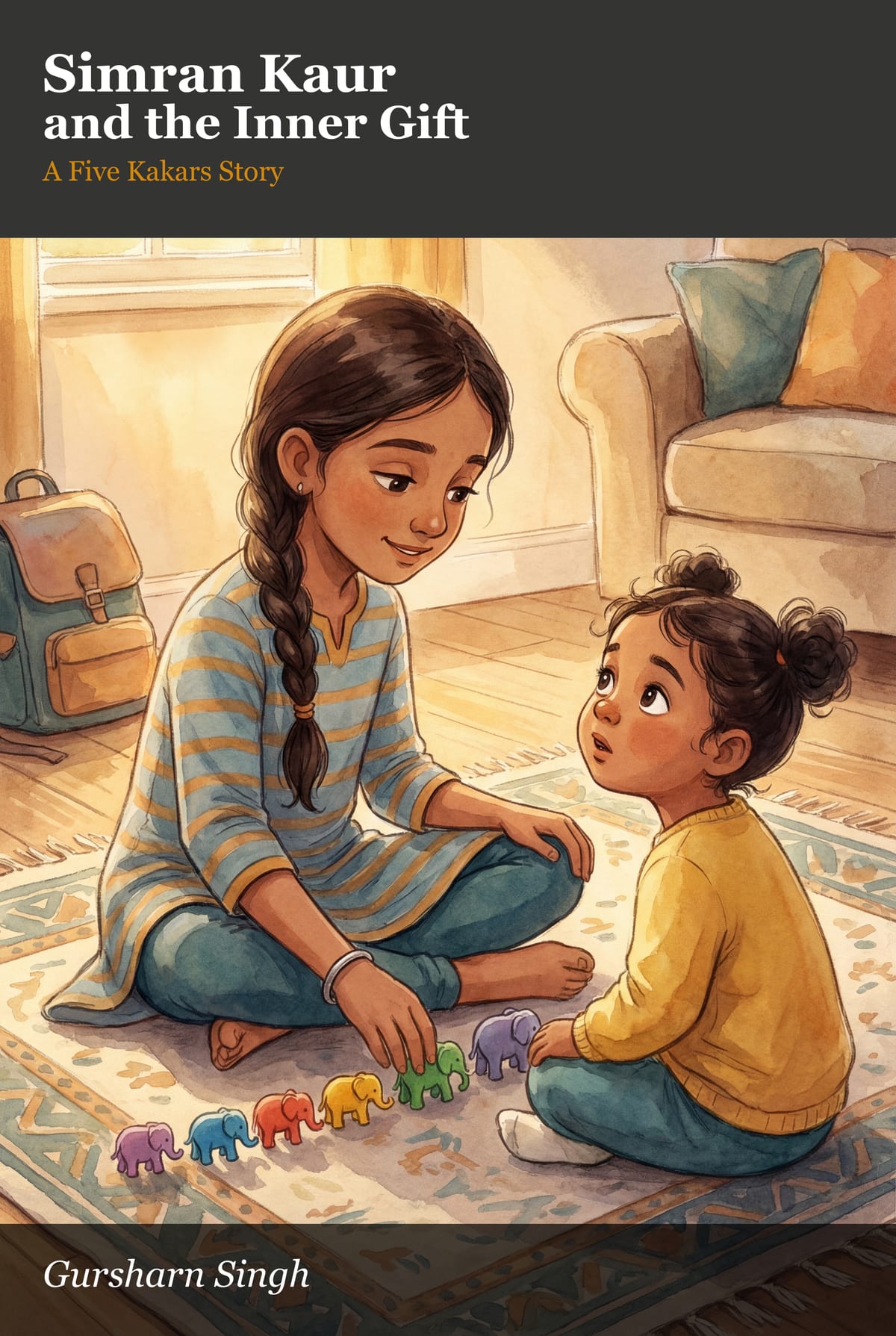
Simran Kaur and the Inner Gift is a free Sikh story for ages 4–12 about the kachera, the one of the Five Kakars nobody ever sees. Simran is minutes from a long-awaited video call with her cousin Fateh when her three-year-old sister asks, “What’s kachera?” She sits down to answer properly, misses the call, and finds she has understood all five Kakars all along.
Thirty-Two
Simran Kaur counted thirty-two steps from the front door to the school bus.
She counted them every morning without quite thinking about it — the way she counted the fourteen red doors on Kennedy Road in Springdale, and the white dome of Gurdwara Dasmesh Darbar two blocks north, and the twelve fridge magnets on the kitchen door. These things were hers. She counted them because knowing they stayed the same made a big, loud world feel like it would hold still long enough to be looked at.
Coming home was different. Coming home she walked fast, backpack thumping, already thinking about the next thing. And today the next thing mattered more than usual.
Four eleven, the kitchen clock would say when she got in. The call was at four fifteen.
It was the call with Fateh she’d been waiting for all week — her cousin in London, five hours ahead, which made the times awkward and the chances rare. They only managed it every couple of weeks, when the hours lined up and neither of them was busy. And this one mattered more than the usual ones, because tomorrow morning, very early, Fateh and his family were flying to Punjab to see his bibi ji for the whole half-term. A week, maybe more. After tonight there wouldn’t be another proper chat until he was back.
Four minutes. She could make it. She pushed through the front door and dropped her bag by the stairs, kicked off her shoes — left one, right one, two kicks, done — and didn’t stop to count anything.
The kitchen clock said four twelve. Three minutes. She was up the stairs before she’d finished thinking about it, because the laptop was in the bedroom she shared with Kiran, and the call would come through on the laptop.
One Elephant
Kiran was on the floor of their bedroom when Simran came in.
She was three years old, in her pyjama top and a pair of leggings, surrounded by plastic animals arranged in a careful and important line along the edge of the rug. She had been doing this for weeks — setting them out, counting them, moving them, setting them out again.
“One elephant,” said Kiran. “Two elephant. Three elephant.”
“Elephants,” said Simran, opening the laptop on the desk. “It’s elephants. Plural.”
“Three elephant,” said Kiran, firmly.
Simran didn’t argue. She’d tried three times before and lost three times. The laptop woke up. Four thirteen. Two minutes. She could feel the call coming the way you can feel a bus about to round the corner.
She pulled her school jumper off over her head and reached for her home clothes from the chair. Her kachera stayed on, the way it always did — the white cotton shorts she’d worn every single day since she was old enough to put them on herself, under everything. When the school trousers came off, the kachera was there. When the home clothes went on, the kachera was still there. It was just always there, the way her kara was always on her wrist and her hair was always braided.
She was reaching for her leggings when Kiran looked up.
“What are those?”
Simran glanced down at herself. “My kachera.”
“What’s kachera?”
Simran looked at the clock. Four fourteen. One minute. The little green light by the laptop camera was about to blink; she knew it was. If she sat down now, she would miss him. If she said later, and got dressed, and pulled the chair in, she would catch Fateh’s face the second it appeared, and they’d have their twenty minutes before he flew away for a week.
“It’s something I wear,” she said, already reaching for the leggings. “I’ll explain later.”
She got one leg in.
Then she looked at Kiran.
Kiran was sitting very still among her elephants, chin slightly tilted up. Not upset. Not demanding. Just waiting — the way three-year-olds wait when they want a real answer, very patient and very complete, as if they have nowhere else to be and all the time in the world.
It’s something I wear. Simran heard it again in her own head. That was the kind of answer that wasn’t an answer at all. It was the shape of an answer with nothing inside it — the empty kind she’d handed people before and regretted every time.
The clock turned to four fifteen. Somewhere on the laptop the call would be ringing now, the little tone she knew by heart, Fateh’s name lighting the screen.
She looked at the laptop. She looked at Kiran.
Then she got the other leg into her leggings, and sat back down on the rug, and let the laptop ring.
“Okay,” she said. “That wasn’t a good answer. Let me try again properly.”
Five Gifts
The elephants wobbled when she sat, but none of them fell. Kiran watched her with the focused expression she kept for things that mattered. Behind them the laptop rang, and rang, and then stopped, and the room was quiet in the particular way a room is quiet after a sound you were waiting for has gone. Simran felt it. She made herself stay where she was.
“Okay,” she said. “You know who Guru Gobind Singh Ji is?”
Kiran thought. “The one who made the Khalsa?”
“Yes.” Simran nodded; Kiran had picked up more than it seemed. “A long time ago, Guru Gobind Singh Ji gave the Khalsa five gifts. Things to wear. Things to carry.” She settled herself on the rug. “To help them always remember who they were.”
Kiran picked up one of her elephants and held it out — small, grey-green, missing one ear. Simran took it without thinking.
“The first gift is kesh,” she said. “That means hair. You let it grow, the way Waheguru made it, and you don’t cut it, because it’s part of you, and Guru Ji said don’t change what God gave you.” She passed the elephant from hand to hand. “That’s my braid. That’s Papa’s dastar. Same reason.”
Kiran nodded. She knew dastar; she liked tracing the folds of Dad’s turban when he held her.
“The second gift is the kanga.” Simran mimed combing. “A little wooden comb, to look after your kesh. Because keeping your hair long means taking care of it too. Patiently.” She set the elephant down between them. “The third gift is the kara.” She lifted her wrist so the steel caught the light. “A circle. No beginning and no end — like Waheguru, always. It means I’ll always try to do good.”
Kiran reached out and touched the kara with one finger, the way she had done since she was old enough to reach.
“The fourth gift is the kirpan. Papa wears it.” Simran touched her own side. “A small blade, but it’s not for fighting. It’s a promise: if someone needs help, you go to them. You don’t walk past.” She looked at Kiran. “You already do that. You come and sit by me when I’m sad, before I even say anything.”
Kiran looked pleased to be told this.
“And the fifth gift,” said Simran, “is the kachera.” She nodded at the white shorts below her leggings.
Kiran studied them carefully, leaning in, then sitting back. “They’re white,” she said.
“Always white. Clean and simple.” Simran looked down at them. “And this is the one nobody can see. The kara — people see that.” She touched her wrist. “The dastar, everyone sees. The kirpan is under Papa’s shirt, but you can feel it when he hugs you. But the kachera—” she pressed a hand lightly to her side “—nobody ever sees it. And it’s the one that’s always closest. Right next to you, all the time.”
“Even in the water?” said Kiran.
“Even when you wash. You keep one on while you change the other. You never take both off at once.” Simran paused, hearing the meaning of it as she said it. “Because you never stop being yourself, even when nobody’s watching.”
Always You
Kiran looked at the kachera, then at Simran. “Always?”
“Always,” said Simran. “The kachera isn’t like a school uniform. You don’t put it on for school and take it off at home. Being Khalsa is part of who you are — like your name. Like your heart. You don’t ever put it away.”
“Even at Nani Ji’s house?”
“Yes.”
“Even at the park?”
“Yes.”
“Even at night, in pyjamas?”
“Yes. Even in pyjamas.”
Kiran’s face shifted into a small, satisfied expression, as if she’d confirmed something she had already suspected.
“I’m always Kiran,” she said.
“Exactly.” Simran looked at her seriously. “Exactly that. You’re always Kiran — not park-Kiran and home-Kiran and gurdwara-Kiran. Just Kiran, all the way through.” She nudged a stray elephant back into line. “That’s what Guru Ji wanted the Khalsa to remember. The same person when people are watching, and when nobody is. The same person when things are easy, and when they’re hard.”
Kiran thought about this with her whole small face. “Is it hard? To always be the same?”
Simran was quiet a moment. She thought, without meaning to, of the laptop that had stopped ringing. Of Fateh’s face that hadn’t appeared. Of how easy it would have been to be quick-Simran, just for a minute, and catch her call, and explain later.
“Sometimes,” she said. “Sometimes you want to be a different person for a minute. Quicker, or smaller, or somewhere else.” She looked at her kara. “But the kachera says no. You’re always you. And that’s not a problem to fix — that’s the gift.”
Kiran reached out and patted Simran’s knee, feeling the fold of white cotton bunched under the leggings.
“Gift,” she repeated, storing it carefully.
“That’s why it’s called the inner gift,” said Simran. “It’s the one nobody sees. But it’s always there.”
Mum in the Doorway
A sound came from the doorway. Simran looked up.
Her mum was standing there, still holding the tea towel she’d been drying her hands on, with the expression that meant she’d been listening without quite meaning to and had decided she was glad she had.
“Sorry,” her mum said. “I came up to say dinner won’t be long.” She didn’t move from the doorway. “That was well said, puttar.”
Simran felt her face warm. “She asked,” she said.
“Three elephant,” Kiran offered, helpfully.
Their mum came and sat on the edge of Kiran’s bed, the tea towel still in her hand, and looked at the two of them on the rug — Simran cross-legged with a one-eared elephant, Kiran with her animals in their careful line.
“You know,” she said, “when I was about your age, Simran — a bit older, maybe — I asked your nani the very same question.”
“About the kachera?”
“About all of them.” She folded the tea towel over her knee. “I was different from my friends in certain ways. Visible ways. And some days I wanted to be less visible.” She paused. “Your nani told me: the Kakars are not things that make you different from other people. They are things that make you the same as yourself. Every day.”
Simran sat with that.
“The same as yourself,” she said slowly.
“The same as yourself.” Her mum stood. “Five minutes, then come down.”
She left. Kiran went back to her elephants. Simran sat on the rug and turned the phrase over — the same as yourself — and decided it was just another way of saying always you, which made it feel more true, not less.
The Call She Missed
When her mum had gone, Simran reached up and turned the laptop towards her.
The screen had a little grey banner across it. Missed call — Fateh. And underneath, the time: 4:15.
She looked at it for a while. It cost her something to look at, and she let it. She’d wanted that call all week. She had counted down to it on the bus, the way she counted down to things that mattered, and now there was just the small grey word missed, and Fateh’s name beside it, and the knowledge that by tomorrow morning he’d be in the air and then a long way away for a week.
She typed him a message, slowly. Sorry I missed you. Kiran asked me what a kachera was and I had to do it properly. She looked at it, then added: Have the best time in Punjab. Say sat sri akal to your bibi ji.
She didn’t expect an answer. London was five hours ahead; it was past nine there, and he’d be packing, or asleep, or being told to be asleep.
She closed the laptop. The missing didn’t go away just because she’d closed it. That was, she thought, sort of the point of missing something — it stayed real whether you looked at it or not. She had chosen Kiran over the call, and she would choose it again, and it still cost what it cost. Both of those things were true at once. She was getting used to two true things standing in the same place.
Dinner
Dad came home at half past six. Simran heard the front door, the shoes coming off, the soft sounds of his jacket going up and his bag going down, and then her mum’s voice low and warm in the kitchen and Dad’s quiet laugh close after it.
At dinner, Kiran ate three bites and then dedicated herself to lining her peas along the rim of her bowl.
“One pea,” said Kiran. “Two pea. Three pea.”
“Peas,” said Simran’s dad.
“Four pea,” said Kiran.
Dad looked at Simran with his eyebrows up. Simran shrugged. This had been going on for months; the plurals never stuck, but the counting always did.
“Simran explained all five Kakars to Kiran this afternoon,” her mum said.
Dad looked at Simran — the way he sometimes did, as if her face were a page and he was reading things there she hadn’t known she’d written. “How did it go?”
“She asked what my kachera was.” Simran moved her food around her plate. “So I stopped and explained. I said it’s the one you can’t see — but it’s the one that’s always there. So you’re always yourself.”
Her dad set down his fork. He took a thoughtful pause, the way he did before the things that mattered, and then he said, “That’s exactly what it is.” Not surprised. More like he was confirming something he’d known she knew.
Then he tilted his head a little. “Wasn’t tonight your call with Fateh?”
Simran looked at her plate. “It was at four fifteen. That’s when Kiran asked.” She turned her fork over. “I missed it. He flies to Punjab in the morning, so it’ll be a week, probably.”
Her dad was quiet a moment, and he didn’t rush to make it smaller than it was. “That cost you something, then,” he said. “I’m sorry you missed him.”
“It’s okay,” said Simran. And then, more honestly, because he hadn’t pretended it was nothing: “It’s mostly okay. I’d still do it again. But I did want the call.”
Her dad nodded slowly, like that was the right answer and the difficult one and he was glad she’d given the true version. “Both of those can be true,” he said.
Kiran looked up from her peas. “I’m always Kiran,” she announced.
“You are absolutely always Kiran,” said Dad, and Kiran went back to her peas, satisfied.
It was near the end of dinner that Simran’s phone buzzed once on the side table. She wasn’t usually allowed it at the table, but her mum nodded, go on, and she turned it over.
A voice note. From Fateh. Eleven seconds. She held it to her ear.
“Sat sri akal!” Fateh’s voice, half a laugh in it, somewhere noisy — packing, probably. “Mum told me you were teaching Kiran the Kakars. That’s proper seva, that is. Way better than talking to me. Catch you when I’m back — save it all up.”
Simran put the phone down. She found she was smiling.
“He’s not even cross,” she said.
“No,” said her mum. “I don’t expect he would be.”
Seven Streetlights
That evening — after dishes, after Kiran’s bath and Kiran’s story and the long slow business of getting Kiran to stay in her cot — Simran sat at her bedroom window.
Seven streetlights. She counted them, as she did every night. Always seven. The same seven, in the same order, making the same small circles of yellow light on the pavement.
She thought about the afternoon. About the laptop ringing, and choosing not to answer it. About sitting on the rug explaining five gifts to a three-year-old while the call she’d wanted all week rang itself out behind her.
She had understood something, sitting there, that she hadn’t quite had words for before. She had thought, for a long time, that the Kakars were things she wore — hair, comb, bracelet, blade, shorts. Five objects. A list you could recite. But this afternoon, putting them into words small enough for Kiran, she’d heard what they actually were under the objects. Not things you put on. Things you are. And the kachera said it most plainly of the five, precisely because no one ever saw it: you don’t get to be one person for the watching world and another for yourself. You’re the same all the way through, or you’re pretending.
She had paid a small price today to be the same all the way through — one missed call, one cousin a week away. It wasn’t a large price. But it was a real one, and she’d paid it on purpose, and that, she was beginning to see, was what the gift had been asking of her all along.
Outside, a car passed slowly, its headlights sweeping the wall and gone. Seven streetlights stood in their places, doing exactly what they were made to do.
What She Carried
Simran pulled her knees up and watched the lights a while longer.
She had tried once, at school, to explain the Kakars to Ethan, and he’d listened and then said, so they’re like rules? — and she’d said no, not rules, and hadn’t been able to say what they were instead.
Now she thought she could.
She went to her desk and found a pencil, and wrote in her notebook in small careful letters — not because she needed to remember, but because putting words on paper made them hold still long enough to look at:
Kesh: I am exactly as I was made.
Kanga: I will take care of what I’ve been given.
Kara: I will always try to do good.
Kirpan: I will not walk past someone who needs me.
Kachera: I am the same person inside and out — when people are watching, and when nobody is.
She read the five lines back. Not rules you followed from the outside. Promises you kept from the inside.
She thought of two words from Punjabi class — andar, inside, and bahar, outside — and how she’d learned them as opposites. But the kachera made them the same thing: from within and without, one person, all the way through. Always herself. Always Simran.
She closed the notebook.
Four Elephant
She went to find Kiran.
Kiran was in her cot, technically in bed and very much not asleep, three of her elephants having migrated from the rug to her pillow over the course of the evening. She looked up when Simran appeared, and her face did what it always did — went from settled to bright, the way a room does when someone switches on a lamp.
“Simran,” said Kiran.
“Four elephant,” said Simran.
Kiran beamed. “Four elephant.”
Simran sat on the edge of the cot. The elephants shifted. Kiran pushed herself up to sitting and leaned warm and heavy against Simran’s arm, the way only small children can.
“You’re always Kiran,” said Simran.
“Always,” said Kiran, in the settled way she said the things she had decided to keep.
They sat together, the two of them and the elephants, while the hallway light made a yellow stripe across the floor. Outside, the seven streetlights stood in their places, making their same small circles. Somewhere over a city five hours ahead, a cousin was packing a bag; in the morning he’d be in the air, and a week from now there’d be a call to catch up on, saved up, all of it.
Simran didn’t count the streetlights this time. She didn’t need to. She already knew they were there — the same as every night, whether she counted them or not. Some things you didn’t have to check. They were just always there, the way the kachera was always there, the way she was always, all the way through, herself.
Teaching Notes: What Is the Kachera?
The kachera is a pair of cotton shorts worn under the clothing — one of the Five Kakars, the five articles of faith given by Guru Gobind Singh Ji to the Khalsa in 1699. Of the five, it is the only one nobody ever sees. The kara is on the wrist; the dastar covers the kesh; even the kirpan can be felt in an embrace. But the kachera is completely hidden — and it is the one worn closest to the body, all day, every day. Traditionally a Sikh never removes both at once, even when washing, keeping one on while changing the other: a small daily practice of never being fully without it. It stands for purity and constancy — being the same person inside and out, in public and in private, when people are watching and when nobody is.
As the finale of the series, this story gathers the five Kakars together — not as a list to recite, but as five promises a child can hold. The teaching turning point is a genuine cost: Simran has a few minutes to make a long-awaited video call with her cousin in another country, the last before he travels for a week, when her little sister asks an honest question. Choosing to stop and answer properly means missing the call — and the story lets that loss be real. That is what makes the kachera’s lesson land: being the same person all the way through sometimes costs you something, and you pay it anyway. For teachers and Gurmat-camp leaders, this opens conversations about integrity, consistency of character, and the difference between behaving well because you are seen and behaving well because of who you are. For the wider context of all five articles, see The Five Kakars — Articles of Sikh Faith.
Discussion Questions by Grade
Grades K–2
- Simran was about to make a call she’d been waiting for all week. Why did she stop and sit with Kiran instead?
- Kiran says, “I’m always Kiran.” What does she mean? Are you the same you at home, at school, and at your grandparents’ house?
- The kachera is the one Kakar nobody can see. Why might it still be important, even though it’s hidden?
Grades 3–5
- Simran says the kachera means “I am the same person whether anyone is watching or not.” What’s the difference between doing the right thing because you might be seen, and doing it because of who you are?
- Choosing Kiran meant Simran missed her cousin Fateh before he flew away for a week. Was it the right choice? Can a choice be right and still cost you something?
- Simran writes the five Kakars as five promises instead of five objects. Pick one of her lines — which feels most important to you, and why?
- Simran’s dad says, “Both of those can be true,” about wanting the call and being glad she stayed. When have two opposite feelings been true for you at the same time?
For Sikh Families
- The kachera is about integrity — being the same person seen and unseen. How do we help children value who they are when no one is watching, not just how they appear?
- This is the last book in the series. Together, name the five Kakars as promises rather than objects, the way Simran does. Which promise does your family find easiest to keep? Which is hardest?
Curriculum link: Common Core ELA RL.3.2 (theme and central message) and RL.3.3 (character motivation and choices); SEL — CASEL self-awareness (personal integrity, identity) and responsible decision-making (weighing what matters most); Ontario Social Studies (identity and belonging) and Language (oral communication, explaining ideas to a younger audience).
Gurbani Verse
ਓਹਿ ਅੰਦਰਹੁ ਬਾਹਰਹੁ ਨਿਰਮਲੇ ਸਚੈ ਨਾਇ ਸਮਾਇਆ ॥
From within and without they are pure, absorbed in the True Name.
Guru Nanak Dev Ji — Ang 139, Sri Guru Granth Sahib JiPunjabi Glossary
| Word | Meaning |
|---|---|
| Andar | Inside / within |
| Bahar | Outside / without |
| Bibi Ji | A respectful term for an elder woman or grandmother; here, Fateh’s grandmother |
| Dastar | A turban — the way many Sikhs keep and cover the kesh |
| Gurdwara | A Sikh place of worship — “the door to the Guru” |
| Kachera | A pair of cotton shorts worn under clothing — one of the five articles of Sikh identity, standing for purity and constancy |
| Kakar | One of the five articles of faith that initiated Sikhs wear or carry, given by Guru Gobind Singh Ji |
| Kanga | A small wooden comb — one of the five articles of Sikh identity |
| Kara | A steel bracelet worn on the wrist — one of the five articles of Sikh identity |
| Kesh | Uncut hair — one of the five articles of Sikh identity |
| Khalsa | The community of initiated Sikhs, founded by Guru Gobind Singh Ji in 1699 |
| Kirpan | A small sword carried as an article of faith — one of the five articles of Sikh identity, standing for mercy that acts |
| Nani | Maternal grandmother |
| Puttar | Child — a term of love used by Punjabi parents |
| Sat Sri Akal | A Sikh greeting — “God is the Ultimate Truth” |
| Seva | Selfless service — helping others without expecting anything in return |
| Waheguru | The Wonderful Creator — the Sikh name for God |
Author’s Note
This is the fifth and final story in the Simran Kaur series — five stories set in Brampton, each woven around one of the Five Kakars, the five articles of Sikh identity given by Guru Gobind Singh Ji to the Khalsa in 1699. The kachera is the most intimate of the five. Worn next to the skin, it is the one nobody sees from the outside — and yet it is always there, the quiet reminder that a Khalsa is always themselves: the same person in public and in private, when the world is watching and when nobody is.
As the capstone of the series, this story lets a three-year-old ask the simplest possible question — what’s kachera? — at the most inconvenient possible moment, and lets the answer cost Simran something real: the call with her cousin before he travels for a week. The cost is the point. Being the same person all the way through is easy to say and sometimes hard to do; the kachera asks for it anyway. In putting all five Kakars into words small enough for her little sister, Simran discovers she has understood them all along — not as five objects she wears, but as five promises she keeps from the inside.
Simran Kaur is Fateh Singh’s cousin. Where Fateh Singh discovers his faith by asking, Simran discovers hers by noticing — and here, at the end, by teaching it to someone smaller. Two cousins, two paths, the same place. It is fitting that the call she gives up is to him: in choosing her sister and the Kakars over the call, she is, as Fateh says, doing a quiet kind of seva — which was always his lesson, arriving now as the close of hers.
Explore More
- The Five Kakars — Articles of Sikh Faith — What the Five Kakars are and why they matter
- Simran Kaur and the Lost Sketchbook — The first story in the Five Kakars series, about the kara
- Simran Kaur and the Fence — The fourth story in the Five Kakars series, about the kirpan
- Fateh Singh and the Saturday Kitchen — Simran’s cousin Fateh, in London, learns about seva