
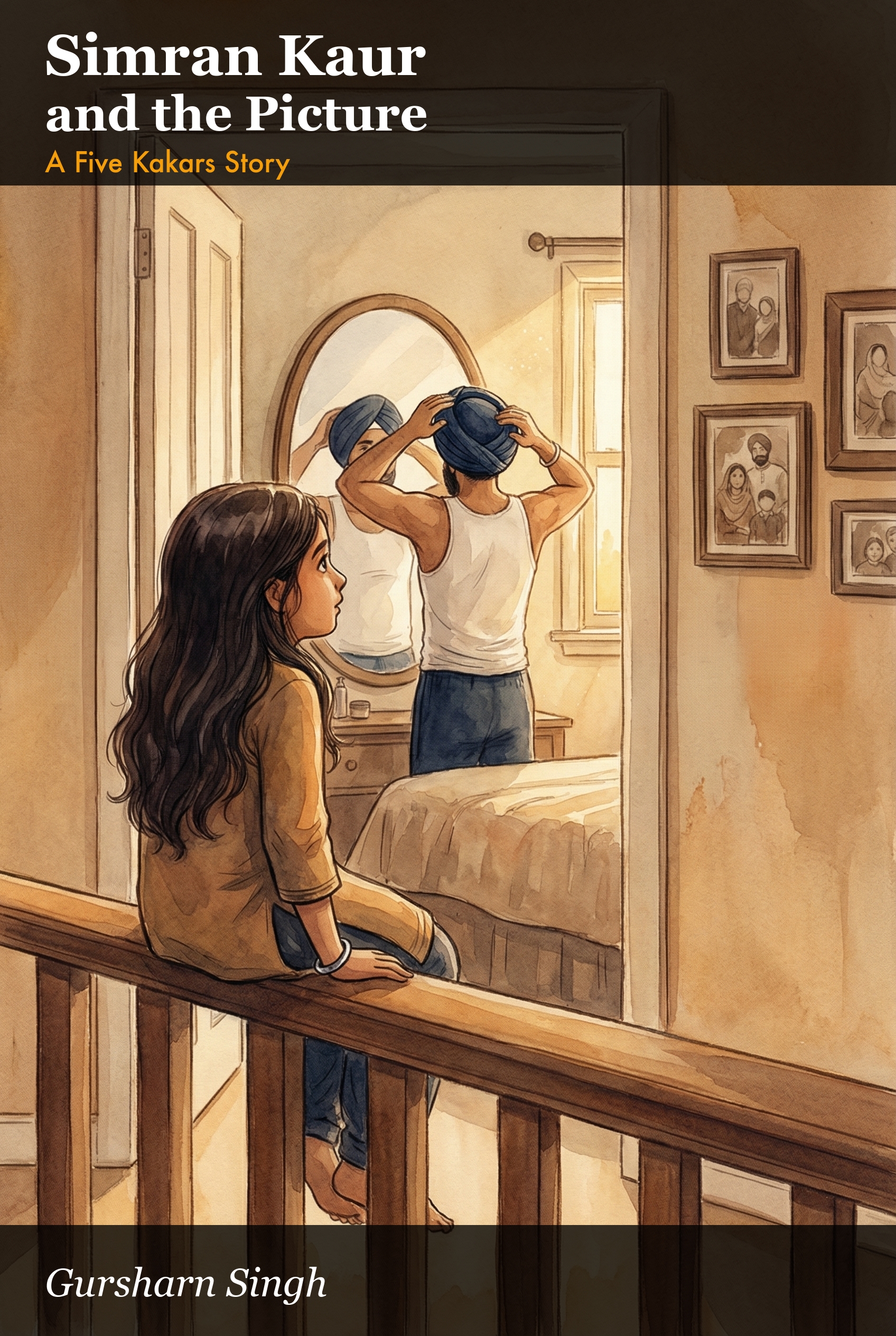
Simran Kaur and the Picture is a free Sikh story for ages 4–12 about kesh, the uncut hair that is one of the Five Kakars. On Picture Day a classmate asks Simran why she has never cut her hair, and all she can say is “it’s just our family thing.” It takes her three days, and three old family photographs, to find her real answer.
Thirty-Two
Simran Kaur counted thirty-two steps to the bus stop every morning.
She had counted them in September, on the first day of school, because she wanted to know. She counted them again the next day to check the number was right. It was. She had counted them every morning since — not because she doubted the number, but because doing it the same way each day was one of the small things that made a big, loud world feel like it would hold still long enough to be looked at.
Thirty-two steps. Always thirty-two.
This morning was Picture Day. She’d been told at breakfast — sit up straight, don’t squint — and her mum had done her hair with extra care, a hundred patient strokes of the kanga instead of the usual thirty-eight, because Picture Day called for smooth. The braid lay over Simran’s left shoulder, heavy and neat, still cool from the comb.
On the bus, Ethan was counting the stops under his breath. “One, two—”
“Seven,” said Simran.
“I wasn’t counting how many there are. I was counting how many people get on at each one.”
“It varies. There’s no reliable pattern.”
“You don’t know that until you’ve counted it properly.”
“I’ve counted it,” said Simran. “Fourteen times. The number changes with the weather. More people on cold mornings, fewer when it’s mild.”
“That is a pattern,” said Ethan, pleased. “That’s a weather-correlated pattern. That’s the best kind.”
Maya sat between them with her sketchbook open, drawing a chickadee from memory, not looking up. “You’re both right,” she said. “There’s a pattern. It’s just not a tidy one.”
This was the shape of most mornings — Simran with the numbers, Ethan with the explanations, Maya choosing neither side and somehow being right anyway. Simran liked it. It was one of the things that stayed the same.
The Question
Picture Day at school went the way it always went. Line up by class in the corridor outside the gym, file in, sit on the stool in front of the grey backdrop, say ready when the photographer held up the little card with the smiley face, try not to squint at the lights.
Simran sat in the corridor with her class, the line shuffling forward a stool’s width at a time. Lily came over from further down and sat beside her on the floor, her back against the cool painted brick. Lily’s hair was in two short braids, very tidy, tied off with white ribbons.
“Your hair is so long,” said Lily. She said it the way you’d say your bag is so blue — just noticing.
“Yes,” said Simran.
“How long has it been since you cut it?”
Simran thought about how to answer that honestly. “I’ve never cut it.”
Lily turned to look at her properly. “Never? Like — not even a trim? Not even the ends?”
“Not even the ends.”
“Why not?”
And there it was: a small, ordinary, completely reasonable question, asked with nothing but curiosity behind it. Simran opened her mouth to answer it.
She knew the answer existed. She knew there was a real one — something to do with Guru Gobind Singh Ji and the Five Kakars and the word kesh, a word she had known her whole life. But she was sitting on a gym floor on Picture Day with the line creeping forward and Lily waiting with friendly, open eyes, and the real answer did not come. What came instead was the small flat thing that fit in the gap.
“It’s just our family thing,” she said. “It’s just what we do.”
Lily nodded, as if that made sense, which it sort of did, and the line moved, and she went back to her own class.
A minute later Simran was on the stool in front of the grey backdrop, saying ready, trying not to squint while the light went snap. But she wasn’t thinking about her face. She was thinking about the words she’d handed Lily.
It’s just our family thing. It’s just what we do.
It wasn’t wrong, exactly. It just wasn’t the answer. It was like being asked what the CN Tower was and saying it’s a tall thing downtown — true, and missing the entire tower. She had flattened something into nothing, and she’d felt it flatten as it left her mouth, and she hadn’t been able to stop it.
The Wrong Answer
In class after lunch, she thought about it again.
She wrote two words in the corner of her notebook, in her small careful hand: kesh. Then underneath: why.
She knew the word. She’d known it forever. Kesh — uncut hair, one of the Five Kakars, given by Guru Gobind Singh Ji to the Khalsa. She wore it. She had always worn it. But wearing something and being able to say what it was for, she was finding, were not the same. You could carry a thing your whole life and never once turn it over to look at the underside.
Ethan was across the table building a small bridge out of his pencil case and two elastic bands, in pieces, whenever Ms. Larson’s back was turned.
“Can I ask you something?” Simran said quietly.
“You never ask first,” said Ethan. “You just ask.”
“Can I ask you something.”
“Yes.”
“If someone asked you why you do a thing that matters to you — a thing you do every single day — and you couldn’t explain it, what would you say?”
Ethan unwound one elastic band and considered it. “I’d say I don’t know.”
“What if I don’t know felt like the wrong answer?”
“Then I’d go and find out.” He wound the band back on. “You’re allowed to not know a thing yet, Simran. You’re just not allowed to pretend the not-knowing is the same as the answer.”
Maya, without lifting her pencil from the chickadee: “It’s not really about finding the words, though. You can’t find the words for a thing until you know what you actually think about it. The words come last.”
Simran looked at her. She hadn’t thought of it in that order before — that the thinking came first and the words came after, and that the reason her answer had been hollow was that she’d reached for words before she’d done the thinking.
She wrote that down too, under kesh / why:
Words come last.
The Tuesday Bus
The next morning the question came back to her on the bus, the way questions did once she’d written them down. Writing a thing down didn’t put it away. It kept it.
Maya had her sketchbook open to a fresh blank page.
“What are you going to draw?” said Simran.
“Don’t know yet. Something from the ravine, maybe. There was a cardinal yesterday, properly red. But I have to fix the exact colour in my head before I start, or it comes out wrong on the page.”
Simran turned her own question over and decided to try it out loud, on Maya, the way you test a number by checking it against something you already trust.
“If someone asked you why you keep your hair long,” she said, “what would you say?”
Maya thought about it. “I’d say I like it long.”
“But if the real reason was bigger than liking it.”
“Then I’d say the bigger reason.”
So Simran tried. She laid the words down in order, carefully, the way she’d been turning them over since Picture Day: Guru Gobind Singh Ji. The Five Kakars. Kesh. The Khalsa. They came out correct, complete, in the right sequence.
Maya listened to all of it. Then she said, “Okay. But that’s what it is. What is it for you?”
Simran didn’t answer.
She had thought she was answering. It turned out she had said what kesh was — the definition, the facts, the things you could look up — and not one word about what it meant to her, the actual person wearing it down her own back.
Ethan looked up from a thick library book about bridge engineering. “You gave her the definition, not the reason,” he said. “Those aren’t the same thing.”
“I know that.”
“Then why’d you give the definition?”
She didn’t answer that one either. The bus pulled up at school and she counted the steps from the bus door to the front entrance — eleven, the way it was every day — and went in, carrying the question with her like a stone in her pocket.
Wednesday
On Wednesday, Ms. Larson handed back Friday’s maths test.
Simran had nineteen out of twenty. She’d lost a mark on the last question — a subtraction slip, the kind that happened when part of her mind was somewhere else. She had written 37 where the answer was 27. She’d been thinking about something else when she wrote it.
She fixed it in her notebook out of habit, then sat with the corrected number a moment. Below it she wrote: definition ≠ reason.
Ethan had been right, and Maya had been right, and the two rightnesses fit together into one thing. Simran had known the definition of kesh since she was small — Guru Gobind Singh Ji, the Five Kakars, uncut hair, the Khalsa. But the definition was the doorway, not the room. Knowing the facts about a thing was the beginning of understanding it. She had been standing in the doorway her whole life calling it the room.
She looked out of the window. Gurdwara Dasmesh Darbar wasn’t visible from this classroom — she was on the wrong side of the building. But she knew exactly where it was: two blocks north, the white dome with the windows she counted from the bus every morning. Some things you knew were there even when you couldn’t see them from where you were standing.
She thought that was probably true of more than gurdwaras. Then she wrote it down.
The Hallway
At home that evening, Simran took her braid out. Just to look.
Her hair hung loose past her shoulders, long and dark and straight. She stood in the bathroom and held a section of it in her hand and thought: this is the thing Lily asked about. It was strange to hold up for inspection something that was simply, always, a part of you — like trying to look at your own elbow, or hear your own voice the way other people heard it.
She had the same hair as her mum. And her mum had the same hair as Nani. She knew this not because anyone had ever sat her down and told her, but because of the photographs in the hallway. She had walked past them ten thousand times. Tonight, with the question still in her pocket, she went and stood in front of them and actually looked.
There were three.
The first was Nani Ji, young — nineteen, maybe — in a garden somewhere in Amritsar. She stood among tall marigolds with a low whitewashed wall behind her and was laughing at something just outside the frame, one hand half-raised as if to wave the photographer away. Her braid hung over her shoulder, thick and dark, exactly where Simran’s was when it wasn’t loose.
The second was Mum, from before Simran was born, standing at the railing at Niagara Falls. The great curve of white water dropped behind her and the mist had got into the edges of the picture so the whole thing looked a little like a dream. Mum was young in it too, and bundled in a coat that didn’t quite fit, and her braid lay over the front of her shoulder in just the same place.
And the third was Dad.
This one Simran had always noticed without quite knowing why. He was small in it — six, perhaps seven — too young for a dastar, so his hair was tied up in a joora, the little knotted topknot, with a soft patka covering it. He was grinning at the camera with a gap where a tooth had been. He looked like a completely different person from the calm, dastar-wearing dad who tied his turban in the mirror every morning. And he looked, at the same time, exactly like him.
Her mum came past with a basket of laundry and saw Simran standing there, and stopped.
“You’re looking at the wall,” Mum said.
“I’ve never really looked at it,” said Simran. “Who took the one of Nani?”
Mum set the basket down on the bottom stair. “Her brother. Your Nana’s friend had a camera — one camera, for the whole street, more or less. They’d borrow it for weddings and then waste the last few frames on whatever was lying around.” She touched the edge of the frame, not quite straightening it. “Nani was nineteen. That garden was behind the house she grew up in, off a lane near the Harimandir Sahib. She used to comb her hair out there in the morning, in the sun, with the same kanga that’s in our bathroom drawer now.”
“The same one?”
“The very same. It came across in a suitcase, wrapped in a cloth.” Mum smiled at the photo. “She’s laughing because her brother kept telling her to stand still and be serious, and she thought that was the funniest thing anyone had ever said to her.”
Simran looked at the laughing nineteen-year-old in the marigolds, and at the braid over her shoulder, and felt the years between them go thin for a second, the way a number you’ve checked enough times stops feeling like a guess.
“And this one?” She nodded at Niagara.
“My first winter here.” Mum’s voice changed a little — not sad, just further away. “I’d been in Canada about three months. I didn’t know anyone except your dad’s family. Everything was new and cold and the wrong shape, and I didn’t have the words for half of it yet.” She looked at her own young face under the mist. “Your dad took me to the Falls because he said it was the one thing nearby that was supposed to be beautiful, and he was right, it was. I remember standing there thinking — almost everything about me had changed. New country. New language. New everything.” She reached up and, lightly, touched the braid in the photo. “But this was still mine. This hadn’t changed. When you’ve left everything else behind, it matters more than you’d think, to keep the one thing that’s still yours.”
Simran said nothing. She was learning, this week, that the not-saying was sometimes where the listening happened.
“And Papa?” she said at last. “Why is he so small?”
“That one I had to hunt for,” Mum said, and almost laughed. “Your Dadi keeps a whole tin of them. I went through it one afternoon and found that and asked if I could have it framed. Your dad pretended to be embarrassed.” She looked at the gap-toothed boy in the joora. “He had a joora until he was nine, then a patka, then he learned to tie the dastar himself when he was about your age. Different ways of holding the same hair, as he got bigger. But it’s the same hair in that photo as the hair under the turban he ties every morning. He’s never cut it. Not once, not ever.”
Three photos. Three decades. A garden in Amritsar, a waterfall in Ontario, a tin of old pictures in Brampton. And in every one of them, the same long uncut hair — kept, carried, never cut — laid over the same shoulder, or knotted up in the same small topknot.
Simran stood in the hallway and looked at all three at once, and felt the shape of something begin to arrive. Not the words yet. Maya was right: the words came last. But the thing the words would be for — she could feel that gathering, the way you can feel the weight of a number before you’ve finished adding the column.
The Box
Her mum looked at her looking, and seemed to decide something.
“Wait here,” she said, and went upstairs, and came back down with a flat tin box, the kind that had once held biscuits and now held everything except biscuits. She sat on the bottom stair and patted the step beside her, and Simran sat.
Inside were photographs — loose, soft-cornered, some black and white, some faded to the orange that old colour photos go. Mum laid them out on her knee one at a time, slowly, the way you turn over cards you already know are good.
Here was Nani again, older now, holding a baby. “That’s me,” said Mum. Here was Nani’s wedding, a serious girl Simran could only just recognise as the laughing one in the marigolds. And then Mum slid out one more, right from the bottom, and held it carefully by the edges because the surface had gone fragile.
“This is Nani’s mother,” she said. “Your great-grandmother. Your Parnani.”
Simran took it the same careful way. The woman in it was old — properly old, sitting very straight on a charpai with her hands folded in her lap and her chin lifted, as if she had been told a photograph was a serious matter and had decided to agree. Her hair was white, pure silver-white, and it was long, drawn back and braided thin over one shoulder, the way Simran’s was thick over hers.
“She kept it long her whole life?” said Simran.
“Her whole life. Ninety-one years of it.” Mum looked at the picture over Simran’s shoulder. “She lived through more than I could tell you in a week. Leaving home, crossing a border with nothing, starting again. She lost a great deal. But she never cut her hair. Not once.” She was quiet a moment. “When she was very old she couldn’t braid it herself anymore, so Nani did it for her, every evening. The way I do yours. The way her own mother had done hers, probably.”
Simran laid the photographs out in a row on the stair, in order, like a number line.
Parnani, silver braid over her shoulder, on the charpai. Nani, dark braid, laughing in the marigolds. Mum, braid in the mist at Niagara. And — she fetched it in her head, because it was on the wall — Papa, small, the joora and the patka and the gap in his grin.
Four people. Four photographs. Born in different decades, in different countries, in a world that had changed completely around them between one picture and the next — different clothes, different languages, different continents, a whole century moving past. And in every single one of them, the same thing: the hair they’d been given, kept, never cut. The braid or the joora moving down the row like a single thread pulled through four different pieces of cloth.
And then — she didn’t say it out loud, but she thought it so clearly it was almost like saying it — there would be a fifth photo. The one being taken this week. Her, on the stool, braid over the left shoulder, trying not to squint. The thread coming on, one more length, into her.
“I think I’m starting to see it,” she said.
“See what?” said Mum, gathering the photos gently back into the tin.
“Why we don’t cut it.” Simran watched the silver braid disappear back under the lid. “I couldn’t say it this morning. I’m still not sure I can say it. But I can see it now. It’s a — ” she reached, and the word came, and it was the right one — “a thread. It goes all the way back. And all the way forward.”
Her mum closed the tin and didn’t make a speech about it. She just put her hand on the top of Simran’s combed-smooth head for a second, the way you’d press your thumb on a knot to say there, and picked the laundry basket back up, and carried on up the stairs.
The Mirror
The next morning, Simran watched her dad tie his dastar.
She had seen it every morning of her life and never once watched it. Today she watched. He stood at the bathroom mirror, working the long navy cloth through his hands, fold after fold, unhurried. It took a while; it always took a while. Nothing about it was rushed. Something in the slow, certain way his hands moved said, without any words at all, this matters.
When he’d finished and tucked the last fold, he caught her eyes in the mirror.
“Papa,” she said. “Why is kesh one of the Five Kakars?”
He didn’t answer straight away. He turned from the mirror to look at her properly, and took a moment with it, the way he did before the things that were worth getting right.
“Did something happen?” he said.
“A girl in my class asked why I never cut my hair. I said it’s just our family thing.” Simran paused. “That’s not the real answer, is it.”
“No,” said Dad. “It’s not wrong. It’s just the smallest part of it.” He sat down on the edge of the bath so his eyes were level with hers. “Guru Gobind Singh Ji gave the Khalsa kesh as a kind of answer to a question. The question is — ” he tilted his head — “is what you were given enough? And the kesh says yes.” He turned a hand over. “Your hair is something you came with. To keep it, just as it is, is a way of saying: I accept myself as Waheguru made me. I don’t need to cut anything off to be right.”
Simran thought about that. “Is that the whole reason?”
“What do you think?” he said. “You’ve been looking at that wall all week. You tell me.”
She thought about the four photographs, and the thread running through them.
“I think it’s also that you can see it,” she said slowly. “When someone keeps their hair, you can tell. Across a room. They’re not hiding what they are.”
Dad nodded once, the way he did when she’d found something herself and didn’t need handing it.
“That’s the part it took me longest to love,” he said, and left it there — no lesson tied to the back of it, just the one true thing, the way you set a stone down rather than throwing it.
He stood up, and the conversation was apparently over, which Simran had learned was how her dad taught: a little, and then space, and then he trusted you to do the rest. He picked up his bag.
“You’ll find the right words for Lily,” he said at the door. “You’ve nearly got them. You can tell — you’ve stopped reaching.”
The Same Hair
At school on Thursday, Simran found Lily at the lockers before the bell.
“I wanted to answer your question better,” she said. “From Picture Day. About my hair.”
Lily looked up, surprised. “Oh — you don’t have to.”
“I know. But I gave you a bad answer, and I knew it was bad while I was saying it.” Simran stood with her hands at her sides, the way she stood when a thing mattered. “The real reason I don’t cut my hair is that it’s one of the Five Kakars — five things Guru Gobind Singh Ji gave to the Sikhs, the Khalsa, a long time ago. Kesh is the hair. The idea is: you accept yourself the way you were made. You don’t cut away what you were given to be someone else.”
Lily listened.
“But also—” and here Simran slowed down, because this was the part she’d found on the stairs and wanted to get exactly right “—when you keep it, people can see it. A dastar, a joora, a long braid — you can tell, straight away, that someone’s made a promise and decided to keep it where everyone can see. And it’s the same hair my dad has, and his mum, and my Nani, and her mum. All the way back. Nobody in my family has cut it for as long as there are photographs. It’s like a thread, and I’m on the end of it.”
She stopped. It was more than she’d meant to say. But it was the true answer, and she knew it was true while it was still coming out — the way she knew a sum was right before she’d checked it.
Lily thought about it. “So it’s kind of like a uniform?”
“Sort of,” said Simran. “But from the inside, not the outside. Nobody makes me. It’s not a rule someone checks. It just — is. I’d keep it even if no one was looking.”
Lily looked at Simran’s braid for a second. “My grandma keeps her hair really long too,” she said. “Not for that reason. She just says it’s part of who she is and she’s not letting anyone talk her out of it.”
“Maybe that’s not so different,” said Simran.
Lily smiled. “Maybe not.” She turned to get her books, then turned back. “I’m glad you told me the real one. The first answer was kind of — I don’t know.”
“I know,” said Simran. “I knew it then too.”
“But you came back and fixed it.”
“I had to,” said Simran. “I’d written the question in my notebook. I can’t leave a written-down question without an answer. It bothers me.”
Lily laughed, as if that was the most reasonable thing she’d ever heard, which to Simran it was.
The Picture
The class photographs came back on Friday, in paper envelopes that Ms. Larson handed out before the bell.
Simran slid hers out and looked. She was in the middle of the back row, where she’d been put for height, the braid over her left shoulder exactly where she’d settled it. At the very edge of her wrist, her kara had caught the light — one bright steady line, the same circle it always was. She looked, she thought, like herself. Which was, she supposed, the entire point of a photograph: to catch the person being who they already are.
Maya leaned in to see. “You look very serious.”
“I’m always serious in photos.”
“You should try not being serious.”
“Then I wouldn’t look like myself.”
Maya considered the photo, then Simran, then the photo again. “Fair,” she said. “You look exactly like yourself. That’s actually quite hard to do. Most people in school photos look like someone doing an impression of themselves.”
Ethan opened his own envelope on the other side. “I blinked,” he announced. “Naturally. Years of practice keeping my eyes open and the one moment it matters, gone.”
Simran looked at her picture a while longer. She thought about the hallway — Nani in the marigolds, Mum in the mist, Papa in the joora, Parnani silver-braided and straight-backed on the charpai. And she thought: one day this goes up too. Some future hallway, some future evening, a girl who didn’t exist yet stopping in front of the wall and finding this — Simran, this year, back row, braid over the left shoulder, the kara a single bright line — and being told, that’s your great-grandmother, she counted everything, she never cut her hair either.
A thread. Pulled all the way back to a garden in Amritsar, and now coming on, through her, all the way forward into people she would never meet.
She slid the photo carefully back into its envelope so the corners wouldn’t soften, and did up the little flap.
Thirty-Two Again
On Monday morning, Simran walked the thirty-two steps to the bus stop and counted every one.
She always would. One, two, three — the familiar rhythm, her bag on her back, the Kennedy Road traffic clearing its throat for the day. The white dome of Gurdwara Dasmesh Darbar showed above the rooftops two blocks north, the way it did every morning. The mithai shop at the plaza wasn’t open yet, but somewhere close a kitchen was awake, and the warm smell of someone’s breakfast drifted out over the cold pavement.
On the bus, Maya had her sketchbook open to the cardinal at last, working the red in with small sure strokes. Ethan was deep in his bridge book, having moved on, he said, from famous engineering disasters to the bridges that had stayed up, which were apparently less exciting but better company.
“I answered Lily properly,” Simran said. “I told her about kesh.”
“What did she say?” said Maya.
“That her grandma keeps her hair long too, and it’s part of who she is. For a different reason than mine.” Simran watched the cardinal gain a feather. “I said maybe it’s not that different.”
Ethan looked up. “Different reasons for the same thing. Does that make it the same thing or two different things?”
“Both,” said Maya, not looking up.
“That’s what you always say.”
“Because it’s usually true.”
Simran watched the white dome slide between the buildings and counted the seconds it stayed in view — three, the same as every morning. Then it was gone behind a rooftop and the bus rolled on, over the bump at the intersection and smooth again. The 37 route sign came up and passed.
Thirty-two steps. Seven stops. One thread she hadn’t been able to see — not because it was hidden, but because she’d never once stopped walking past it long enough to look.
She got out her notebook — not the sketchbook, the notebook — and wrote, in her small careful hand:
I told Lily the right answer. It took me three days. That seems like the right amount of time for an answer that big.
And underneath, the thing she most wanted to keep:
The definition is what it is. The reason is what you carry. I’m carrying a thread, and I’m on the end of it, and that’s the part nobody can hand you — you have to turn around and see it for yourself.
She closed the notebook. Outside, Brampton went by, grey and ordinary and entirely itself, and Simran Kaur sat with her braid over her left shoulder and counted the things that stayed the same.
Teaching Notes: What Is Kesh?
Kesh — uncut hair — is one of the Five Kakars, the five articles of faith given by Guru Gobind Singh Ji to the Khalsa in 1699. Of the five, it is the one a Sikh wears most completely: not carried in a pocket or worn on the wrist, but grown from the body itself and kept, uncut, for life. Boys often tie it in a joora (a topknot) and later a dastar (turban); girls and women often wear it in a long braid. Keeping the kesh is a way of saying I accept myself as Waheguru made me — that what you were given is already enough — and of being visibly, openly who you are rather than hidden.
This story turns on a distinction children meet all the time without a name for it: the difference between knowing the definition of something and understanding what it means to you. Simran can recite exactly what kesh is — Guru Gobind Singh Ji, the Five Kakars, the Khalsa — and still give a hollow answer, because she has never stopped to ask what it means for her. She finds the real answer not in a book but on the wall: three family photographs, and an old tin of more, that show the same uncut hair carried across four generations and two continents. Kesh becomes, for her, a thread connecting everyone who has made the same quiet promise — back to a garden in Amritsar, forward into a hallway that doesn’t exist yet. For teachers, this opens a conversation about identity, family heritage, and the difference between reciting a fact and owning a belief. For the wider context of all five articles, see The Five Kakars — Articles of Sikh Faith.
Discussion Questions by Grade
Grades K–2
- When Lily asks why Simran never cuts her hair, Simran says “it’s just our family thing.” Why does Simran feel like that wasn’t a good answer?
- Simran looks at old photos of her Nani, her mum and her dad. What is the same in all the pictures?
- Simran’s dad says keeping your hair is a way of saying “what I was given is enough.” What is something about you that you’re happy to keep just the way it is?
Grades 3–5
- Ethan says: “You’re allowed to not know a thing yet. You’re just not allowed to pretend the not-knowing is the same as the answer.” What’s the difference between those two things?
- Maya tells Simran that “the words come last” — you have to know what you think before you can say it. Have you ever struggled to explain something you believe? What helped?
- Simran calls kesh “a thread” connecting everyone in her family who kept their hair. What is a “thread” in your own family — something passed down that connects you to people who lived long ago?
- It takes Simran three days to find her real answer. Why might a big answer be worth taking your time over, instead of saying the first thing that fits?
For Sikh Families
- Simran already knew the definition of kesh but had to discover what it meant to her. How can we help children move from reciting facts about our faith to genuinely owning them?
- The story finds its answer in old family photographs. Try it together: pull out real photos of grandparents and great-grandparents and trace what has been kept across the generations — the kesh, the dastar, a kanga, a way of doing things. What thread runs through your own family?
Curriculum link: Common Core ELA RL.3.2 (theme and central message) and RL.3.3 (character motivation and growth); SEL — CASEL self-awareness (identity, personal values) and social awareness (respecting differences); Ontario Social Studies (heritage and identity, family history) and Language (oral communication, expressing ideas with clarity).
Gurbani Verse
ਮਨ ਤੂੰ ਜੋਤਿ ਸਰੂਪੁ ਹੈ ਆਪਣਾ ਮੂਲੁ ਪਛਾਣੁ ॥
O my soul, you are the embodiment of the Divine Light — recognise your own origin.
Guru Amar Das Ji — Ang 441, Sri Guru Granth Sahib JiPunjabi Glossary
| Word | Meaning |
|---|---|
| Amritsar | A city in Punjab, India — home of the Harimandir Sahib (the Golden Temple) |
| Charpai | A traditional woven bed or cot with a wooden frame |
| Dadi | Paternal grandmother |
| Dastar | A turban — the way many Sikhs keep and cover the kesh |
| Gurdwara | A Sikh place of worship — “the door to the Guru” |
| Harimandir Sahib | The Golden Temple — the most sacred Sikh gurdwara, in Amritsar |
| Joora | A topknot of hair, worn by Sikh boys before they are old enough to tie a full dastar |
| Kakar | One of the five articles of faith that initiated Sikhs wear or carry, given by Guru Gobind Singh Ji |
| Kanga | A small wooden comb — one of the five articles of Sikh identity |
| Kara | A steel bracelet worn on the wrist — one of the five articles of Sikh identity |
| Kesh | Uncut hair — one of the five articles of Sikh identity, standing for acceptance of oneself as Waheguru made you |
| Khalsa | The community of initiated Sikhs, founded by Guru Gobind Singh Ji in 1699 |
| Nana | Maternal grandfather |
| Nani | Maternal grandmother |
| Parnani | Maternal great-grandmother — your mother’s grandmother (Nani’s mother) |
| Patka | A head covering worn by Sikh boys, covering the joora |
| Waheguru | The Wonderful Creator — the Sikh name for God |
Author’s Note
This is the third story in the Simran Kaur series — five stories set in Brampton, with roots in Amritsar, each woven around one of the Five Kakars, the five articles of Sikh identity given by Guru Gobind Singh Ji to the Khalsa in 1699. In this story, the kesh — uncut hair — is shown as what it truly is: not a rule and not merely a family habit, but a statement of acceptance. I am as Waheguru made me. And more than that — a thread, connecting every person who has made the same quiet promise across decades and distances.
Simran gives the wrong answer first, and knows it. The real one doesn’t come from a lecture; it comes from three photographs she has walked past her whole life without stopping to see — her Nani laughing in a garden in Amritsar, her mum newly arrived at Niagara Falls, her dad a small boy in a joora — and an old tin of more. The same hair, kept and carried, all the way back. That children are surrounded by such threads, and rarely stop walking long enough to notice them, is the heart of the book.
Simran Kaur is Fateh Singh’s cousin. Where Fateh Singh discovers his faith by asking, Simran discovers hers by noticing — this time, by finally noticing what had been hanging on the wall all along. Together, they are two paths to the same place.
Explore More
- The Five Kakars — Articles of Sikh Faith — What the Five Kakars are and why they matter
- Simran Kaur and the Knot — The second story in the Five Kakars series, about the kanga
- Simran Kaur and the Fence — The fourth story in the Five Kakars series, about the kirpan
- Fateh Singh and the Saturday Kitchen — Simran’s cousin Fateh, in London, learns about seva