
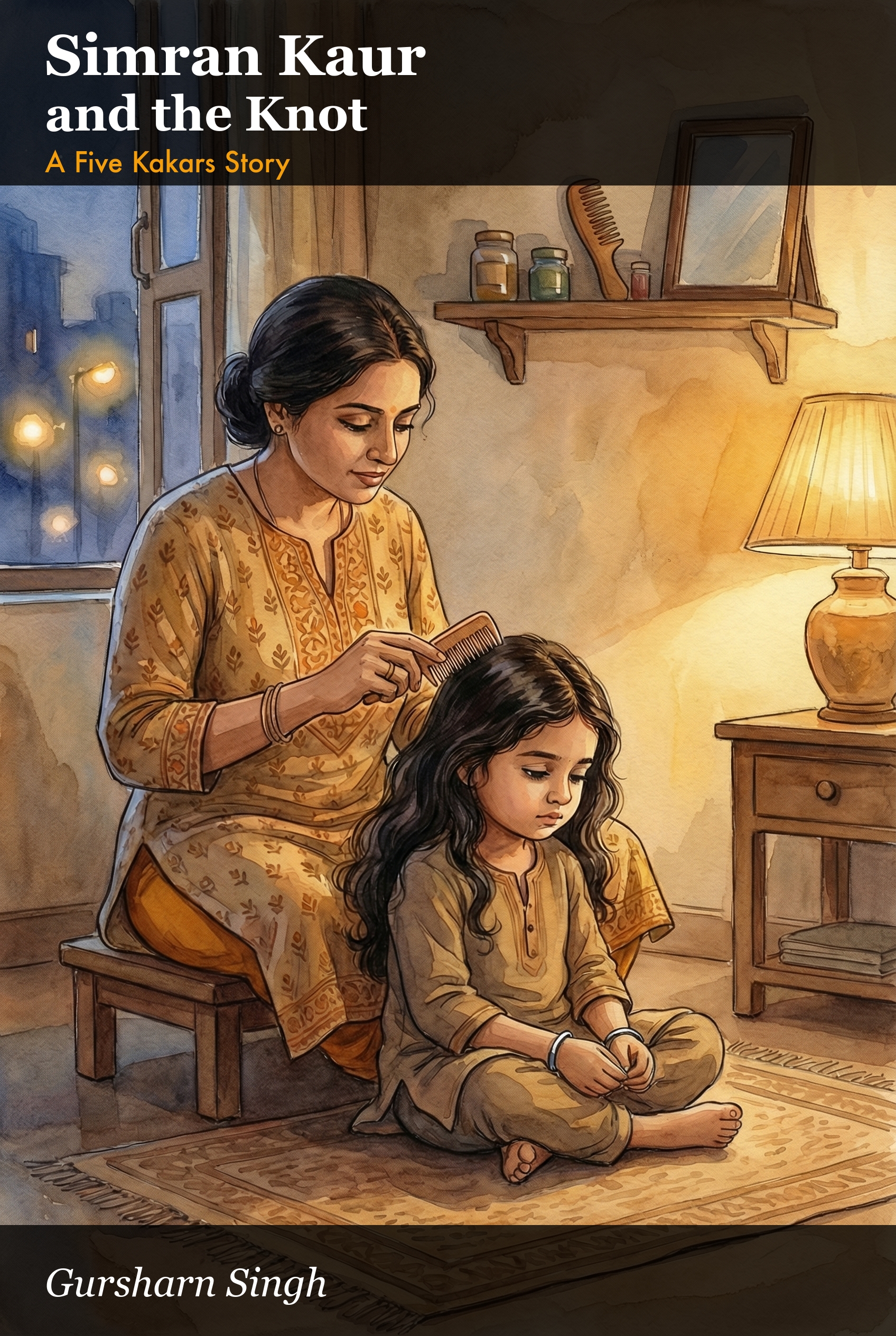
Simran Kaur and the Knot is a free Sikh story for ages 4–12 about the kanga, the small wooden comb that is one of the Five Kakars. Simran tells her best friend Maya, in front of the whole class, that her drawing of the CN Tower is the wrong shape. She’s right, and it doesn’t help at all. The patient way her mum’s kanga works a knot loose, from the loose edges in, shows Simran how to mend the friendship.
Tuesday
Tuesday was art afternoon, and Simran liked Tuesdays for exactly that reason.
At one o’clock, Ms. Larson cleared the desks and set the materials out — watercolours on Mondays, pencils on Tuesdays — and for forty-five minutes nobody had to do maths, or spelling, or answer questions about the main character’s feelings. They could just make things. The radiator ticked under the window. Outside, the Brampton sky was the flat pale grey it went in February, and a plane from Pearson came down low over the rooftops, the way they did every few minutes, so close some afternoons you could count the windows along its side.
Simran wasn’t a drawer the way Maya was a drawer. So she usually did something adjacent — labelling diagrams, making careful maps of things she’d noticed that week. Last Tuesday she had drawn the bus route from home to school with every stop marked and the rough number of people who got on or off at each one. Ms. Larson had pinned it on the wall by the door, and Simran had checked, twice, that it was straight.
Today she was working on a map of Chinguacousy Park from memory, to see how close to right she could get it without looking. She had the numbers for it. Thirty-two steps from her front door to the bus stop. The pond, and the little arched bridge over the stream that fed it, and the geese that lived there in summer — twelve of them, she was fairly sure, though geese were hard to count because they moved. She drew the pond as a soft oval and the bridge as a careful curve and started pacing out, in pencil, how far the path ran between them.
Beside her, Maya unrolled her Toronto skyline.
The Drawing
It started with the CN Tower.
Maya had been working on the skyline for three art afternoons. She kept it rolled in a cardboard tube and unrolled it carefully each time, weighting the corners with her pencil case and a glue stick. Today she unrolled it all the way and sat back, and Simran knew that sitting-back — it was the sitting-back of someone showing you a thing they believe in.
It was good. The buildings were drawn from memory — the towers along Bay Street, the flat shine of the lake behind them, and in the middle, rising over everything, the CN Tower. Maya had a way with a pencil that Simran didn’t have and didn’t pretend to. She could make a line look like it was standing in light.
Simran looked at it properly, the way she looked at everything. And the longer she looked, the more one thing bothered her, the way a stone in your shoe bothers you until you have to stop and shake it out.
“You’ve made it too thin,” she said. “The CN Tower is wider than that. Especially at the base — the base is really wide. It goes out before it goes up.”
Maya looked at her own drawing. “I know what the CN Tower looks like.”
“I’m just saying. The proportions are off.”
Maya picked up her pencil and didn’t answer.
“The pod partway up is bigger too,” Simran went on, because the first thing being true made the second thing feel safe to say. “It’s like a big disc. Yours looks like a small dot.”
“Simran.” That was Ethan, from the desk behind, not looking up from the straw bridge he was gluing. “She didn’t ask.”
Simran stopped. The words were already out — both true and already out, which she was learning were not the same as harmless. She looked at Maya’s drawing, and then at Maya, who had turned a little away and was no longer working on the tower at all. She was adding clouds to the top corner instead, small quick strokes, the kind you do with your hand so your face has somewhere to look.
“It’s a really good drawing,” Simran said.
Maya kept adding clouds.
Simran went back to her park map. She drew the bridge, and the pond, and the twelve geese as small oval shapes on the water. She drew the path between them and checked it against the picture in her head, and it looked right to her — the proportions good, the distances about correct. She had been right about the tower, too. She was almost always right about a shape. So she couldn’t work out why the afternoon had gone heavy, the way the radiator made the room go heavy by three o’clock.
After school, walking out to the bus, Maya went ahead with two girls from the other class, her oversized olive-green coat — her mum’s coat, far too big — flapping at her ankles. She didn’t look back. Ethan fell into step beside Simran instead.
“You should have just not said anything,” he said.
“The proportions were wrong, though.”
“She knows that. She didn’t need you to tell her in front of everyone while she was showing it off.”
Simran was quiet. She counted the cracks in the pavement — six, seven, eight — the way she did when a thing wouldn’t sit still in her head. She had been right. The CN Tower’s base was wider than Maya had drawn it; she would have bet her whole map collection on it. But Ethan was also right, which was somehow worse than if he’d been wrong, because it meant two true things were standing in the same place at the same time and pointing in opposite directions.
She wasn’t sure what you did with that.
Thirty-two steps from the bus stop to her front door. She counted them on the way up. Usually counting tidied her thoughts into a row. Tonight the number came out right and tidied nothing at all.
Zero
On Wednesday morning, Simran decided she would fix it. She was good at fixing things. You found the broken part and you mended the broken part; that was how fixing worked.
She made a plan, and her plans were usually good. She would find Maya before the bell, explain that she’d been right about the proportions but wrong about the timing, and Maya would see that this was fair, and everything would go back to how it was on Monday. Clear plan. Two parts, in order. It should work.
Maya was at her locker at half past eight. Simran walked over, lined the words up, and let them out.
“I was right about the proportions,” she said. “But I should have said it differently.”
Maya closed her locker without slamming it, which was somehow worse than slamming it. “I know the proportions were wrong. I worked that out on my own.”
“I’m just saying — the actual observation wasn’t wrong.”
“You already said that.” Maya picked up her bag. “You said it yesterday, in front of everyone. And now you’re saying it again.” She looked at Simran — not angry, more tired, the tired you get when someone keeps handing you a thing you’ve already put down. “You’re apologising for how you said it, but you keep saying it again while you do.”
She walked to class.
Simran stood at the locker and felt the plan come apart in her hands like wet paper. She’d had two parts in the right order, she was sure of it. She just hadn’t noticed that the first part — I was right — undid the second part before the second part even got out.
She had started from the wrong place. She had started from the middle.
At lunch, Maya and Ethan were at their usual table, but everything was at a slightly different angle. Maya sat half-turned toward Aanya, who drew birds too and was apparently, today, very interesting. Ethan sat in the careful middle he went to when he didn’t want to be on anyone’s side. Simran sat down and ate her lunch and said almost nothing, which for Simran was unusual enough that Ethan noticed and pretended not to.
She counted the ceiling tiles to give her eyes something to do. Forty-four. She counted again and got forty-six; the grid was irregular near the wall and she couldn’t get a number she trusted. She gave up on the third try, which she never did.
She had started from the proportions because the proportions were true, and true felt like the safest place to stand. But she was beginning to see that true wasn’t the only thing in the room. There was when you said a true thing, and how, and who else could hear — and those weren’t true or false, they were kind or unkind, and she had walked straight past all of them to get to the part where she was right.
The worst of it was that every time she thought through what to say next, the whole thing tangled tighter. There was the fact of the proportions being correct, and there was the separate fact of the moment being wrong, and she kept grabbing both at once and pulling, and every pull drew the knot down smaller and harder.
You’re apologising for how you said it, but you keep saying it again.
Maya was right. Simran had reached straight into the middle of the tangle and pulled.
On the bus home she sat alone. Seven stops. The white dome of Gurdwara Dasmesh Darbar slid up between the rooftops two blocks north, the way it did every afternoon, pale against the grey.
She didn’t count its windows. She only counted it once, the whole thing, as one quiet shape going by, and then she let it go.
The Comb
That evening, Simran’s mum called her for the kanga.
It wasn’t always the evening kanga — some days it was the morning one only, depending on what kind of day Simran had had with her hair. Today she’d run hard at lunch break trying to be too busy to feel left out, and the braid had loosened and the ends had gone soft and tangled.
Simran sat on the low stool in the bathroom, and her mum began at the ends — always the ends first, easing the knots out from the bottom of the braid before working any higher. The kanga she used was old. It had come from Amritsar decades before Simran was born, carried in a suitcase wrapped in a square of cloth. Nani had used it every night on Mum’s hair, in a house in Punjab, by a window that looked out on a lane. Now it lived in the second drawer of a bathroom in Brampton and did, every night, exactly what combs do: patient, steady, starting at the edges.
Simran watched it move in the mirror.
“Maa,” she said. “Why do you always start at the bottom?”
“Because if you start at the top, you push the knot down ahead of you and make it tighter.” Mum found a tangle and worked it without forcing — coming at it from the side, a little at a time. “You have to start at the edges of a knot. Find where it’s already loose. Then work in from there.”
Simran watched it happen exactly as Mum said it. The comb slid through a free length of hair, easy, then came up against the tangle and didn’t push — it touched the outside of it, loosened one strand, then another, in small unhurried strokes. The knot didn’t vanish all at once. It got smaller. And smaller. Until there was no knot, only the place where a knot had been.
She thought about Maya.
The edges of that knot — what were they? Not I was right. Not even I was wrong. Those were both the middle, both the hard tight centre she kept grabbing. The loose edge was just one small true thing she hadn’t actually led with yet: I should have said it differently. No proportions attached. No tower. Just that.
She turned it over to see if it was honest, all by itself, with nothing tied to it. She thought it was.
“Was the kanga Nani’s?” she asked.
“Her mother’s before that. It came from a little shop near the Harimandir Sahib. Very old wood — you can feel it’s heavier than the new ones.” Mum kept working upward. “A good kanga is patient. It doesn’t rush the hair. It finds where the hair is willing to move, and it starts there, and it lets the hair do the rest.”
“What if the knot’s really bad?”
“Then you’re more patient, not less. You never force it. You just keep going from the outside in, and you trust that it’ll come.”
The tangle in Simran’s hair was gone now, and Mum drew the comb up to the roots in long smooth strokes, the old dark wood steady in the mirror. Simran sat very still and let herself be combed and thought, in time with the strokes: start at the edges. Find where it’s loose. Work in.
Dinner
At dinner, Simran’s dad asked how school had been. He asked it the same way every evening — not as a test, just as part of the rhythm of everyone sitting down together.
“Fine,” said Simran.
“Fine meaning good? Or fine meaning it happened?”
“Fine meaning complicated.” She moved the rice around her plate without doing much eating. “I said something to Maya that was true but wrong. And then when I tried to fix it I made it worse, because I led with the part that was true.”
Dad didn’t answer straight away. He set down his fork and sat with it for a moment, the way he did before the things that mattered — turning the question over first, in no hurry to have an answer ready before he understood it.
“Go on,” he said.
“The true part was that her CN Tower drawing had the proportions wrong. The wrong part was that I said it out loud, in front of everyone, while she was showing it.” Simran looked at her plate. “I tried to say sorry today, but I kept saying the proportions were wrong while I did it. So it wasn’t really sorry. It was just — being right again, with sorry on top.”
Dad thought about that. Then he said: “Knots get worse if you pull.”
Simran looked up. “What does that mean?”
“Just what it says.” He didn’t reach for a lesson or a long story; he let the small thing be the whole thing. “You pull on a knot, the knot tightens. Everyone who’s ever had a knot knows it. The pulling feels like doing something. It isn’t.”
“That’s all?”
“That’s all,” he said. “You already know the rest. You told it to me yourself, just now. You said you led with the part that was true. So.” He turned his hand over, open, so. “Don’t lead with that part.”
Simran ate, and thought about the kanga starting at the bottom, finding the loose edge before it ever came near the knot. The edge of her knot was small and a little bit unimpressive — I shouldn’t have said it the way I said it — and the worst part of it was that it had nothing in it about her being right. Nothing to stand on. Just the loose end, offered, with no defence tied to the back of it.
She could start there. She could just say that, and stop, and not pull.
Seven Streetlights
After dinner, Simran sat at her bedroom window.
Seven streetlights from here. She had counted them so many evenings that they didn’t really need counting anymore — but she counted them anyway, because counting them wasn’t about the number. The number never changed. That was the point of it: seven small steady circles of yellow light landing in the same seven places on the pavement, the same tonight as last week, as last winter. Some things you count to find out. Some things you count just to be sure they’re still there.
She thought about the kanga in the bathroom drawer. The old dark wood, the fine close teeth, the carved edge worn smooth by two grandmothers’ worth of evenings. It had crossed an ocean in a suitcase to end up in a drawer in Brampton, and it spent its nights doing the smallest, most patient thing in the world. That was a long way to travel to keep being gentle.
And she thought about the knot at the back of her braid that evening — the tight one at the nape of her neck — and how her mum had worked it loose without once pulling. It hadn’t come free all at once. The edges first. Then the middle. Then gone.
She had gone to Maya yesterday morning and reached straight for the middle. Led with the true thing. Pulled. Made it tighter.
Tomorrow she would find the edge instead.
She counted the streetlights one more time, slowly, and they were all there. Seven. She hadn’t really doubted it. She just liked to be sure.
Almost Again
On Thursday morning, the plan nearly went wrong in a brand-new way.
Maya got on at the fourth stop, sketchbook under her arm, and came down the aisle and — because Maya didn’t reroute around problems, she walked straight through them — sat down in the seat next to Simran, the way she did every single day.
Simran had her loose end ready. I was wrong about how I said it. Just that. She had practised it the way she practised free throws, until the words went quiet in her mouth.
But Maya, settling her bag, opened the sketchbook on her knees, and there was the skyline — and there, right in the middle of it, was the CN Tower, still too thin, still tapering to that needle with the little dot of a pod. Maya hadn’t fixed it yet. And before Simran had decided anything, she felt the old true thing rise straight up in her like water in a glass: the base is still wrong, it’s still too narrow, you’ve still got the pod too small —
Her mouth was already a little bit open.
And she thought of the comb. Of the knot getting smaller. Of her dad’s open hand. Don’t lead with that part.
She closed her mouth. She put the true thing down — actually put it down, like setting a heavy bag on the floor — and left it there. It was, she would think later, the hardest small thing she had ever not-done. Being right was right there, free for the taking, and she stepped over it.
She breathed once and said the loose end instead.
“I was wrong about how I said it,” she said. “On Tuesday. That’s all I wanted to say.”
She didn’t add but I was right about the proportions. She let the loose end be a loose end and held perfectly still, the way you hold still when the comb is near a knot.
Maya was quiet for one whole stop. Outside, Springdale slid by — the plaza with its signs in Gurmukhi and English, the fabric shop, the corner where the 37 bus swung wide, the grocery with the vegetable crates out front and two aunties stopped beside them, mid-sair, talking with their hands.
“Okay,” Maya said at last. She didn’t say it’s fine. She said okay, which was a different word and they both knew it. Okay meant I heard you and I’m thinking about it. It meant the knot had loosened by one strand.
They rode another stop. The bus filled and thinned. Simran didn’t pull on the okay. She just let it sit there and be one loosened strand, and waited.
The Edges
It was Maya who spoke next.
“I’ve been fixing it, actually,” she said. She pulled the sketchbook back onto her knees and turned to the skyline. “Not — not because you said. I mean, a bit because you said. But mostly because once you’d said it I couldn’t un-see it, and then I wanted it right.” She found a half-erased ghost of the old tower under fresh pencil. “Look. I started over on the tower.”
Simran looked. The base was wider now, planted, the way the real thing sat its weight down before it climbed; the pod had grown into a proper disc. It was only half-redone, the new lines drawn confidently over the rubbed-out old ones, but you could already see it was going to be better than the first — and the first had already been good.
“It’s really good,” said Simran. And then, carefully, she did not say anything else about it. She left the rest of the true things where she’d put them down.
“I know,” said Maya, and a little of the old Maya came back into her voice when she said it. Then she looked at the page instead of at Simran. “I was embarrassed when you said it. That was the actual thing. Not that you were wrong — you weren’t — but that I was holding it up like it was finished, and it wasn’t finished, and you saw that in front of everyone.” She turned a strand of hair behind her ear. “I wanted it to be done so badly that I’d started pretending it was. And then you said the one true thing out loud and the pretending fell off it.”
“I should have waited,” said Simran. “Or told you on the way home. Just you.”
“Yes,” said Maya. She turned and looked at Simran directly now. “But you didn’t do it to be mean. I knew that even on Tuesday. I just needed a few days for the embarrassed part to stop being the loudest part.” She paused. “It’s quieter now.”
Simran felt something give — not all at once, but in stages, edge first and then the middle, the way the comb did it.
“Are we okay?” she asked. She nearly said are we done, and changed it.
“We’re okay,” said Maya.
In the seat ahead, Ethan turned around. He’d clearly been listening to all of it and pretending, for three whole stops, to read a book about bridges that he was holding upside down. “Finally,” he said. “Do you have any idea how uncomfortable it is to sit next to a disagreement you’ve decided to have no opinion about?”
“You were three rows ahead,” said Maya.
“Disagreements have range,” said Ethan, and turned the book the right way up.
Smooth
That evening, Simran sat on the bathroom stool again, and her mum drew the kanga through her hair — thirty-eight strokes, end of the day, smooth all the way from root to tip. No tangles tonight. Only the steady, unhurried travel of the old wood, root to end, root to end.
Simran watched it in the mirror.
The kanga was small. Smaller than she used to think it was when she was little — back then it had seemed like a proper object, a thing with weight in the world. Now she could see it was just a comb. Old dark wood, fine teeth, a carved edge gone soft with handling. Nani had carried it from Amritsar. Now it spent its evenings in the second bathroom drawer in a house in Brampton, doing what combs do.
“Maa,” she said. “Why is the kanga one of the Five Kakars? It’s just a comb.”
Her mum didn’t answer straight away. She was easing a small soft tangle at the nape of Simran’s neck, finding its loose edge first. “What do you think?” she said.
“I think—” Simran watched the comb work. “I think it’s about taking care of things. Your hair. But also — other things. Things that get tangled.”
“Keep going.”
“If you don’t comb it, it gets worse. And if you rush it, it also gets worse. So you have to be patient. You have to find where it’s loose and start there.” She paused, because the next bit had only just arrived in her and she wanted to say it right. “Like fixing something with a person. You can’t just pull on the part you want fixed. You have to find the loose end and go gently or you make the knot smaller and harder.”
Mum worked the last tangle free and drew the comb up smooth. “Guru Gobind Singh Ji gave the Khalsa the kanga so they wouldn’t neglect what they’d been given,” she said. “Your kesh, first — the hair Waheguru gave you, kept clean and cared for, not left wild and not cut away. But once you’ve understood it for hair, it doesn’t stay being only about hair.” She made the long final strokes. “Your mind gets tangled too. Your days. The people you love. The kanga is the small daily discipline that says: look after it. Patiently. Before the knot gets bad. And when it is bad — gently, from the edges, never by force.”
“I didn’t know it meant all that,” said Simran.
“You mostly worked it out yourself,” said Mum, “sitting on that stool.” And Simran felt her smile in the mirror more than she saw it.
The Bridge Drawing
On Friday, Maya brought the finished skyline to school to show Simran before she handed it to Ms. Larson for the exhibition. She unrolled it on Simran’s desk and weighted the corners and stepped back, and there was the sitting-back again — but easy this time, not braced.
Simran looked at it the way she looked at everything, slowly and all the way to the edges. The CN Tower was right now — the wide planted base, the disc of the pod, the long needle tapering up off the top of the page. And around it Maya had set the rest of the city down with a care she must have gone and researched: the lake horizon laid flat behind, the arena, the old railway hotel, the towers stepped back in proper order so the eye knew which was near and which was far.
“It’s really good,” said Simran.
“I know,” said Maya. “It’s the best thing I’ve drawn.”
“Better than the crow?”
Maya considered this seriously, because the crow had been very good. “Better than the crow.”
Ethan leaned over from the next desk. “What was wrong with the crow?”
“Nothing was wrong with the crow,” said Maya. “Nothing was ever wrong with the crow. The tower was wrong. The crow was always fine.”
“Then why submit the skyline and not the crow?”
“Because the skyline is harder,” said Maya. “And now it’s right. Those are different feelings.” She rolled the drawing back into its tube, carefully, from one edge. “I wouldn’t have fixed it if Simran hadn’t said anything. I knew it was wrong the whole time. I was just pretending it wasn’t, because I wanted to be finished, and finished felt nicer than right.” She slid the cap on the tube. “Things that are hard and right feel different from things that are easy and fine. I didn’t really know that until this week.”
Simran wrote it down in her own notebook that afternoon, under the park map, in her small careful hand:
Things that are hard and right feel different from things that are easy and fine.
She thought it might be one of the truest things Maya had ever said, and Maya said a lot of true things — but quietly, and at the right time, which Simran was beginning to understand was the whole trick of it.
The Tower
That weekend, the three of them rode into Toronto with Simran’s family to visit Dad’s cousin. Simran and Maya sat together. Ethan had come because the alternative was staying home, which he announced was strictly worse, and he brought a book about famous engineering disasters that he read for the first twenty minutes and then set down, because Toronto coming up out of the flat land was more interesting than any disaster.
Simran counted the exits — seven, from the edge of Brampton to the downtown ramp. And then the CN Tower came up over the highway, real and grey and much bigger than she’d braced for, its base going wide before it went up, the pod sitting exactly where Maya had finally drawn it.
“There it is,” said Simran.
Maya looked, and held her rolled drawing up to the window and let it unspool a little, comparing. The base matched. The pod matched. The long needle matched the long needle.
“There it is,” said Maya.
They sat with it a minute — the real tower in the window and the drawn one on the paper, both saying the same true thing, neither one shouting it.
Simran thought about the kanga. The knot you start at the edges of. The patience that finds the loose strand before it ever touches the tight middle. She thought about standing in the classroom on Tuesday and saying the proportions are wrong with everyone watching — reaching straight into the middle and pulling — and then about sitting on this same kind of bus two days later and finding the edge instead: I was wrong about how I said it. Small. Loose. Offered with nothing tied to the back of it. And how that one small true thing, said by itself, had loosened in a day what the big true thing had only tightened.
The tower slid sideways and away as the bus curved down the ramp into the city. Maya rolled her drawing closed.
“Thank you for the correction, by the way,” she said. “I mean it now.”
“You didn’t seem thankful at the time,” said Simran.
“No,” Maya agreed. “I wasn’t. The embarrassed part was too loud.” She looked out at the buildings going up around them. “But I am now. Both can be true. You taught me that, sort of. Two true things in the same place.”
Behind them, Ethan looked up from his phone. “For the record, I was right that you should have kept quiet on Tuesday.”
“You were,” said Simran.
“And the drawing is better because you didn’t.” He went back to his phone, then added, to the window, “I’ve been thinking about that all week. I don’t love it. Two opposite things being right at once. But there it is.”
“There it is,” said Simran, and looked out at the real tower one last time before it was gone behind the buildings — wide at the base, planted, going out before it went up, exactly the way she’d said.
Teaching Notes: What Is the Kanga?
The kanga is a small wooden comb — one of the Five Kakars, the five articles of faith given by Guru Gobind Singh Ji to the Khalsa in 1699. A Sikh keeps it tucked in the hair and uses it to keep the kesh (the uncut hair) clean and tidy. Of the five, it is the most everyday: a tiny tool for a small daily task. That ordinariness is the lesson. The kanga stands for discipline and care — looking after what Waheguru has given you, attending to it patiently and regularly, before neglect turns into a tangle.
This story uses the comb’s most literal, physical truth — you never untangle a knot by pulling it from the top; you start at the loose edges and work gently in — as a lesson about something children meet constantly: how to repair a friendship after you’ve hurt someone, even when you were right. Simran’s first apology fails because she “leads with the part that was true,” reaching straight into the middle of the knot and pulling. The kanga teaches her to find the loose end instead — a single honest sentence with no defence tied to it — and to let it do its quiet work. For teachers, this opens a rich conversation about the difference between being right and being kind, about timing, and about what a real apology contains and doesn’t contain. For the wider context of all five articles, see The Five Kakars — Articles of Sikh Faith.
Discussion Questions by Grade
Grades K–2
- Simran’s mum always combs out a knot starting at the bottom, never the top. Why does pulling from the top make a knot worse?
- How do you think Maya felt when Simran said her drawing was wrong in front of everyone?
- Simran says sorry by telling Maya just one small true thing. What was it? Why was saying less the thing that helped?
Grades 3–5
- Simran was right about the CN Tower — so why didn’t being right help her? When is the right moment, and the right way, as important as being correct?
- Simran’s first apology fails because she “keeps saying it again while she apologises.” What was she still doing wrong, even though she said sorry?
- On Thursday, Simran almost corrects the drawing again — and stops herself. Why is not saying the true thing sometimes the harder, braver choice?
- Maya says, “Things that are hard and right feel different from things that are easy and fine.” What do you think she means? Can you think of a time that was true for you?
For Sikh Families
- The kanga is the smallest and most everyday of the Five Kakars. Why might a small daily discipline — combing the kesh, before the knot gets bad — be exactly the right image for looking after a friendship, or a mind, or a day?
- Practise the “loose end” together: think of a real disagreement, and try to find the one honest sentence you could lead with that has no “but I was right” tied to the back of it. How does it feel to say only that, and stop?
Curriculum link: Common Core ELA RL.3.3 (character motivation and response) and SL.3.1 (collaborative conversation, perspective-taking); SEL — CASEL relationship skills (conflict repair) and social awareness (empathy, timing); Ontario Health & Physical Education (healthy relationships, conflict resolution) and Language (oral communication, expressing a point of view with sensitivity).
Gurbani Verse
ਆਪੁ ਤਿਆਗਿ ਸਰਣੀ ਪਵਾਂ ਮੁਖਿ ਬੋਲੀ ਮਿਠੜੇ ਵੈਣ ॥
Forsaking self-conceit, I seek the shelter of the Lord, and with my mouth I speak words of sweetness.
Guru Arjan Dev Ji — Ang 136, Sri Guru Granth Sahib JiPunjabi Glossary
| Word | Meaning |
|---|---|
| Amritsar | A city in Punjab, India — home of the Harimandir Sahib (the Golden Temple) |
| Gurdwara | A Sikh place of worship — “the door to the Guru” |
| Gurmukhi | The script in which Punjabi is written and the Guru Granth Sahib is recorded |
| Harimandir Sahib | The Golden Temple — the most sacred Sikh gurdwara, in Amritsar |
| Kakar | One of the five articles of faith that initiated Sikhs wear or carry, given by Guru Gobind Singh Ji |
| Kanga | A small wooden comb — one of the five articles of Sikh identity, standing for the discipline of care |
| Kesh | Uncut hair — one of the five articles of Sikh identity |
| Khalsa | The community of initiated Sikhs, founded by Guru Gobind Singh Ji in 1699 |
| Maa | Mum / mother |
| Nani | Maternal grandmother |
| Sair | An evening walk, often taken in pairs around the neighbourhood |
| Waheguru | The Wonderful Creator — the Sikh name for God |
Author’s Note
This is the second story in the Simran Kaur series — five stories set in Brampton and Toronto, each woven around one of the Five Kakars, the five articles of Sikh identity given by Guru Gobind Singh Ji to the Khalsa in 1699. In this story, the kanga — a small wooden comb — is shown as what it truly is: not just a tool for tidy hair, but a daily lesson in patience and care. Guru Gobind Singh Ji gave it to the Khalsa as a reminder that what you’ve been given — your kesh, yourself, your friendships — has to be looked after, gently and often, and never forced. You cannot rush a tangle. You find where it’s already loose, and you start there, and you work in.
The CN Tower, the cooled friendship, and the clumsy apology that only made things worse all come from ordinary life. Most children — most adults — know the particular tangle of being right in a way that helps nobody. The way out, in this story, is the way Simran’s mum combs out a knot: lead with the loose end, the single honest sentence, and let it do its quiet work.
Simran Kaur is Fateh Singh’s cousin. Where Fateh Singh discovers his faith by asking, Simran discovers hers by noticing — and, this time, by holding her tongue at the right moment. Together, they are two paths to the same place.
Explore More
- The Five Kakars — Articles of Sikh Faith — What the Five Kakars are and why they matter
- Simran Kaur and the Lost Sketchbook — The first story in the Five Kakars series, about the kara
- Simran Kaur and the Picture — The third story in the Five Kakars series, about the kesh
- Fateh Singh and the Saturday Kitchen — Simran’s cousin Fateh, in London, learns about seva