
Gurpurab 2026 · celebrating at home

Guru Nanak Dev Ji's 557th Parkash Purab falls on Tuesday, 24 November 2026.

77
sleeps
hours
minutes

ਸਤਿਗੁਰੁ ਨਾਨਕੁ ਪ੍ਰਗਟਿਆ ਮਿਟੀ ਧੁੰਧੁ ਜਗਿ ਚਾਨਣੁ ਹੋਆ।

Satigur Nanak pragatiaa, mitee dhundh jag chaanan hoaa.

"With the emergence of the true Guru Nanak, the mist cleared and the light scattered all around."

— Bhai Gurdas Ji, Vaar 1

A Gurpurab is a day of remembrance and celebration in Sikh tradition. This special day marks the Parkash Purab — the arrival of the divine light of Guru Nanak Dev Ji into our world. Communities celebrate together at the gurdwara as one sangat, listening to kirtan, where the Guru's words of wisdom and love are sung in devotion.

✦ Made by Sikh parents and teachers, for our kids

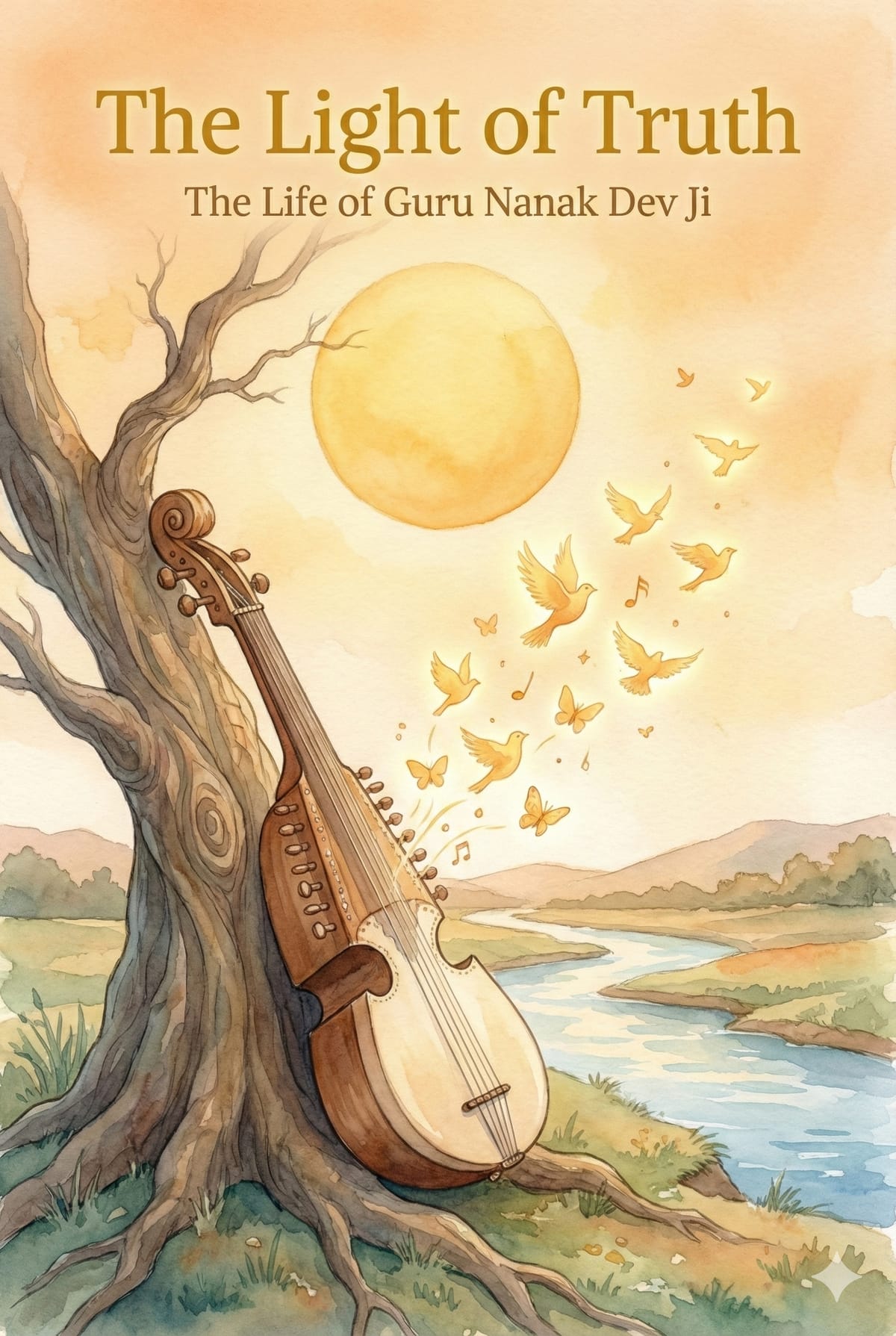
The Light of Truth: The Life of Guru Nanak Dev Ji — book cover Tell them his story The Light of Truth His whole life, from Talwandi to Kartarpur — 26 short chapters, free to read together.
A story to tell them on the day

The boy who asked for a different thread

Good for ages 5 and up.

Young Nanak seated in a circle of family and friends as the family priest holds out the cotton thread

When Guru Nanak Dev Ji was about ten, his family gathered for a ceremony. He was to be given a sacred thread to wear across his shoulder — a janeu — the way boys of certain families were, and boys of other families were not.

The priest came forward with the thread. And the boy asked him a question instead of putting out his arm. What happens to this thread, he asked, when it gets dirty? When it frays? When it breaks? When I die and my body burns, does the thread burn with me?

The priest said yes. Of course. It is only cotton.

Then give me a different thread, said Guru Nanak Dev Ji. Spin it from mercy, and spin it from contentment, and tie it with truth. That thread won't snap and it won't burn and it won't get dirty, and it will still be there long after this one is ash. If you have a thread like that, I'll wear it gladly.

Nobody had one to give him. He didn't wear the thread.

It's a small story about a piece of string, and it's the whole thing in miniature — that what you are matters more than what you're wearing, and that a ten-year-old is allowed to ask why. If your children only take one story from this day, this is a good one.

Read it illustrated: The Thread That Never Breaks →

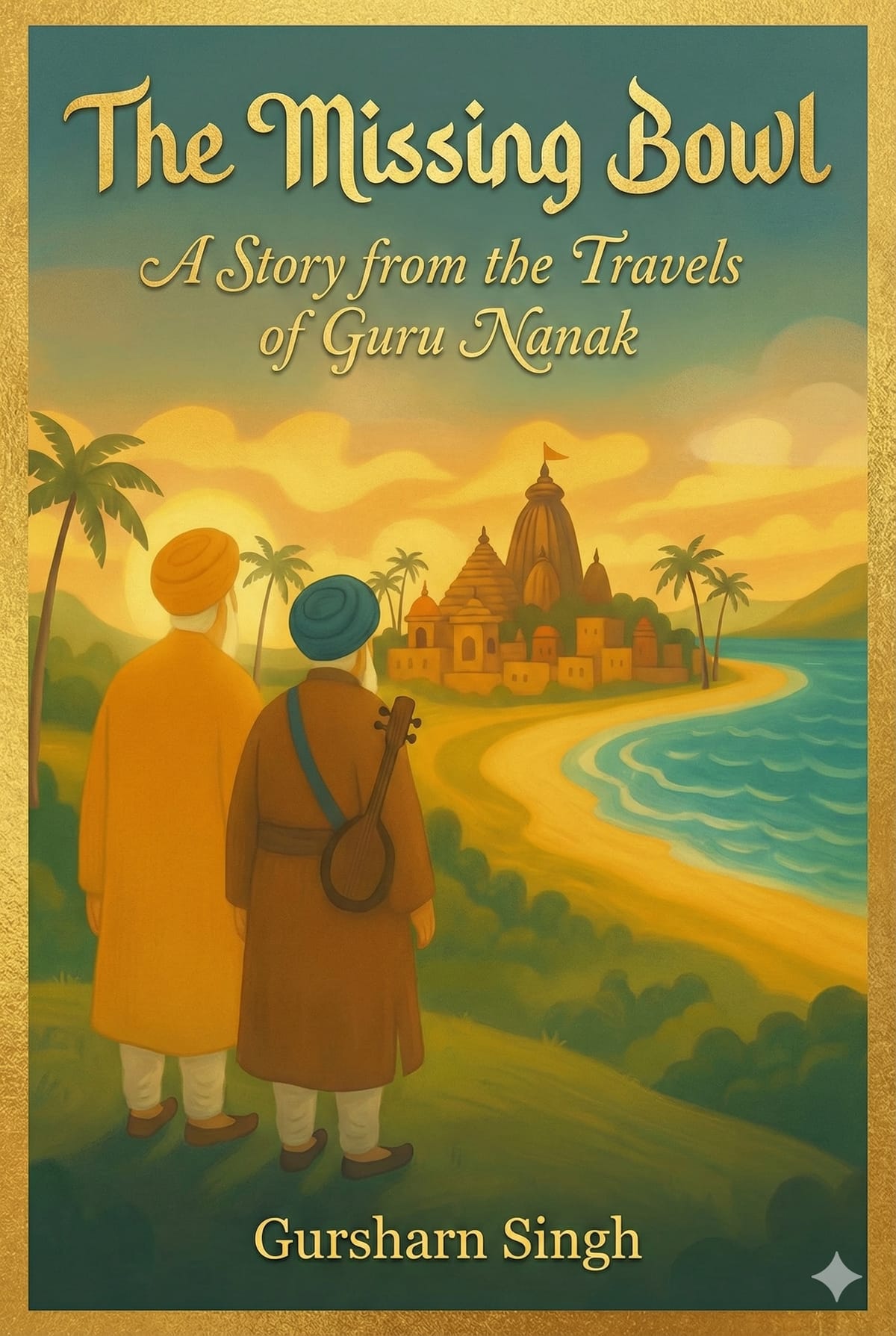
More stories from his life, illustrated

Why we celebrate it

Guru Amar Das Ji put the reason in Sri Guru Granth Sahib Ji, and it is a parenting line as much as a spiritual one:

ਬਾਬਾਣੀਆ ਕਹਾਣੀਆ ਪੁਤ ਸਪੁਤ ਕਰੇਨਿ ॥

Baabaaneeaa kahaaneeaa put saput karen.

"The stories of one's ancestors make the children good children."

— Guru Amar Das Ji, Ang 951

That's the whole case for the day. Telling your children where they came from is not nostalgia — it is how they work out who they are going to be. So a Gurpurab isn't only looking backwards at 1469. The question it asks is a present-tense one: how do we live his wisdom this week?

Three sentences to borrow at dinner

What to say to your kids

"Today is Guru Nanak Dev Ji's day — the first of our ten Gurus. Gurpurab means the Guru's day."

"He taught that there is one light in every single person — so nobody is above anybody else, and everybody eats together."

"What a family really passes down isn't money or things. It's the stories, and how we treat people. That's what we're doing when we light the candles tonight."

New to this? What the word means, and how any Gurpurab is kept →

Celebrating at home

Celebrating Gurpurab at home

In our family, Gurpurab doesn't start on the day. It starts somewhere in September, when the evenings get dark and I catch myself counting. If you didn't grow up leading any of this, that's the first useful thing to know: nobody is doing it perfectly, and the build-up is most of the joy.

1 · Weeks before

Weeks before

  • any age Put a Guru Nanak Dev Ji shabad playlist on the TV in the evenings. Nobody has to sit and listen. It just becomes the sound of the house for a few weeks, and the kids start humming things without being taught.
  • 4–7 read aloud · 7+ alone Read one sakhi a week. One a week is genuinely enough — by the time the day arrives they know who he was, and you haven't run a curriculum.
  • any age In the days before, the gurdwara holds a prabhat pheri (an early-morning walk with kirtan, in the days before). Ours are laps of the car park — half an hour, a few people leading the kirtan, everyone else following and singing along.

Back home the sangat (everyone gathered together, warmer than the word congregation sounds) walks through the town, and people come out of their homes to welcome them as they pass. That's the part that didn't make it here. The kirtan did, the walking did, the cold morning did — but the street doesn't know what we're doing. I miss it every year. And we go anyway, and the kids think the car park is completely normal, which is its own kind of answer.

2 · The week before

The week before

  • any age We clean the house and get it in order. Not a deep clean — the kind you'd do before people you like are coming to stay.
  • 7+ with help Get the decorations out. This year we're making a Nishan Sahib (the tall saffron flag outside every gurdwara, the one your kids can spot from the car) for the house out of a dowel and orange fabric. It will not be perfect. That's rather the point.

3 · The night before

The house with the lights on

The lights go up. If you do exactly one thing on this whole page, do this one — let the kids put the lights up, outside if you can, and leave them on. Every child who has ever celebrated anything remembers the night the house looked different. That's the memory. It costs an hour.

4 · The day

The day

I take the day off work. I'm not going to pretend that's available to everyone — if it isn't, protect the evening instead and treat it the way you'd treat a birthday dinner: phones down, their favourite food, everyone at the table. The day off is what I do. It is not the price of entry.

  • Japji Sahib together in the morning. We read it as a family. If you can't read Gurmukhi, read it in English or play it and listen — nobody is marking you. Japji Sahib, pauri by pauri.
  • Gifts, in the morning. In our family the kids get presents on Gurpurab. That isn't a rule anyone handed me — it's a decision we made, because our children are surrounded by Decembers and I wanted this day to be the one they can't wait for. Do what fits your family.
  • Their favourite food. Whatever it actually is. This is the day to cook it.
  • The gurdwara, afternoon or evening, and we stay till night. The bhog (the moment a full reading of Sri Guru Granth Sahib Ji is completed, on the morning of the celebration) is in the morning, the diwan (the gathering in the main hall, everyone sitting together) runs all day, and the building slowly fills. Our kids listen to kirtan for a bit, do seva (helping out unasked and unpaid, the everyday kind, like washing dishes) in the langar (the blessed community meal, shared by everyone sitting together as equals on the floor) hall, and mostly tear around with their friends. All three of those count.

If you're starting from nothing

Make their favourite food. Protect the time. Give them something. Be with them all day if you can and all evening if you can't. That's it — that's the whole method. Make the day feel like the best day of the year and they will carry it, and one day they'll do it for their own kids and won't be able to tell you exactly why. The learning arrives on its own. The memory has to be built on purpose.

The whole plan, on one card

ਮਾਸਟਰ ਜੀ

Six things. That's the whole plan.

The week before

  • Put a Guru Nanak Dev Ji shabad playlist on in the evenings
  • Read one sakhi with the kids
  • Get the decorations out — lights up the night before

On the day

  • Japji Sahib together in the morning
  • Their favourite food, and something sweet you made
  • Gurdwara in the afternoon — stay for langar
Print the checklist

Screenshot this and drop it in the family group.

maastarji.com — free Sikhi resources for families

Something for the kids, right now

If you found this page late in the evening and want one thing you can actually hand them — start here. All of these are free and none of them need setting up.

Going to the gurdwara, if you're not sure what to expect

For many families the biggest hesitation around Gurpurab isn't about what to do at home — it's walking into the gurdwara with young children and feeling unsure what to expect. Two simple truths make all the difference:

1 · There is no wrong time to arrive
On Gurpurab the diwan and kirtan run throughout the day. Late afternoon or early evening often works best for families with kids — the atmosphere is vibrant, welcoming, and full of community warmth.
2 · You can leave whenever you need to
Share langar together if you can — it is the Guru's gift of a warm, shared meal where everyone sits as equals. But if your little one is tired, restless, or has simply had enough, give yourself permission to step out. Nobody is keeping score. A joyful thirty-minute visit your children remember fondly beats an hour they had to endure.

The basics are simple: cover your head, slip shoes off at the door, and sit on the carpet wherever your family feels settled. Read our full guide to gurdwara etiquette and traditions →

Three things he asked of us

Kirat Karni → Earn it honestly Work for what you have, and take nothing that was made by someone else's suffering.
Naam Japna Remember Keep Waheguru somewhere in your day — not only in a building, and not only on Sundays.
Vand Chakna Share it Whatever you have, some of it belongs to someone who has less. Give it before you are asked.

Read his life in full →

Ten lines on Gurpurab

For the homework that's due tomorrow. Copy freely.

  1. Gurpurab means "the Guru's day".
  2. The one most families mean when they say "Gurpurab" is the birthday of Guru Nanak Dev Ji, the first Sikh Guru.
  3. This year it falls on Tuesday 24 November.
  4. Guru Nanak Dev Ji was born in 1469 in a village that is now in Pakistan.
  5. He taught that there is one Creator, and the same light is inside every person.
  6. He said nobody is higher or lower than anybody else, whoever their parents were.
  7. He asked people to work honestly, share what they have, and remember the Divine.
  8. Sikhs mark it with an Akhand Path (a reading of the whole Sri Guru Granth Sahib Ji, beginning to end, that is never paused), finishing on the morning of the day.
  9. There is kirtan all day at the gurdwara, and langar — a blessed meal shared by everyone, sitting together as equals.
  10. Many families decorate their homes with lights and spend the whole day together.

Questions parents actually ask

Did Guru Nanak tie a rakhi?
No. Raksha Bandhan is a cultural and Hindu observance, not a Sikh festival. Guru Nanak Dev Ji famously questioned and rejected the ritual wearing of the janeu (the sacred cotton thread) in childhood, teaching that an external thread cannot protect virtue, character or soul. Tying a thread like a rakhi runs against Guru Ji's philosophy of spiritual sovereignty and of sisters and brothers standing as equals. Children may hear the folklore from friends or online; there is no historical sakhi behind it.
What do families do on Gurpurab?
Families celebrate both at the gurdwara and at home. Gurdwaras conclude an Akhand Path — a continuous 48-hour reading of Sri Guru Granth Sahib Ji — followed by kirtan and langar. At home, families often light divas or candles, cook special meals or sweets, read sakhis together, and spend time reflecting on Guru Ji's message of equality and service.
Do children receive gifts on Gurpurab?
There is no religious tradition either requiring or forbidding gifts. In the diaspora many parents give presents or Gurmat storybooks so the day carries the same anticipation as the seasonal holidays around it; many others focus purely on seva, sweets and family time. Both are entirely embraced.
Can non-Sikh friends or partners visit the gurdwara?
Yes, absolutely. The doors are open by design to people of every faith and background, and everyone is served langar as an equal. All that is asked is that you cover your head, remove your shoes at the entrance, and bring no tobacco or alcohol. Sevadars and sangat are always glad to guide a first-time visitor.
Why does the date change every year on our calendar?
Most gurdwaras observe Guru Nanak Dev Ji's Parkash Purab on Katak Puranmashi, the full moon of the lunar month of Katak, so the Gregorian date shifts each year.

A note on the dates. Katak Puranmashi is the date this page observes and the one most gurdwaras worldwide keep. Some institutions observe Guru Nanak Dev Ji's birth according to the solar Mool Nanakshahi calendar, on 1 Vaisakh (14 April). Both are commemorated with love and devotion across the Panth. Read more on how the Sikh calendar works.

A gentle reminder, right when you need it

We'll email you a fortnight before Gurpurab with our free family printable kit and practical ways to celebrate together at home.

maastarji.com · Thoughtful resources for raising Sikh kids in the diaspora