
Building Resilience in Children: A Sikh Parent's Guide
What the science of resilience really says — it's built, not born — plus Chardi Kala and Sangat: a Sikh parent's guide to raising children who bounce back.
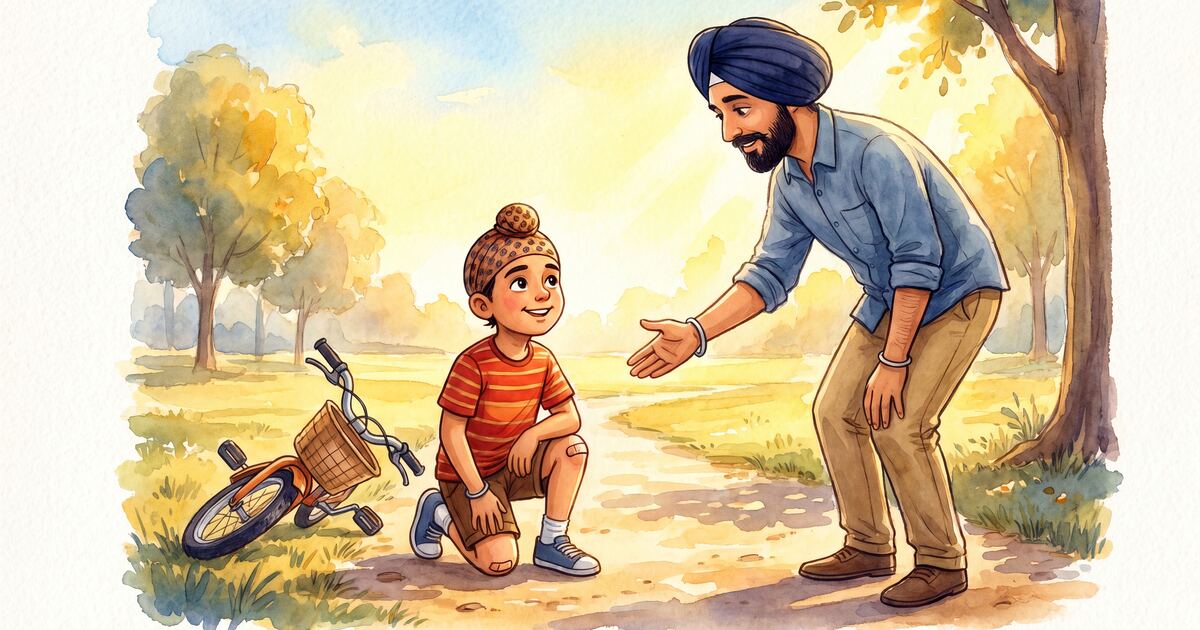
The short answer: Resilience is built, not born. Decades of research at Harvard’s Center on the Developing Child point to one finding above all others — the single most common factor in children who cope well with hardship is at least one stable, supportive relationship with a caring adult. Resilience isn’t toughness or going it alone; it’s a capacity you help build, at any age, through steady relationships and manageable challenges. Sikhi names the same spirit Chardi Kala — relentless high spirits in the face of difficulty.
Every parent wants a child who can take a knock and get back up — who doesn’t crumble at a bad grade, a lost game, or a falling-out with a friend. We often imagine resilience as a kind of toughness, something a child either has or doesn’t. The science tells a warmer and far more hopeful story, and it lines up almost exactly with a value Sikhs have lived for centuries.
Resilience is built, not born
It’s tempting to think some children are simply made of sterner stuff. But researchers describe resilience as the interplay of a child’s genes and their experiences — not a fixed trait stamped in at birth. As Harvard’s Center on the Developing Child puts it, resilience is an ability that can be strengthened or weakened over time in response to our experiences and our environments.
That single shift changes everything for a parent. If resilience were inborn, there’d be nothing to do but hope. Because it’s built, every ordinary day is a chance to help build it.
Sikhi has never treated steadiness of spirit as luck of the draw, either. It is something we cultivate — through remembrance, through good company, through how we meet what comes. The Sikh word for that steady, hopeful inner state is Chardi Kala: relentless high spirits, an optimism that doesn’t depend on everything going well.
Tipping the scale: protection vs adversity
Harvard offers a simple, vivid model — a balance scale. On one side, life piles up adversity: stress, loss, hardship, fear. On the other side sit protective experiences — a caring adult, a sense of belonging, chances to feel capable. When the protective side outweighs the adversity, the scale tips toward resilience. When adversity overwhelms, it tips the other way.
The good news is that we can add weight to the protective side every day. We can’t always shield a child from hardship — and we shouldn’t try to remove all of it — but we can keep stacking the other end.
Guru Arjan Dev Ji gives us the inner posture that keeps that scale steady even when life is heavy:
ਜੋ ਤੁਧੁ ਭਾਵੈ ਸੋ ਭਲਾ ਪਿਆਰੇ; ਤੇਰੀ ਅਮਰੁ ਰਜਾਇ ॥
Whatever pleases You, that is good, O Beloved — Your will is everlasting.
Guru Arjan Dev Ji — Ang 432, Sri Guru Granth Sahib JiThis is the heartbeat of Chardi Kala. It isn’t pretending hard things aren’t hard. It’s facing them while trusting that we can meet them — and that posture, that steadiness of hope, is exactly what helps a child carry weight without being crushed by it.
The one ingredient that matters most: a supportive relationship
If there is a headline from the science, it is this. The most common factor in children who overcome serious hardship is at least one stable and committed relationship with a supportive parent, caregiver, or other adult. These responsive relationships buffer a child from harm, model the skills to cope, and — crucially — help a child build hope for the future.
Notice what this is not. It is not toughening a child up. It is not leaving them to sink or swim. Resilience grows out of connection, not isolation.
Sikhi has a word for the strength we draw from good company: Sangat — the community we keep, the people whose presence steadies us. Guru Arjan Dev Ji calls true company a stroke of great fortune:
ਵਡੈ ਭਾਗਿ ਸਤਸੰਗੁ ਹੋਇ; ਨਿਵਿ ਲਾਗਾ ਪਾਈ ॥
By great good fortune, the company of the holy is found; humbly, I bow at their feet.
Guru Arjan Dev Ji — Ang 709, Sri Guru Granth Sahib JiFor a child, you are their first Sangat. So is a grandparent who always has time, a teacher who believes in them, the family at the Gurdwara who knows their name. Every one of those relationships adds weight to the protective side of the scale.
Good stress, bad stress: why some struggle is healthy
Here’s where many well-meaning parents go wrong. Fearing harm, we try to remove all stress. But the science separates stress into three kinds, and they are not the same.
| Type of stress | What it looks like | Effect on the child |
|---|---|---|
| Positive stress | Brief, manageable — a vaccination, a first day at school, a hard test — with a caring adult nearby | Healthy. Builds coping capacity, like exercise for the mind |
| Tolerable stress | More serious — a loss, a move, an illness — but buffered by supportive relationships | Manageable. The child recovers when surrounded by support |
| Toxic stress | Severe, frequent or prolonged adversity faced without supportive relationships | Harmful. Can disrupt healthy development |
The dividing line is almost always the same: is a supportive adult present to help the child cope? With that support, even hard experiences become tolerable and growth-producing. Resilience, in fact, is what transforms potentially toxic stress into tolerable stress.
So the goal was never a stress-free childhood. It is a childhood where a child meets manageable challenges with you alongside them — and slowly learns, “Hard things happen, and I can get through them.”
Practical scaffolding: routines, responsiveness, and safe struggle
You build resilience the way you build anything sturdy — with good scaffolding. A few things matter most:
- Predictable routines. Reliable rhythms — mealtimes, bedtimes, a regular trip to the Gurdwara — give a child a stable base. When the world feels predictable, a child has more capacity to handle the parts that aren’t.
- Responsive, warm caregiving. Children read our steadiness. A calm adult who responds to distress without being overwhelmed by it teaches a child that big feelings are survivable.
- Safe struggle. Let children attempt things slightly beyond their current reach, then recover from small failures with your support. This is positive stress in action — the everyday gym of resilience.
- Naming hope. Resilient children believe things can get better. Talk openly about hard times that passed, about effort that paid off, about tomorrow being a fresh start. This is Chardi Kala spoken out loud.
Sikh history is full of figures who held their spirits high through extraordinary hardship — who met loss and danger with steady faith rather than despair. We don’t need to dwell on the difficult details with young children; the lesson they can carry is simpler and truer: Sikhs strive to stay in Chardi Kala — to keep hope and high spirits even when things are hard. That is a story of strength a child can be proud to inherit.
It’s never too late: resilience at any age
Perhaps the most freeing finding of all: resilience is not locked in during the early years. It can be strengthened — or weakened — across a whole lifetime, in response to experience. If you’re reading this with an older child in mind, or feeling you’ve missed some window, you haven’t.
The ingredients don’t change with age. An eleven-year-old, a fifteen-year-old, even a grown adult builds resilience through the same things: supportive relationships, manageable challenges, and real chances to practise coping. The relationship you strengthen today still adds weight to the scale.
This, too, is deeply Sikh. Chardi Kala isn’t a fixed point you reach once; it’s a spirit you return to, again and again, through every season of life. It is always available, and it is never too late to choose it.
What to do and what to avoid
Do:
- Be the reliable, supportive relationship — the single biggest protective factor there is.
- Keep predictable routines so a child has a stable base to cope from.
- Let children meet manageable challenges with you nearby, rather than removing all difficulty.
- Talk openly about hope, recovery, and getting through hard things.
- Lean on Sangat — wider family, teachers, the Gurdwara community — to widen a child’s circle of support.
Avoid:
- Equating resilience with toughness, or expecting a child to “just cope” alone.
- Rescuing so fast that a child never feels a safe, recoverable struggle.
- Treating a setback as a verdict on the child rather than a passing event.
- Assuming it’s “too late” for an older child — the science says otherwise.
- Forcing a cheerful face that denies real feelings; Chardi Kala holds hope and honesty together.
A final word
Resilience isn’t a suit of armour you hand a child once. It’s something you build together, one steady relationship and one safe struggle at a time — the protective side of the scale, stacked a little higher each ordinary day.
The science and the wisdom point the same way. Stay close. Let them struggle a little, with you beside them. Keep the routines, name the hope, and widen the circle of good company. And model, in your own setbacks, the spirit Sikhi has always prized: facing what comes in Chardi Kala — steady, hopeful, and unbroken.
Faith practice supports this work; it doesn’t replace it. If your child is facing serious or lasting distress, please reach out to a doctor or qualified mental-health professional. Chardi Kala and good care walk together.
Sources
- The Science of Resilience (InBrief) — Center on the Developing Child at Harvard University — the single most common factor is at least one stable, supportive relationship; resilience can be strengthened across the lifespan.
- Toxic Stress (Key Concept) — Center on the Developing Child at Harvard University — the distinction between positive, tolerable, and toxic stress.
- Three Principles to Improve Outcomes for Children and Families — Center on the Developing Child at Harvard University — supportive relationships and reducing toxic stress as core principles.
- The Resilience Scale / Resilience as the interplay of genes and experience — Alberta Family Wellness Initiative (with Harvard’s Center on the Developing Child) — the “tipping the scale” metaphor: protective experiences vs adversity.
Related guides
- Growth Mindset and Handling Failure — helping a child bounce back from setbacks in Chardi Kala.
- Tantrums and Emotional Regulation — the early co-regulation roots of a resilient child.
🎥 Prefer to watch?

Uses YouTube's privacy-enhanced mode — no cookies set until you press play.
Frequently asked questions
Conversation starters for parents and kids.
- Is resilience something a child is born with, or can it be taught?
- It's built, not born. Researchers at Harvard's Center on the Developing Child describe resilience as the interplay of a child's genes and their experiences — not a fixed trait. The single most common factor in children who cope well with hardship is at least one stable, supportive relationship with a caring adult. That means resilience is something you can actively help build, at any age.
- What is the single most important thing for building resilience?
- A supportive relationship. Harvard's research is clear that the most common factor for children who overcome serious hardship is having at least one stable, committed relationship with a parent, caregiver, or other adult. It is not toughness, and it is not leaving a child to struggle alone — it is the reliable presence of someone who helps them cope. In Sikhi this echoes the value of Sangat, the strength we draw from good company.
- Doesn't protecting my child from stress make them weak?
- Not all stress is equal. Brief, manageable stress with a supportive adult nearby — called positive stress — actually builds coping capacity, like a vaccination for the mind. The harm comes from toxic stress: severe, prolonged adversity faced without supportive relationships. The goal isn't a stress-free childhood; it's helping children meet manageable challenges with you alongside them.
- What is Chardi Kala and how does it relate to resilience?
- Chardi Kala (pronounced char-dee ka-laa) means relentless high spirits — an unshakeable, hopeful inner state that Sikhs strive to keep even in hardship. It is the cultural heart of resilience: not pretending hard things aren't hard, but facing them with steady optimism and trust. It pairs beautifully with the science, which shows that hope for the future is one of the things supportive relationships help a child build.
- My child is older — is it too late to build their resilience?
- It's not too late. Harvard's research describes resilience as something that can be strengthened or weakened across a whole lifetime in response to experience — it is not locked in during the early years. Older children and even adults build resilience through the same ingredients: supportive relationships, manageable challenges, and chances to practise coping. Starting today still works.