
Tantrums & Emotional Regulation: Calming Big Feelings
Why tantrums happen, what brain science says about emotional regulation in children, and how a parent's own calm — Sikhi's Sehaj — helps a child settle.
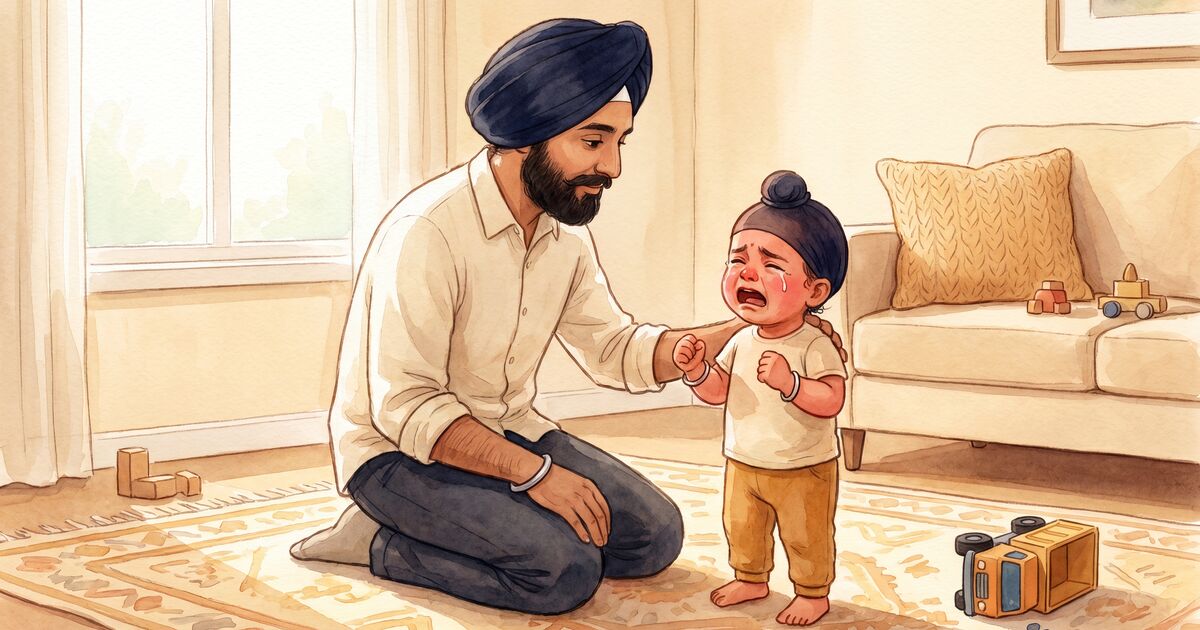
The short answer: A tantrum is a normal developmental event — an immature brain briefly flooded by more emotion than it can manage — not bad behaviour or bad parenting. Children cannot reliably calm themselves until the brain’s self-control system matures, so first they co-regulate: they borrow a calm adult’s steadiness before building their own. Sikhi has a name for that steadiness — Sehaj, a balanced mind that holds through storms — and a practice for returning to it, Naam Simran, that lines up neatly with what the science calls breathing together.
Why tantrums happen: an immature brain, not defiance
It helps to know what a tantrum actually is. The brain’s alarm system — the amygdala — is essentially online from birth. The brain’s braking system — the prefrontal cortex, which handles impulse control, planning, and managing emotion — develops slowly and is not fully built until a person’s mid-twenties. A toddler screaming on the kitchen floor isn’t choosing to be difficult; their accelerator is fully connected while their brakes are still being installed.
This is why tantrums peak between ages two and three, when the gap between what a child wants and what they can do, wait for, or express is at its widest, and why they ease after age four as language and self-control catch up. Hunger, tiredness, and sensory overload shrink that small capacity even further — which is why the same request lands fine at 10am and triggers a meltdown at 5pm.
Gurbani describes this restless, racing mind too. It is called chanchal man — the wandering mind — and Sri Guru Granth Sahib Ji repeatedly speaks of steadying it (dhaavat raakhai — restraining the wandering mind and bringing it home), never of crushing it. The framing matters: the goal with a flooded child is not to win, but to help an overwhelmed mind come back to centre.
Children borrow your calm before they build their own
Before a child can self-soothe, they co-regulate. The term was framed by developmental researchers Katie Rosanbalm and Desiree Murray, whose 2017 practice brief describes how a young child’s capacity to manage feelings grows out of warm, responsive relationships with trusted adults — a calm presence, a structured environment, and patient coaching of regulation skills over years. In the earliest years especially, children’s brains are not yet wired to settle themselves; they borrow a steadier adult nervous system first.
The practical implication is counter-intuitive: in the middle of a meltdown, an adult’s state matters more than their words. A slower voice and unhurried breathing settle an activated nervous system; a raised voice pours fuel on it. The calm is contagious — in both directions.
Sikhi arrived at this insight by a different road. The company you keep shapes the state you carry — the steadying effect of Sangat — and remembrance quiets a heated mind:
ਅਕਾਲ ਮੂਰਤਿ ਅਜੂਨੀ ਸੰਭੌ; ਮਨ ਸਿਮਰਤ ਠੰਢਾ ਥੀਵਾਂ ਜੀਉ ॥
Timeless in form, beyond birth, self-existent — remembering the One within my mind, I become cool and calm.
Guru Arjan Dev Ji — Ang 99, Sri Guru Granth Sahib JiThe word in that line — thandha, “cool” — is the same idea a parent reaches for instinctively: helping a hot moment cool down. A grounded adult is, in effect, lending the child their Sehaj until the child can generate their own.
Five tools the research supports
These are the approaches that hold up across the parenting-science literature. None of them is a trick to end a tantrum faster; together they build the skill of regulation over time.
1. Name the feeling. A landmark 2007 UCLA study by Matthew Lieberman and colleagues, Putting Feelings Into Words, found that simply labelling an emotion reduces activity in the amygdala and engages the thinking brain — the basis of what psychiatrist Dan Siegel later called “name it to tame it.” Putting a word to the storm (“you’re really frustrated that it ended”) does measurable work in the brain.
2. Breathe together. Because young children co-regulate, slowing your own breathing gives the child a rhythm to match. This is also the quiet mechanics of Naam Simran — remembrance anchored breath-by-breath. The same act steadies the one breathing and, through Sangat, the one beside them.
3. Model it. Children learn regulation by watching it far more than by being told about it. A child who repeatedly sees an adult get frustrated and recover is being shown the whole skill — including the recovery, which is the part that matters most.
4. Praise the effort to calm down, not just the calm. Noticing the trying — “you took a big breath all by yourself” — teaches a child that self-soothing is a thing they did, and can do again.
5. Connection before correction. A flooded brain cannot absorb a lesson. Comfort and co-regulation come first; the conversation about what happened lands later, once the thinking brain is back online. The Australian Tuning in to Toddlers emotion-coaching program — tested in a randomised controlled trial by Havighurst and colleagues — found that teaching parents this kind of emotion coaching improved children’s behaviour and lowered stress for both parent and child.
Sehaj: the goal beneath emotional regulation
It is worth being clear about what “emotional regulation” is actually aiming at. The goal is not a child who never feels big things — that child does not exist, and would be the poorer for it. The goal is a child who can feel deeply and still find their way back to balance. Sikhi names that balance Sehaj: a steady, settled state of mind that holds through both joy and hardship.
ਸਦਾ ਸਹਜੁ ਫਿਰਿ ਦੁਖੁ ਨ ਲਗਈ ਭਾਈ; ਹਰਿ ਆਪਿ ਵਸੈ ਮਨਿ ਆਇ ॥
Then you abide in lasting equipoise (Sehaj), O sibling, and sorrow does not overwhelm you again; the Divine itself comes to dwell within the mind.
Guru Amar Das Ji — Ang 639, Sri Guru Granth Sahib JiThe same Shabad locates the route to that equipoise in letting go of self-conceit — aap chhodd, releasing the grip of haumai (ego). It is a strikingly modern observation: much adult escalation in a child’s meltdown is really the adult’s own ego flaring — the need to be obeyed, to not be embarrassed in public, to win. Seen that way, a parent’s self-control is not just a technique. It is, in the Sikh sense, a discipline — the steadiness one keeps so that the child has something steady to borrow.
What to expect, age by age
| Age | What’s going on | What regulation looks like |
|---|---|---|
| 1–2 | Almost no impulse control; feelings arrive as a flood | Near-total reliance on a calm adult; soothing and distraction |
| 2–3 | Tantrums peak; wants outrun words and patience | Borrowed calm; simple feeling-words offered for them |
| 4–5 | Language grows; some self-soothing begins | Can name feelings with help; learning to pause |
| 6–8 | Better self-control, but big feelings still overflow when tired | Practising tools — breathing, taking space — with reminders |
| 9–12 | More capacity, plus new social and academic pressures | Increasingly independent, but still needs a steady adult to return to |
What not to do
A few responses reliably make things harder. Shaming (“big boys don’t cry,” “stop being a baby”) teaches a child to hide feelings rather than handle them. Escalating — matching the child’s storm with a bigger one of your own — removes the calm nervous system the child needs to borrow; krodh (anger) simply feeds more krodh. And using a screen as the off-switch ends the noise but skips the skill — the child is distracted out of the feeling rather than walked back through it, and learns nothing about returning to balance.
When to seek extra help
Tantrums are normal; some patterns still warrant a professional’s eye. Worth a conversation with a paediatrician or child psychologist: tantrums that are still frequent and intense well beyond age five, meltdowns that regularly involve hurting themselves or others, or outbursts so prolonged and unmanageable that they dominate daily family life. Faith practice and good parenting are complements to that support, never a replacement for it.
Sources
- Lieberman, M. D., et al. (2007). Putting Feelings Into Words: Affect Labeling Disrupts Amygdala Activity in Response to Affective Stimuli. Psychological Science.
- Rosanbalm, K. D., & Murray, D. W. (2017). Co-Regulation From Birth Through Young Adulthood: A Practice Brief. UNC Frank Porter Graham Child Development Institute / Administration for Children and Families.
- Havighurst, S., et al. (2022). A randomized controlled trial of an emotion socialization parenting program… Tuning in to Toddlers. Behaviour Research and Therapy.
- Siegel, D. J., & Bryson, T. P. The Whole-Brain Child — the “upstairs / downstairs brain” and “name it to tame it.”
- American Psychological Association — Helping kids understand and manage their emotions.
- Sri Guru Granth Sahib Ji — Ang 99 (Guru Arjan Dev Ji); Ang 639 (Guru Amar Das Ji). Sourced via the Gurbani RAG.
Related guides
- Positive Discipline and Gentle Parenting — staying warm and firm once the storm has passed.
- Building Resilience in Children — how everyday co-regulation grows into lasting coping skills.
🎥 Prefer to watch?

Uses YouTube's privacy-enhanced mode — no cookies set until you press play.
Frequently asked questions
Conversation starters for parents and kids.
- At what age do tantrums stop?
- Tantrums usually peak between ages two and three, when a child's wants race far ahead of their ability to wait, switch tasks, or put feelings into words. They typically ease after age four as language and the brain's self-control systems mature. Occasional meltdowns in older children are still normal, especially when a child is tired, hungry, or overwhelmed.
- Are tantrums a sign of bad parenting?
- No. A tantrum is a developmental and biological event, not a verdict on parenting. The part of the brain that manages impulses and big emotions — the prefrontal cortex — is still under construction throughout childhood and is not finished until the mid-twenties. A young child melting down is doing what an immature brain does when it is flooded with more feeling than it can yet handle.
- What is co-regulation?
- Co-regulation is the process by which a calm, responsive adult helps a child settle emotions the child cannot yet settle alone. Young children effectively borrow an adult's steadier nervous system before they build their own. A warm presence, a slower voice, and unhurried breathing do more to end a meltdown than any explanation offered mid-storm.
- How does Sikhi connect to managing emotions?
- Sikhi describes a steady, balanced state of mind called Sehaj — composure that holds through both joy and difficulty. It also describes the restless, racing mind (chanchal man) that is gently steadied rather than beaten into silence. The practice of Naam Simran — remembrance, often anchored in slow breath — is a centuries-old way of returning the mind to calm, and it maps closely onto what psychologists now call co-regulation and breathing together.