
Raising Confident Daughters: Building Real Self-Esteem
What really builds girls' self-esteem — competence and belonging, not empty praise — woven with Sikhi's equality and role models like Mai Bhago.
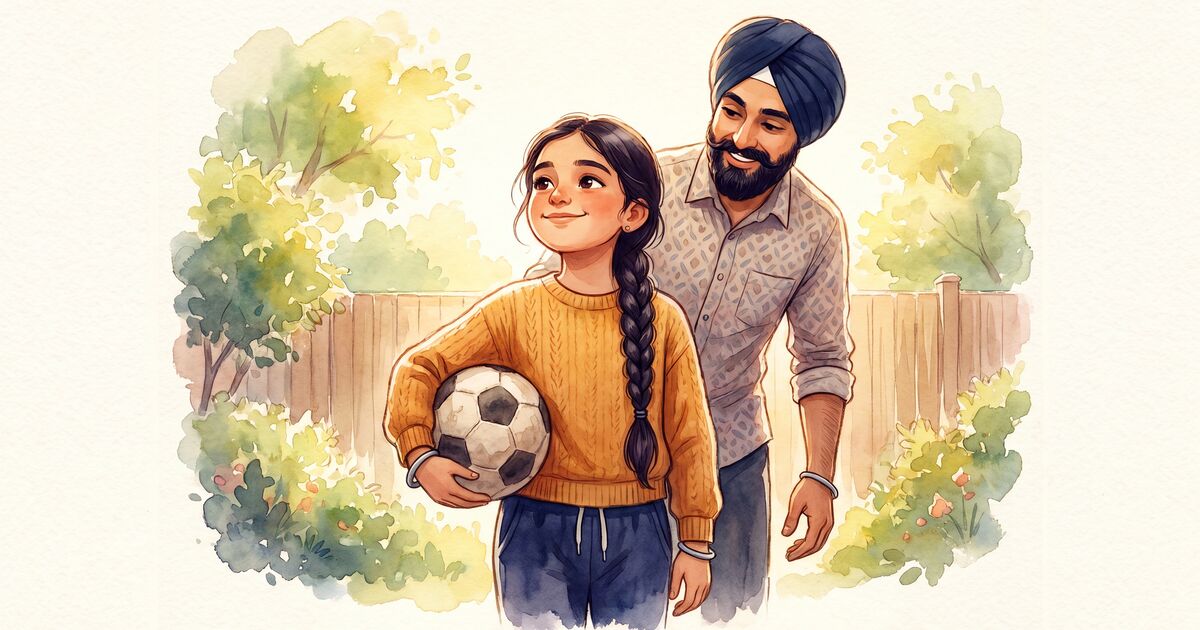
The short answer: Real self-esteem in a daughter is built from two things research keeps confirming — a sense of competence (she can genuinely do hard things) and a sense of unconditional belonging (she is loved whether she succeeds or not). Empty or inflated praise does the opposite. The strongest confidence comes from capability, secure love, and an identity rooted in worth that doesn’t depend on anyone’s approval — which is exactly what Sikhi offers a girl in the name Kaur.
We want our daughters to walk into a room sure of themselves. So we tell them they’re beautiful, clever, amazing — and hope it sticks. But the research on how self-esteem actually forms points somewhere quieter and sturdier than praise. This guide blends what psychologists have learned about confident girls with the wisdom of Sri Guru Granth Sahib Ji and the example of Sikh women who needed no one’s permission to be brave.
What actually builds self-esteem (and what doesn’t)
Psychologist Susan Harter, whose self-perception research is widely used by the field, found that children’s self-worth rests on two pillars: a sense of competence — I am good at things that matter — and a sense of social acceptance — I am wanted and loved as I am. Self-determination theory, one of the most tested frameworks in psychology, says much the same: humans thrive when their needs for competence and relatedness (connection) are met.
Notice what’s not on that list: being told you’re wonderful. In fact, a 2017 study in Child Development found that when parents’ praise inflates, children’s self-esteem deflates — the more inflated praise a child received, the lower their self-esteem tended to become. Empty praise quietly teaches a girl that she is loved because she’s exceptional, which is a fragile, exhausting thing to believe.
So the formula isn’t flattery. It’s: let her become genuinely capable, and love her unconditionally while she does.
This is also where Sikhi starts — not with a girl earning her worth, but with worth already given. Guru Nanak Dev Ji asked his society a question that still lands today:
ਸੋ ਕਿਉ ਮੰਦਾ ਆਖੀਐ ਜਿਤੁ ਜੰਮਹਿ ਰਾਜਾਨ ॥
Why call her lesser, the one from whom even kings are born?
Guru Nanak Dev Ji — Ang 473, Sri Guru Granth Sahib JiIn a 15th-century world that treated daughters as a burden, this was radical. Sikhi holds that women and men carry the same divine light and the same dignity — not as a slogan, but as a foundation. A daughter raised knowing this starts from a place most confidence advice never reaches: she doesn’t have to earn her value, only discover it.
Confidence comes from capability, not compliments
If competence is half of self-esteem, the most useful thing we can do is let our daughters become genuinely good at real things — and resist the urge to do it for them.
That means chores, responsibility, and mastery. A girl who can cook a simple meal, fix her own bike chain, or finish a hard project she nearly quit has evidence she can rely on. Confidence built on evidence doesn’t wobble when someone is unkind to her, because it isn’t borrowed from their opinion. Praise fades; competence stays.
The body-image and comparison trap — and the smartphone effect
Around the tween years, many girls quietly shift from what can my body do? to how does my body look — and how does it compare? Social media pours fuel on this. Every scroll is a comparison against filtered, edited, impossible images, and girls are especially vulnerable.
The timing matters enormously. A 2025 study from the Global Mind Project (Sapien Labs) of more than 100,000 young adults found that those who got their first smartphone before age 13 reported poorer mental wellbeing as adults — and the effects, including lower self-worth, were stronger in young women. The phone itself isn’t the whole story; it’s the early door it opens to social comparison, cyberbullying, and disrupted sleep during the exact years a girl’s self-image is forming.
The practical takeaway: delay the smartphone, and especially social media, as long as you reasonably can. And talk about bodies in terms of capability, not appearance — what her body lets her do, not how it ranks.
Sikhi gives a daughter a different mirror to look into. Worth, Gurbani teaches, is found within — the divine light recognised in your own self — not in a reflection or a feed:
ਗੁਰਮਤੀ ਆਪੁ ਪਛਾਣਿਆ ਰਾਮ ਨਾਮ ਪਰਗਾਸੁ ॥
Through the Guru's wisdom, one recognises one's own true self, and the light of the Divine shines within.
Guru Amar Das Ji — Ang 86, Sri Guru Granth Sahib JiA girl who learns to look inward for her worth has armour against a culture that constantly tells her to look outward for approval.
Protecting against perfectionism and people-pleasing
Two traps shadow many bright girls: perfectionism (it has to be flawless or I’ve failed) and people-pleasing (my job is to keep everyone happy with me). Both come from the same root — the belief that love and worth are conditional on performance. Inflated praise feeds this; so does praising results over effort.
The antidote is to make effort and honesty the things you notice out loud, and to let her see that mistakes are survivable — including yours. A daughter who watches her mother say “I got that wrong, and that’s okay” learns that her own worth survives imperfection.
This is also where Sikhi’s idea of Kaur does quiet, daily work. Every Sikh girl carries the name Kaur — meaning sovereign or princess — the equal counterpart to Singh (“lion”). It was given for a precise reason: so that a woman’s identity and dignity would never depend on a father’s family name, a husband, or anyone else’s approval. She is sovereign in her own right. Said simply to a struggling tween — “You’re a Kaur. You don’t need their approval to know who you are.” — it reframes a whole anxious moment.
Give her anchored role models — not imported ideals
Girls absorb who they could become from the women they hear about. If the only models on offer are celebrities and influencers, she’ll measure herself against looks and fame. Sikh history offers something far sturdier — women of courage, faith, and leadership:
- Mata Bhag Kaur (Mai Bhago) rallied a group of soldiers who had deserted Guru Gobind Singh Ji and led them back into battle herself. A woman, in armour, leading men — and remembered for it with honour.
- Mata Sahib Kaur is revered as the Mother of the Khalsa, a figure of deep spiritual standing in the Sikh community.
- Mata Gujri Ji held her family together through unimaginable loss with a steadiness that is still spoken of with awe.
These are not soft, sidelined figures. They are leaders, warriors, and pillars — proof that a Sikh girl’s tradition expects courage and capability from her, not just prettiness or politeness.
Model the self-respect you want her to have
Daughters calibrate their own self-worth by watching their mothers and the women around them. A girl who hears the women in her life pick themselves apart in the mirror, apologise for taking up space, or shrink to keep the peace learns that this is what being a woman means. A girl who sees women set a boundary calmly, speak up without apology, and treat themselves with respect learns that instead.
You don’t have to be perfectly confident. You just have to let her catch you respecting yourself — finishing your own sentence, saying no without a paragraph of excuses, refusing to trash your own body out loud. Sikhi’s equal dignity of women isn’t only a historical fact for her to read; it’s something she should see lived in the women around her.
An age-by-age guide
| Age | What builds her confidence | What to watch |
|---|---|---|
| 4–6 | Small real jobs she can master; praise the effort; lots of secure, unconditional warmth | Don’t redo her work to make it “look nice” — it tells her her effort wasn’t enough |
| 7–9 | Bigger responsibilities; teach what Kaur means; introduce Sikh women role models as stories | First comparison talk (“she’s prettier/cleverer”) — redirect to capability and worth |
| 10–12 | Genuine mastery and independence; honest, growth-focused feedback; talk openly about media and edited images | Delay smartphone/social media; watch for perfectionism and people-pleasing creeping in |
A final word
You can’t hand a daughter confidence in a compliment. You build it the slow way — by letting her become truly capable, loving her without conditions, guarding the years when comparison hits hardest, and giving her role models and an identity that say your worth was never up for a vote.
Sikhi hands you a head start on all of it: a faith that declared women equal centuries before the world caught up, a roll-call of fearless women to look up to, and a name — Kaur — that tells every girl she is sovereign. Praise the effort. Build the competence. Love her unconditionally. And remind her, often, what her name means.
Sources
- Harter, S. Self-Perception Profile for Children — competence and social acceptance as the core components of children’s self-worth (hosted by the American Psychological Association): apa.org
- Ryan, R. M., & Deci, E. L. — Self-Determination Theory: competence and relatedness as basic psychological needs underlying wellbeing: American Psychological Association
- Brummelman, E., et al. (2017). “When Parents’ Praise Inflates, Children’s Self-Esteem Deflates.” Child Development: Wiley Online Library
- Global Mind Project / Sapien Labs (2025) — early smartphone ownership linked to poorer adult mental wellbeing, with stronger effects in young women: Sapien Labs
Related guides
- Growth Mindset and Handling Failure — why praising the process, not the trait, builds sturdier confidence.
- Building Resilience in Children — capability, Chardi Kala, and bouncing back from knocks.
- How to Teach Your Child Honest Work (Kirat Karni) — building character and capability through real, honest effort.
- Raising Children with the Wisdom of Japji Sahib — practical principles for parents drawn from Gurbani.
🎥 Prefer to watch?

Uses YouTube's privacy-enhanced mode — no cookies set until you press play.
Frequently asked questions
Conversation starters for parents and kids.
- What actually builds self-esteem in a daughter?
- Two things, according to decades of research: a sense of competence (she can genuinely do hard things) and a sense of unconditional belonging (she is loved and accepted whether she succeeds or not). Empty or inflated praise — telling a child she's amazing at everything — does the opposite: studies show it can actually lower self-esteem. Real confidence is built through mastery and secure love, not flattery.
- Does telling my daughter she's beautiful or clever boost her confidence?
- Surprisingly, constant inflated praise can backfire. A 2017 study found that the more inflated praise children received, the lower their self-esteem tended to be. It teaches a child that love depends on being exceptional. Praise the effort and the choice ('you kept going when it got hard') rather than fixed traits ('you're so smart' or 'so pretty'), and let real accomplishment do the rest.
- At what age should I give my daughter a smartphone?
- Later is safer. A 2025 Global Mind Project study of over 100,000 young adults found that those who got their first smartphone before age 13 reported poorer mental wellbeing as adults — and the effects were stronger in young women, including lower self-worth. Delaying the phone, and especially social media, protects the years when a girl's self-image is most fragile.
- How does being a Kaur help a Sikh girl's confidence?
- Every Sikh girl carries the name Kaur — meaning sovereign, or princess. It was given so that a woman's dignity would never depend on a husband, a family name, or anyone's approval. Reminding a daughter what Kaur means gives her an identity rooted in equal worth, not in likes, looks, or others' opinions — a powerful anchor against a validation-seeking culture.
- Who are some real Sikh women role models for girls?
- Mata Bhag Kaur (Mai Bhago), who led soldiers into battle; Mata Sahib Kaur, honoured as the Mother of the Khalsa; and Mata Gujri Ji, whose courage held a family together through terrible loss. These are anchored, faith-rooted role models — women of courage, faith, and leadership — that a daughter can look up to instead of imported celebrity ideals.