
Reading Aloud & Early Literacy: The Sikh Tradition
What reading aloud does to a child's brain, why dialogic reading matters most, and how the Sikh tradition of katha, sakhis, and Suniai got there first.
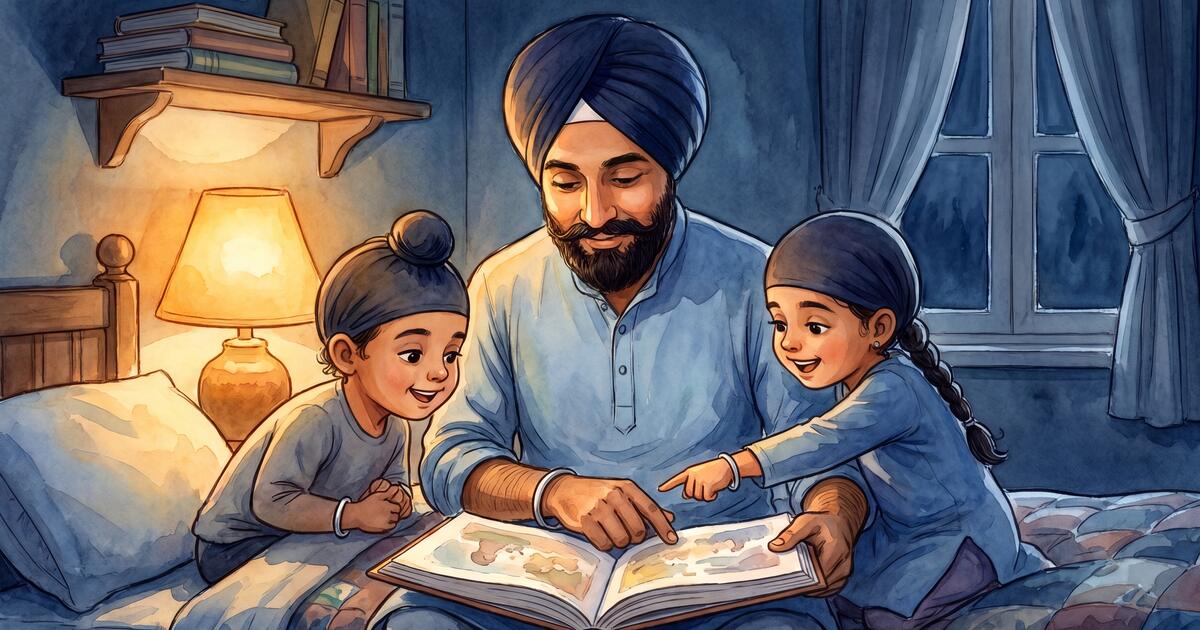
The short answer: Reading aloud — starting in infancy — builds the brain circuits behind vocabulary, comprehension, and school readiness, and it works best when it’s dialogic: a two-way conversation, not a performance. The Sikh tradition has practised exactly this for five centuries through katha, sakhis, and the hearing of Gurbani. Japji Sahib even names the power of deep listening — Suniai — making the act of being read to a spiritually and developmentally rich one.
What happens in a child’s brain during read-aloud
When an adult reads aloud to a young child, far more is happening than entertainment. Brain-imaging research (notably the work of Dr. John Hutton and colleagues) has found that read-aloud activates and strengthens the networks a child uses to form mental imagery, grasp word meaning, and build narrative comprehension — the very circuitry reading later depends on. The American Academy of Pediatrics and programmes like Reach Out and Read recommend daily reading aloud from the first year of life, because the children read to most consistently arrive at school with larger vocabularies and stronger pre-reading skills.
Crucially, none of this requires a child who can read, or even talk. The infant absorbing the rhythm of your voice is already laying the foundation. Reading aloud is one of the highest-return, lowest-cost things a family can do.
Dialogic reading: make it two-way
The single most important refinement the research offers is this: how you read matters as much as that you read. Dialogic reading — developed and tested by Grover (Russ) Whitehurst and colleagues — turns story time from a monologue into a dialogue. Instead of simply reading the words, the adult pauses to ask open questions (“What do you think happens next?” “Why is he sad?”), follows the child’s lead, expands on their answers, and gradually lets the child carry more of the telling.
Children read to dialogically show significantly larger gains in vocabulary and expressive language than children read to passively. The story becomes a conversation, and the conversation is where the learning lives.
The Sikh tradition is dialogic read-aloud — with a 500-year head start
Here is where Sikh families have something most parenting guides never mention: the tradition is fundamentally oral and participatory. Katha is spoken explanation, a teacher unfolding meaning and inviting reflection. Sakhis — the stories of the Gurus — are told and retold, questioned, and discussed. Gurbani is recited and heard. None of this is passive consumption; it is the back-and-forth of meaning that dialogic reading research is trying to recreate.
Japji Sahib goes further and makes listening itself a theme. Several verses begin with the word Suniai — “by listening” — describing what deep, attentive hearing can do:
ਸੁਣਿਐ; ਸਤੁ ਸੰਤੋਖੁ ਗਿਆਨੁ ॥
Through deep listening come truth, contentment, and understanding.
Guru Nanak Dev Ji — Japji Sahib, Ang 3, Sri Guru Granth Sahib JiThe Suniai verses describe listening as transformative — a route to knowledge, steadiness, and insight. For a parent, that is a striking validation of the simplest act: a child who is truly listened to, and who learns to truly listen, is being given something the tradition has always treated as profound. Reading a sakhi aloud and talking it through is, in this light, both literacy and inheritance.
Building a home reading culture
| Age | What helps most |
|---|---|
| 0–2 | Daily reading; board books; your voice and rhythm matter more than the words; sing and recite |
| 3–5 | Dialogic reading — questions, not just pages; let them “read” pictures and retell; first sakhis |
| 6–8 | Keep reading aloud even as they learn to read; richer stories than they can decode alone |
| 9–12 | Read-aloud as shared pleasure and discussion; longer Guru stories; let them lead the talk |
The aim is a household where books and stories are simply part of the texture of the day — and where reading is tied to closeness, not homework.
Reading aloud is attachment, not just academics
It is easy to frame reading aloud as an educational task — a means to test scores and school readiness. It is that, but it is also something quieter and more important: a daily ritual of closeness. A child on a lap, a parent’s voice, an unhurried story — this is bonding time that happens to also build a brain. The Sikh family reciting Gurbani together or sharing a sakhi at bedtime is doing all of it at once: literacy, identity, and love, in a single ordinary act.
Sources
- American Academy of Pediatrics — Early Literacy (read aloud from the first year).
- Reach Out and Read — Child Development.
- Hutton, J. S., et al. — neuroimaging research on read-aloud and children’s brain activation.
- Whitehurst, G. J., et al. — research establishing dialogic reading and its vocabulary gains.
- Sri Guru Granth Sahib Ji — Japji Sahib, Ang 3, the Suniai verses (Guru Nanak Dev Ji). Sourced via the Gurbani RAG.
Related guides
- Raising Bilingual Children — keeping the read-aloud habit alive in Punjabi.
- Children’s Spirituality and Moral Development — sakhis as the engine of empathy and moral imagination.
- Growth Mindset and Handling Failure — stories of effort and perseverance, told and retold.
Frequently asked questions
Conversation starters for parents and kids.
- When should I start reading aloud to my child?
- From infancy — earlier than most parents assume. The American Academy of Pediatrics recommends reading aloud beginning in the first year of life. A baby doesn't understand the words, but they are absorbing the rhythm, sounds, and warmth of language and of your voice, which lays the groundwork for everything that follows.
- What is dialogic reading?
- Dialogic reading turns story time from a one-way performance into a two-way conversation. Instead of just reading the page, the adult asks open questions, follows the child's interest, adds to their answers, and lets the child gradually 'tell' the story too. Research shows this back-and-forth produces markedly bigger gains in vocabulary and comprehension than passive reading.
- Does reading aloud still matter once a child can read themselves?
- Yes. Reading aloud to a child who can already read exposes them to richer vocabulary and more complex stories than they could decode alone, and keeps reading bonded to closeness and pleasure rather than schoolwork. Many educators encourage reading aloud well into the later primary years.
- How does Sikh tradition connect to reading aloud?
- Deeply. The Sikh tradition is profoundly oral: katha (spoken explanation), sakhis (stories of the Gurus), and the reciting and hearing of Gurbani. Japji Sahib devotes whole verses to Suniai — the transformative power of deep listening. A child who grows up hearing sakhis and Gurbani is already doing what literacy research recommends: learning through the spoken, heard word.