
Raising Bilingual Kids: Keeping Punjabi Alive at Home
Two languages help, not harm. What actually works to raise a bilingual child — and why Punjabi at home is the doorway to Gurbani, elders, and identity.
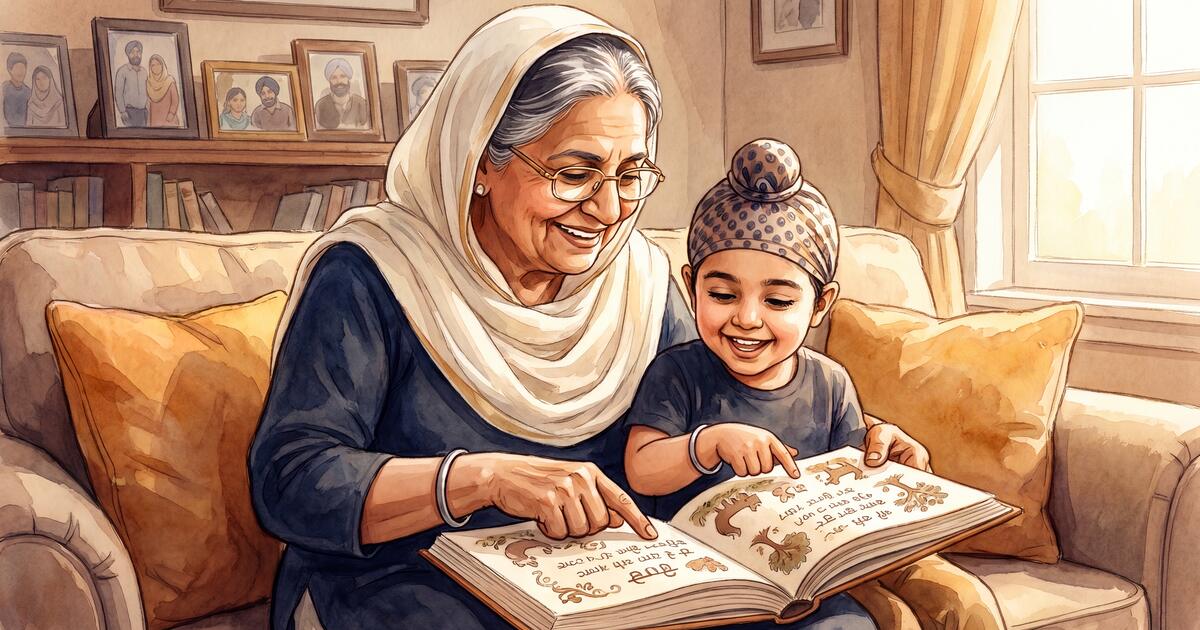
The short answer: The science is clear — two languages help a child’s developing brain rather than confusing it, and the old fear of “delay” is a myth. What works is consistent, live interaction in the heritage language (through strategies like one-parent-one-language or minority-language-at-home), sustained past the age when school pulls toward English. For Sikh families there’s a deeper payoff: Punjabi and Gurmukhi are the doorway to Gurbani, to elders, and to identity — the language is the carrier of the faith, not just a skill.
The myth that won’t die — and the science that buries it
Almost every diaspora parent has heard the warning: “Don’t teach them two languages, you’ll confuse them and delay their speech.” It is one of the most stubborn myths in parenting, and decades of research have steadily dismantled it.
Bilingual children do sometimes mix languages in a single sentence (this is called code-switching, and it’s a sign of skill, not confusion) and may show a slightly smaller vocabulary in each language early on — but their combined vocabulary across both languages is right on track, and they hit the core developmental milestones within the normal range. Children’s brains are not single-language machines that overload with a second input; they are built for multiple languages, and much of the world grows up bilingual as a matter of course.
The cognitive case for two languages
Beyond simply not harming, bilingualism appears to help. Research summarised by sources such as the U.S. National Institutes of Health’s PubMed Central literature points to advantages in executive function — the brain’s set of skills for focusing attention, ignoring distraction, holding information in mind, and switching flexibly between tasks. The leading explanation: a bilingual child’s brain is constantly, quietly managing two language systems and selecting the right one for the moment, and that ongoing mental exercise seems to strengthen attention and cognitive flexibility more broadly.
These advantages are real but should be held modestly — they are not a guarantee of academic stardom. The stronger reasons to keep a heritage language, for most families, are about connection and identity.
What actually works
Raising a confident bilingual child is less about method and more about consistency and real human interaction. Two well-known strategies:
- OPOL (one parent, one language): each parent consistently speaks one language to the child.
- Minority-language-at-home: the family speaks the heritage language at home, and the child picks up the majority language from school and the wider community.
Either can work; what they share is consistency and exposure. The single most important finding is that live interaction beats screens. A child learns language from back-and-forth conversation with people who respond to them — not from passive video, however educational it claims to be. Talking, reading aloud, singing, and storytelling in Punjabi do far more than any app.
The age-5 cliff — and how to hold the line
The hardest moment for most diaspora families comes when a child starts school. Suddenly the child spends the bulk of their waking hours immersed in English, makes English-speaking friends, and often starts answering parents in English even when spoken to in Punjabi. Without a deliberate effort, the home language quietly recedes — and language loss in diaspora families tends to be a one-way slide unless something pushes back.
Holding the line takes intention rather than pressure:
- Keep speaking Punjabi at home, and resist the easy slide into English “just to be quicker.”
- Read aloud in Punjabi and tell stories — the heritage-language version of the read-aloud habit.
- Connect children regularly with grandparents and Punjabi-speaking Sangat, who give the language real relationships to live inside.
- Give the language a purpose the child can feel — and for a Sikh family, the deepest purpose is built in.
Why this matters more for a Sikh family
For most communities, a heritage language is about culture and family ties — which is reason enough. For Sikh families there’s an additional thread that runs to the heart of the faith: Punjabi, and the Gurmukhi script, are the doorway to Gurbani in its own words.
A child can absolutely know and live Sikhi in English — understanding the meaning of Gurbani matters more than decoding the script, and no child should ever feel locked out of their faith by a language barrier. But Punjabi keeps open the deeper room: the ability to one day read a Pothi, follow along in the Gurdwara, sit with grandparents, and hear the Gurus’ words without translation standing in between. The language is, quite literally, the carrier of the inheritance.
This is why heritage-language effort and Sikhi reinforce each other. Reading a sakhi aloud in Punjabi is bilingual exposure and identity-building. Hearing Gurbani at home is listening practice and connection. If you’re looking for a gentle, structured start, Maastarji’s free Gurmukhi resources are built for exactly this — meeting a child where they are and keeping the door to reading Gurbani open.
A secure identity is the real payoff
Underneath the cognitive benefits and the practical strategies sits the thing that matters most: research links a strong heritage-language and cultural identity with belonging and wellbeing, especially for children growing up between cultures. A child who can move comfortably between worlds — English at school, Punjabi and Sikhi at home — tends to carry their identity as a gift rather than a burden. Keeping Punjabi alive isn’t only about a skill set. It’s about giving a child a secure place to stand.
Sources
- National Institutes of Health / PubMed Central — reviews on the cognitive advantages of bilingual children and executive function.
- BrainFacts (Society for Neuroscience) — How a child becomes bilingual.
- Center for Applied Linguistics — Raising Bilingual Children (debunking the “delay/confusion” myth; OPOL and home-language strategies).
- Research on heritage-language maintenance, ethnic identity, and adolescent wellbeing.
Related guides
- Reading Aloud and Early Literacy — the read-aloud habit works just as well in Punjabi.
- Children’s Spirituality and Moral Development — why Punjabi is the doorway to Gurbani and identity.
- Building Resilience in Children — belonging and a secure identity as protective strengths.
🎥 Prefer to watch?

Uses YouTube's privacy-enhanced mode — no cookies set until you press play.
Frequently asked questions
Conversation starters for parents and kids.
- Does raising a child bilingual cause speech delays or confusion?
- No. This is one of the most persistent myths in parenting, and the research consistently debunks it. Bilingual children may briefly mix languages or have a slightly smaller vocabulary in each single language early on, but their total vocabulary across both is on track, and they reach core milestones in the normal range. Two languages do not confuse a child — children's brains are built for exactly this.
- What's the best way to raise a bilingual child?
- Consistency and live interaction. The two common strategies are OPOL (one parent, one language) and minority-language-at-home (the heritage language is the home language, with the majority language coming from school and community). What matters most is plentiful real conversation with people — screens and apps are a weak substitute for back-and-forth talk.
- How do I keep Punjabi alive once my child starts school?
- Around age five, school floods a child with English and the home language can quietly recede. Keeping it alive takes intention: keep speaking it at home without switching to English to make things easier, read aloud in Punjabi, connect children with grandparents and Punjabi-speaking community, and give the language a living purpose — including reading and understanding Gurbani.
- Why does the heritage language matter beyond communication?
- For Sikh families, Punjabi and Gurmukhi are the doorway to Gurbani in its own words, to conversations with elders, and to a secure sense of identity. Research links a strong heritage-language and cultural identity with belonging and wellbeing. The language isn't only a skill — it's the carrier of faith, family, and self.