
Teaching Kids About Money: An Age-by-Age Guide
Money habits are largely set by age 7. How to teach kids to earn, save, and share — and how Dasvandh, Kirat Karo, and Vand Chhako turn it into character.
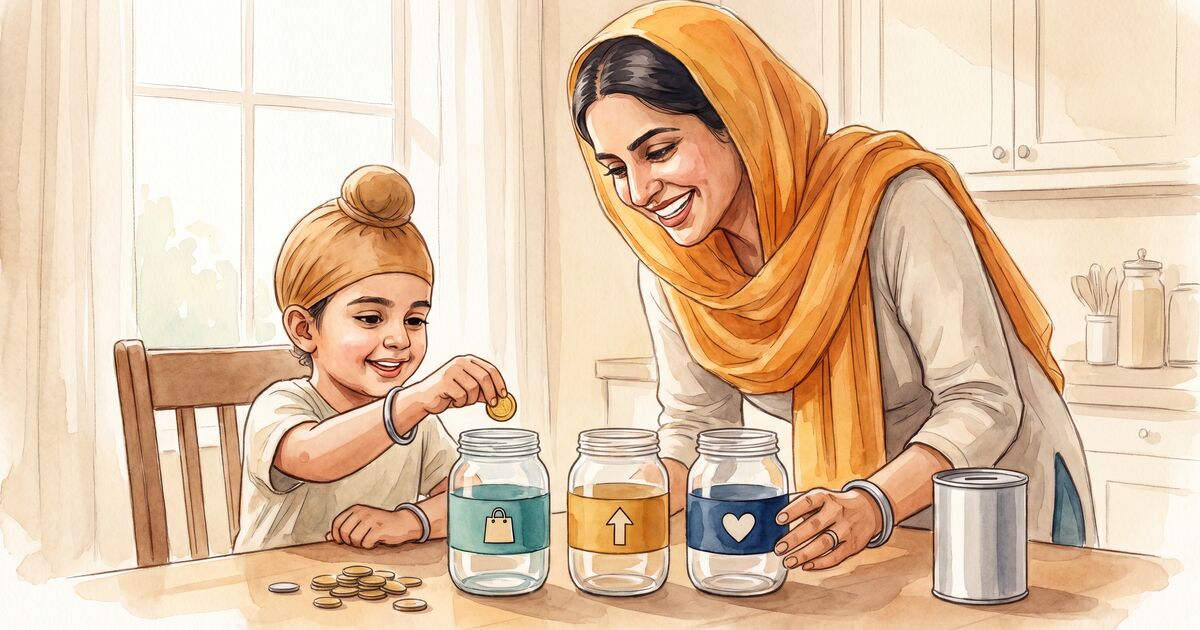
The short answer: Children’s lifelong money habits are largely set by about age seven, so the goal in the early years isn’t budgeting — it’s building the everyday attitudes of earning, waiting, saving, and sharing. The simplest tool is the three-jar method: Spend, Save, Share. In a Sikh home the Share jar already has a name and centuries of practice behind it — Dasvandh — sitting alongside Kirat Karo (earn honestly) and Vand Chhako (share what you earn).
Why the early years matter more than you think
A widely cited study from the University of Cambridge, commissioned by the UK’s Money Advice Service, found that children’s core financial habits and attitudes are largely formed by around age seven — well before they handle real money or understand interest. By that age, many children have already absorbed the family’s unspoken patterns: whether money is talked about openly or anxiously, whether wants are waited for or satisfied instantly, whether giving is normal.
This is good news for parents, because it means the most powerful teaching happens through ordinary moments, not formal lessons. It also means the Sikh household has a quiet advantage: a family that already practises Dasvandh and shared langar is modelling generosity and stewardship long before a child can spell either word.
The three jars: Spend, Save, Share
The most durable tool in financial education for young children is also the simplest. Give a child three labelled jars and, whenever they receive money, help them divide it:
- Spend — for small, soon purchases. This jar teaches choosing.
- Save — for something bigger and later. This jar teaches waiting.
- Share — for giving to others. This jar teaches that money is not only for the self.
The Share jar is where the Sikh lens enters naturally. Dasvandh — the tradition of setting aside roughly a tenth of what you earn for the service of others — gives the Share jar a name, a proportion, and a reason. A generic money guide tells a child to “give some away”; a Sikh home can tell them why, and connect the jar to the Gurdwara, langar, and seva they already see.
ਨਾਨਕ ਅਗੈ ਸੋ ਮਿਲੈ; ਜਿ ਖਟੇ ਘਾਲੇ ਦੇਇ ॥
O Nanak, what truly stays with you is only what you earn through honest toil — and then give from your own hand.
Guru Nanak Dev Ji — Ang 472, Sri Guru Granth Sahib JiThe full salok this line closes draws a sharp contrast: wealth gained dishonestly — even if offered up in someone’s name — counts for nothing, while what is earned cleanly and shared is what lasts. That is Kirat Karo and Vand Chhako in a single breath: honest earning and open-handed giving are two halves of the same teaching, not separate virtues.
An age-by-age roadmap
| Age | What they can grasp | What to practise |
|---|---|---|
| 2–7 | Coins are real; you can’t have everything; some things are for sharing | Spend/Save/Share jars; small choices (“this or that, not both”); naming Dasvandh |
| 8–10 | Money is earned; saving reaches a goal | A small allowance; saving toward one wanted item; first giving decision of their own |
| 11–14 | Budgeting; trade-offs; needs vs wants | Managing a small monthly amount; tracking spending; a regular Dasvandh habit |
| 14–18 | Earning, taxes, living within means | A part-time wage or larger budget; opening an account; giving as a settled practice, not a prompt |
Allowance: responsibility, not bribery
Allowance is one of the most debated topics in financial parenting, and the evidence points toward a middle path. Tying every helpful act to payment can teach a child to ask “what do I get?” before helping — the opposite of the family contribution that chores are meant to be. But giving money with no responsibility attached teaches little about earning.
A practical approach many educators favour: keep a modest baseline allowance as a tool for practising money management (so the child has something to divide between the three jars), treat ordinary chores as an unpaid contribution to the household, and offer extra earning for bigger optional jobs. The money becomes a teaching instrument; the helping stays a value.
Money conversations are the real curriculum
Children learn far more from the money talk they overhear than from any lesson delivered at them. Letting a child see you compare two prices, wait a month for something, decide not to buy, or set aside Dasvandh quietly each month teaches stewardship more deeply than a worksheet ever could. The household that talks about money calmly and gives openly is running the most effective financial-literacy programme there is — without calling it one.
Framed this way, teaching children about money stops being about money at all. Kirat Karo, Vand Chhako, and Dasvandh turn it into something closer to Maastarji’s actual subject: raising a person who earns honestly, shares freely, and isn’t owned by what they own.
Sources
- University of Cambridge / Money Advice Service — Habit Formation and Learning in Young Children (Whitebread & Bingham): money habits largely set by age ~7.
- Federal Reserve Bank of St. Louis — How to Teach Kids About Money.
- Consumer financial education guidance on the spend/save/share model and age-appropriate allowance.
- Sri Guru Granth Sahib Ji — Ang 472 (Guru Nanak Dev Ji). Sourced via the Gurbani RAG.
Related guides
- Children’s Spirituality and Moral Development — Seva and Dasvandh as character, not just charity.
- Tantrums and Emotional Regulation — the impulse control and waiting the Save jar quietly teaches.
- Growth Mindset and Handling Failure — effort, patience, and earning as something you cultivate.
🎥 Prefer to watch?

Uses YouTube's privacy-enhanced mode — no cookies set until you press play.
Frequently asked questions
Conversation starters for parents and kids.
- At what age should I start teaching my child about money?
- As early as age three, in the most concrete way possible — coins, jars, and simple choices. Cambridge University research found that the basic money habits children carry into adulthood are largely formed by about age seven, so the early years matter more than most parents expect. You are not teaching budgeting to a toddler; you are building the everyday attitudes — waiting, choosing, sharing — that budgeting later rests on.
- Should I tie allowance to chores?
- It depends what you want to teach. Many educators suggest keeping a small baseline allowance separate from chores — chores are a contribution to the family, not paid labour — while offering extra earning opportunities for bigger optional jobs. The aim is to avoid the message that a child should only help when paid, while still letting them practise earning, managing, and waiting for money of their own.
- What is the three-jar method?
- A simple system where a child divides any money they receive into three jars: Spend, Save, and Share. It makes abstract ideas visible and turns saving and giving into habits rather than afterthoughts. In a Sikh home the Share jar has a natural name and history — Dasvandh, the tradition of setting aside a tenth to give.
- How does Sikhi approach money and children?
- Sikhi frames money through three linked ideas: Kirat Karo (earn honestly through your own effort), Vand Chhako (share what you earn with others), and Dasvandh (giving roughly a tenth in service). Together they reframe financial literacy as character formation — not just how to manage money, but how to be a person who earns it cleanly and holds it with an open hand.