
For parents and kids
Nagar Kirtan: a family guide
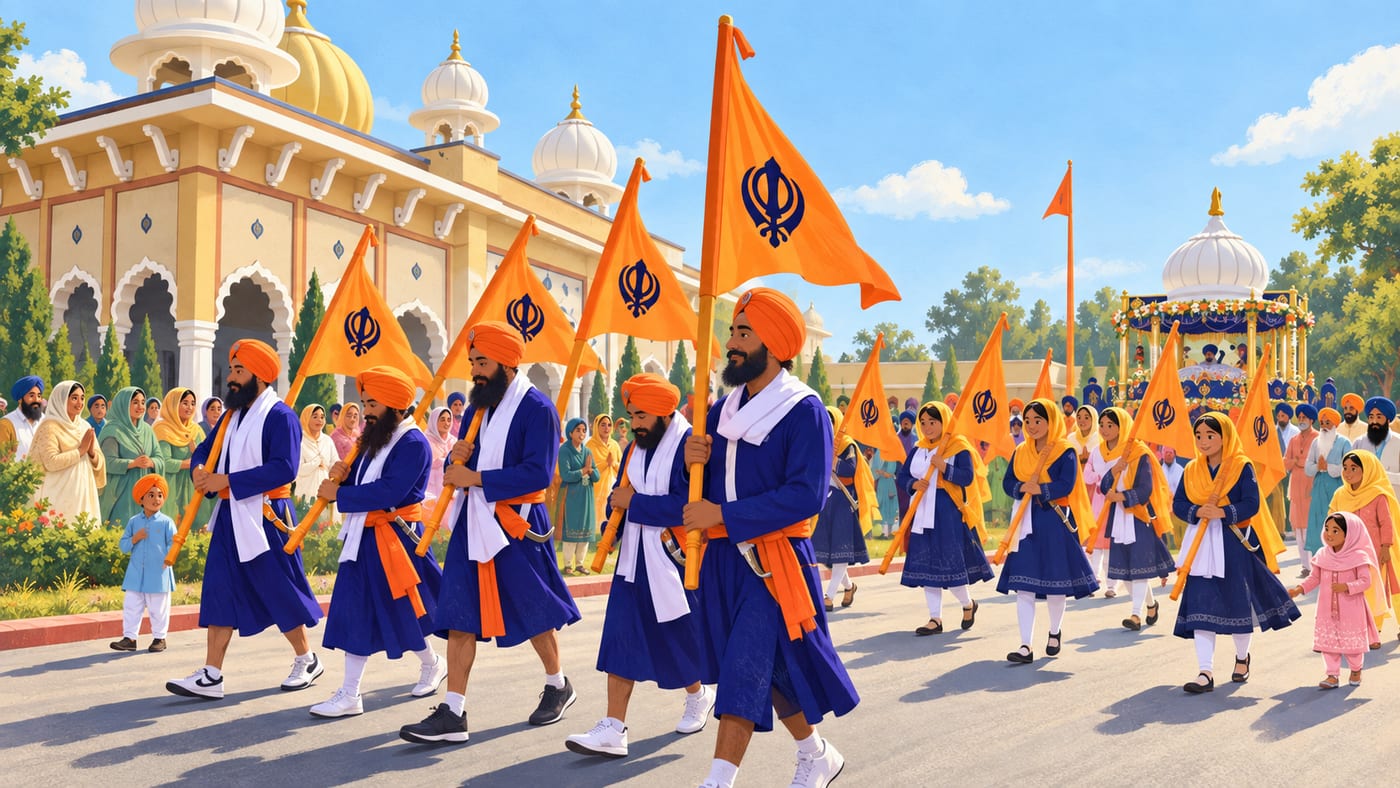
A Nagar Kirtan (ਨਗਰ ਕੀਰਤਨ, “kirtan through the town”) is a Sikh procession through the streets, led by the Panj Pyare, with Sri Guru Granth Sahib Ji in a decorated palki and the sangat walking behind, singing Gurbani and serving free langar along the way.
Quick answers
Why
Why Sikhs hold a Nagar Kirtan
The name says it plainly. Nagar means town or neighbourhood, and kirtan is the singing of shabads — so a Nagar Kirtan is the sangat singing kirtan through the town. The Panj Pyare lead; Sri Guru Granth Sahib Ji is in the palki, with sevadars doing kirtan and in attendance; the sangat walks behind.
The point of walking is who it reaches. Most weeks the sangat comes to the Guru; on this day the Guru’s word goes out to the doorstep of the whole neighbourhood — past the schools, the shops and the front lawns, to everyone who never thought to come looking for it. Many Sikh communities hold one, wherever they have settled.
There is no one fixed date. Processions are usually held on a weekend so the whole sangat can walk, and your city’s may mark:
-
Vaisakhi (Khalsa Sajna Diwas)
April – mid-May
The day in 1699 Guru Gobind Singh Ji created the Khalsa. Most processions in Canada, the UK and the US are for Vaisakhi, held on weekends through the spring. About Vaisakhi
Say this to your child “Today is Vaisakhi — the day Guru Gobind Singh Ji created the Khalsa, in 1699.”
-
First Parkash Purab of the Adi Granth
August – September
The first installation of the Adi Granth at Sri Harmandir Sahib in 1604, compiled by Guru Arjan Dev Ji, with Baba Buddha Ji as the first Granthi. This is not the same day as the Gurgaddi below — keep the two apart. Read more
Say this to your child “Today is the First Parkash Purab — the day the Adi Granth was first installed at Sri Harmandir Sahib, in 1604.”
-
Gurgaddi of Sri Guru Granth Sahib Ji
October – November
The day Guru Gobind Singh Ji conferred Guruship on Sri Guru Granth Sahib Ji, in 1708. Yuba City’s November procession marks this one. Read more
Say this to your child “Today is the day Guru Gobind Singh Ji gave the Guruship to Sri Guru Granth Sahib Ji, in 1708 — our Guru forever after.”
-
A Gurpurab
Through the year
Especially Guru Nanak Dev Ji’s Parkash Gurpurab in November, and the Gurpurabs your own gurdwara marks. About Gurpurabs
Say this to your child “Today is Guru Nanak Dev Ji’s Gurpurab — we are walking for the day he was born.”
Not sure which one yours is for? Ask at your gurdwara — it’s a good question to ask with your child.
ਜਿਥੈ ਜਾਇ ਬਹੈ ਮੇਰਾ ਸਤਿਗੁਰੂ ਸੋ ਥਾਨੁ ਸੁਹਾਵਾ ਰਾਮ ਰਾਜੇ ॥
Wherever my True Guru goes and sits, that place becomes beautiful.
Guru Ram Das Ji · Ang 450What you’ll see
What you’ll see, front to back
The order changes a little from city to city, but most Nagar Kirtans move like this. Read it to your kids the night before — then let them spot each part on the day.
-
Stop 1
The Panj Pyare
Five Sikhs in bana (traditional dress, often kesri) walking at the front with the Nishan Sahibs. They stand for the first five who answered Guru Gobind Singh Ji’s call at Vaisakhi 1699.
Tell your child: “Count them — there are always five. They lead because the first Khalsa led.”
-
Stop 2
Nishan Sahibs
The Sikh flags, carried high near the front.
Tell your child: “Wherever you see a Nishan Sahib, you’ll find a gurdwara — today it’s walking with us.”
-
Stop 3
Sri Guru Granth Sahib Ji on the palki
The heart of the procession. Sri Guru Granth Sahib Ji is in a decorated palki, with a granthi and sevadars in attendance, kirtan from the palki the whole way, and the chaur sahib waved as for a sovereign.
Tell your child: “Everything else in the procession is there because the Guru is here.”
-
Stop 4
Kirtan jathas and floats
Groups singing shabads — on floats from gurdwaras and Khalsa schools, and on foot.
Tell your child: “Listen for a shabad you know — see if you can hum along.”
-
Stop 5
Gatka
Teams showing the Sikh martial art with sticks and swords, usually a crowd favourite.
Tell your child: “Gatka is practice for being brave and disciplined — not for showing off.”
-
Stop 6
The sangat
Everyone else, walking together: families, grandparents, babies in carriers. That’s you.
-
Stop 7
Langar along the route
Families and gurdwaras hand out free food, fruit, water and snacks from stalls and front lawns. Nobody asks who you are, and nothing is sold.
Tell your child: “Did anyone ask for money? That’s langar — everyone is fed the same.”
Everything handed out along the route is seva. Nothing is sold, and nobody is asked for anything.
Etiquette
How to behave — what’s firm and what’s custom
Some things come from the Sikh Rehat Maryada (the Sikh code of conduct) and are the same everywhere. Others are custom and vary by city. Knowing which is which saves a lot of worry.
Firm — the same everywhere
-
Cover your head. The Rehat Maryada asks Sikhs never to sit bare-headed before Guru Sahib or in sangat, and organisers ask the same of every visitor. A patka, rumal, chunni or turban all do the job.
-
No alcohol, tobacco or smoking. Intoxicants are forbidden to Sikhs under the Rehat Maryada, and organisers ask everyone attending to keep the day clear of them.
-
Give the palki room. Not a written rule — simply how Guru Sahib is treated everywhere. Don’t reach for the palki, and don’t walk through the Panj Pyare’s formation.
Custom — varies by city
-
Shoes stay on to walk the route. It’s a long walk on city streets. Many people take their shoes off when they go up to the palki to bow — slip-on shoes make that easy for kids.
-
Bowing (matha tekna) is your choice. Wait until the palki pauses and follow the sevadars’ directions — never push in while it’s moving. Standing quietly with folded hands is just as respectful. Why we bow
-
Karah prashad in cupped hands, both hands together.
-
Photos are fine of the procession. Near the palki, be discreet: no flash, don’t block the way.
-
Modest dress is a courtesy — covered shoulders and knees are the norm.
-
Take a little, and bring a bag. You will be handed more than anyone can eat along the route. Take what you want, put the extra in your bag to enjoy at home, and keep your wrappers until you find a bin — langar is never wasted.
On the day
What to expect on the day
The practical questions parents ask before the day.
-
It’s most of a day
Processions usually leave the host gurdwara in the morning and finish late afternoon; big ones close roads from early morning to evening. Plenty of families walk the whole route. With little ones you can also pick a stretch, walk a section, stop to eat, and head home when they have had enough.
-
Crowds are big
The largest draw hundreds of thousands. The festival ground at the end is usually the busiest point — with little ones, a quieter stretch mid-route is easier.
-
Take transit if you can
Parking near the route is scarce, and many cities run a shuttle. Check your city’s page the week before, because routes change year to year.
-
Dress for three kinds of weather
Vaisakhi mornings can be cold, afternoons sunny, and rain is always possible. Layers win.
-
Plan for getting separated
Agree a meeting point everyone can find. Some processions (Surrey is one) have volunteers who help reunite families — find out where they’ll be.
“Take a photo of them that day. A wristband with contact details can help if someone gets lost.” — City of Calgary, Nagar Kirtan visitor advice
-
Strollers vs carriers
A carrier is easier for babies. A compact stroller works if you stay on the edge of the route rather than in the middle of the crowd.
-
It can be loud
Several floats play kirtan at once, and the nagara carries a long way. Ear defenders help little ones who don’t like loud sound.
-
Follow the sevadars
Sevadars and marshals keep the route moving and everyone together. Following their directions as you walk matters more than anything else on this list.
What to bring
The essentials
Seven things that make the day easier with kids. Read it on your phone, or print it for the fridge.
- A head covering for everyone, plus a spare — patka, rumal or chunni
- Water bottles, and comfortable slip-on shoes for the palki moment
- Layers, a rain jacket and sunscreen — mornings are cold, afternoons aren’t
- A bag — for extra snacks to take home, and for wrappers until you find a bin
- Each child’s name and a parent’s phone number in a pocket, and a meeting point agreed before you set off
- Phone charged, plus a power bank
- If your child has a food allergy, bring safe snacks — the langar along the route is home-cooked and ingredients aren’t labelled
- The one sentence: what today is for — say it on the way there
For kids
The Nagar Kirtan adventure hunt
Ten things to find along the route. Read them out on the way there, or print the list and take it with you.
- The Panj Pyare — how many? What colour are they wearing?
- Count the Nishan Sahibs
- Spot the palki
- The nagara — can you hear the drum before you see it?
- A gatka team — what are they holding?
- A float from a gurdwara or a Khalsa school
- A shabad you know — hum along
- Three snacks given out along the route
- “ੴ” or “ਵਾਹਿਗੁਰੂ” written somewhere — can you read it?
- Say “Waheguru Ji Ka Khalsa, Waheguru Ji Ki Fateh” to someone
Before you set off, tell the kids
- Stay close to your grown-up — the crowd moves and it is easy to drift
- Listen to your parents and to the sevadars on the route
- No running, and cross the road only with an adult
- Take what you will eat; anything spare goes in the bag
 Nagar Kirtan colouring sheet Colour it before, then draw what you saw after. Get the sheet →
After the day — talk about it
Around the world
Ten of the biggest Nagar Kirtans in the world
Crowd numbers are rough estimates and change from year to year, and so do the dates — check your city’s organisers each season.
-
Surrey
CanadaVaisakhi · April
450,000–550,000
Often called the largest in the world. It began in 1998 with about 16,000 people.
-
Vancouver
CanadaVaisakhi · April
About 200,000
Loops from the Ross Street gurdwara through the Punjabi Market.
-
Yuba City
USAGurgaddi of Sri Guru Granth Sahib Ji · early November
About 200,000
Running every November since 1980.
-
Calgary
CanadaVaisakhi · May
About 100,000
The city runs a free shuttle; its second-biggest parade after the Stampede.
-
Abbotsford
CanadaFirst Parkash Purab · late August / September
100,000+
Held for the First Parkash Purab of Sri Guru Granth Sahib Ji, drawing sangat from across the Fraser Valley.
-
Toronto
CanadaKhalsa Day · late April
100,000+
Held since 1986, from Exhibition Place to Nathan Phillips Square.
-
Southall, London
UKVaisakhi · April
75,000–100,000
Food stalls line the route between two gurdwaras.
-
Leicester
UKVaisakhi · April, and a November Gurpurab
10,000+ walking
Two Nagar Kirtans a year.
-
Birmingham
UKVaisakhi · April
10,000+
Visits a chain of gurdwaras along Soho Road to Smethwick.
-
New York
USASikh Day Parade · late April
Thousands
Down Madison Avenue since 1988, the oldest of the US parades.
Across Punjab and the rest of India, Gurpurabs are marked through the year, and most towns and villages hold at least two Nagar Kirtans — for Guru Nanak Dev Ji’s and Guru Gobind Singh Ji’s Parkash Purabs. The Mohalla held at Anandpur Sahib each Hola Mohalla draws lakhs of people, but it belongs to its own tradition rather than to this list — read about Hola Mohalla.
FAQ
Questions parents ask
- What does “Nagar Kirtan” mean?
- Nagar means town or neighbourhood, and kirtan is the singing of Gurbani. Together: kirtan taken out through the town, so the whole neighbourhood can hear the Guru’s word.
- Is a Nagar Kirtan the same as a Vaisakhi parade?
- Usually, yes — most “Vaisakhi parades” in Canada, the UK and the US are Nagar Kirtans. But Nagar Kirtans are also held for Gurpurabs and other days, so not every Nagar Kirtan is for Vaisakhi.
- What is the difference between the First Parkash Purab and the Gurgaddi?
- They are two different days, and they are easy to blur. The First Parkash Purab (August–September) marks the first installation of the Adi Granth at Sri Harmandir Sahib in 1604. The Gurgaddi (October–November) marks 1708, when Guru Gobind Singh Ji conferred Guruship on Sri Guru Granth Sahib Ji. A Nagar Kirtan may be held for either.
- Do I have to take my shoes off?
- Not to walk the route — shoes stay on. Many people take them off when they go up to the palki to bow. Slip-on shoes make that easy with kids.
- Do kids need to cover their heads?
- Yes. Everyone covers their head near Sri Guru Granth Sahib Ji — a patka, rumal or chunni is perfect. Pack a spare; they get lost.
- Is it OK to bring a toddler or a baby?
- Yes — you’ll see plenty. Choose a quieter stretch of the route instead of the busy end, use a carrier or compact stroller, and leave before they’re exhausted.
- Can non-Sikhs attend?
- Yes, and you’ll be made very welcome. Cover your head, don’t drink or smoke, and accept food with a smile.
- Is the food really free?
- Yes. Everything handed out along the route is langar — free, given as seva, and nobody will ask who you are. Nothing is sold.
- Can we take photos?
- Yes, of the procession. Near the palki, be discreet — no flash, and don’t block the way.
- When is the Nagar Kirtan in my city?
- Vaisakhi processions run on weekends from April to mid-May; others follow Gurpurabs. Dates change each year — check your local gurdwara or the organiser’s website.
Local maryada, routes and timings vary from city to city and from year to year. Treat this page as a family’s guide, not a rulebook: check your own gurdwara and your city’s organisers before the day, and follow the sevadars on the route. We review the page each spring.
Keep going
Vaisakhi & Khalsa Sajna Diwas
CelebrationsThe story of 1699 and how families celebrate it.
The Panj Pyare
GuideWho the five at the front of the procession stand for.
Gurmat etiquette for young Sikhs
GuideA quick reference for the gurdwara and beyond.
Gurpurab
CelebrationsThe Gurpurabs families mark, and what to do with the kids.
Free printables — plus a letter for Sikh parents
New tracing sheets, coloring pages and printables land through the year, and I write a weekly letter for parents raising Sikh children far from Punjab. Both free, no spam.
Get them by emailFor parents & teachers · unsubscribe anytime